

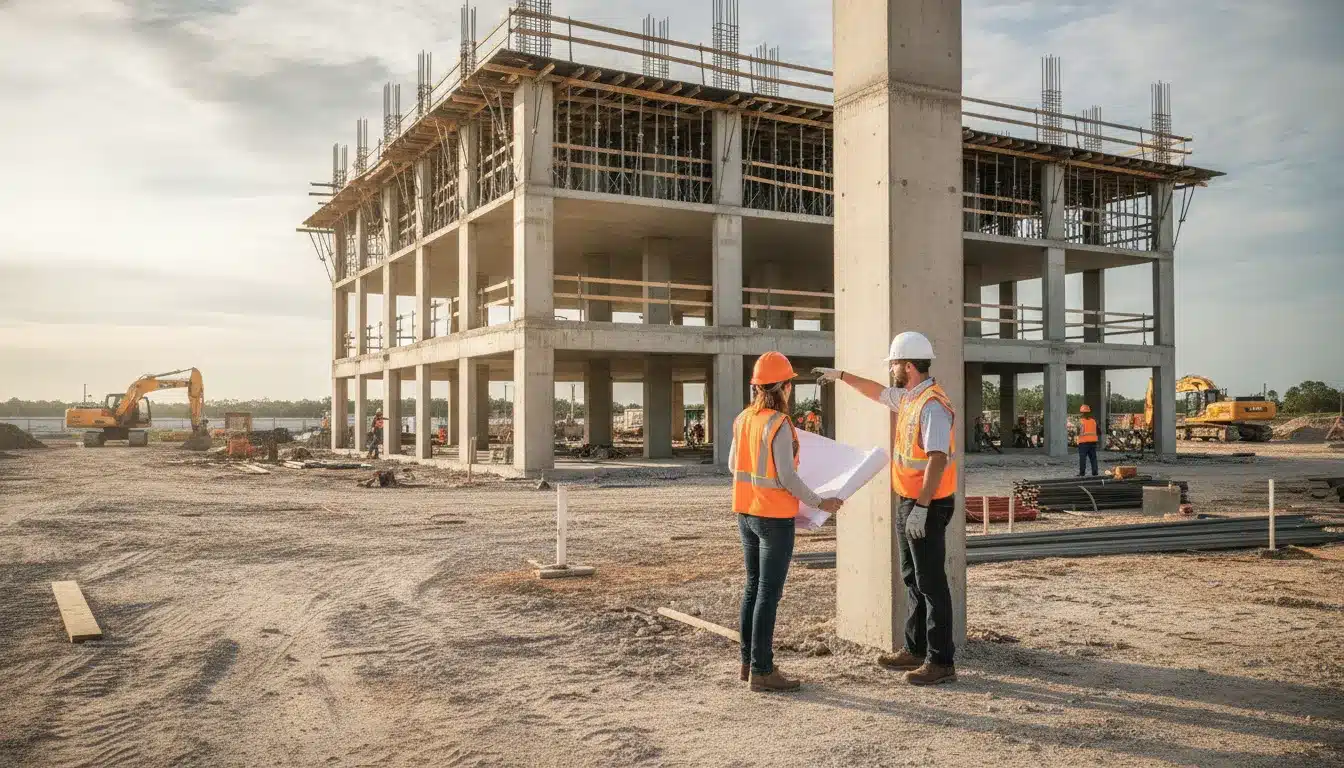
The Clay County Florida building permit process for a commercial project starts with confirming the correct jurisdiction and scope, then moves through coordinated submittal, plan review, corrections, fees, inspections, and closeout. Project teams that control those handoffs before submission can reduce avoidable review friction and protect the construction schedule.
Request a commercial permitting proposal
1. Confirm the Clay County jurisdiction and project scope
Start with the project address, parcel information, proposed use, and construction scope. Clay County’s Building Division provides permit applications, plan review, inspections, permit lookup, contractor services, and related development resources. The county lists the Development Services Building at 435 Walburg Street, Green Cove Springs, as the location for permitting and related development services. Review the Clay County Building Division’s current services and contact information before preparing the final package.
Jurisdiction confirmation is more than putting a county name on the application. Confirm whether the parcel is in unincorporated Clay County or subject to a municipal process, then identify zoning, planning, development review, fire, drainage, utility, environmental, and other approvals that may run alongside the building permit. Clay County’s plan review information says commercial structures are reviewed for compliance with the Florida Building Code and applicable zoning restrictions. Its FAQ also directs applicants to separate contacts for zoning, drainage, development review, planning, landscaping, and fire safety.
- Record the site address, parcel identifier, and project owner.
- Define whether the work is new construction, an addition, alteration, tenant improvement, change of use, or another commercial scope.
- List building, structural, electrical, plumbing, mechanical, gas, fire, sign, demolition, and site-related permits that may apply.
- Assign one person to own AHJ questions, status tracking, corrections, and inspection coordination.
2. Assemble a complete commercial permit package
A commercial permit package should describe one coordinated project. The application, drawings, site information, ownership records, contractor information, valuation, and supporting documents should use consistent project identifiers and scope language. The exact requirements depend on the property and work, so confirm the current checklist with Clay County before uploading.
For a typical commercial submission, the project team should be prepared to coordinate the permit application, site and development information, architectural and structural plans, accessibility and life-safety information, energy documentation, and the mechanical, electrical, plumbing, fire, and other discipline material triggered by the scope. Product approvals, engineering, special inspections, testing, and outside-agency approvals should be tracked as conditional items instead of discovered after the first review.
Clay County’s Plan Review Division states that it reviews commercial structures and coordinates with other county departments for Life Safety Code and related requirements. The county lists plan examiner hours as Monday through Friday, 9:00 a.m. to 4:00 p.m., and provides plan review contacts. Use the county’s plan review page to confirm current procedures.
| Package control | What to confirm | Schedule benefit |
|---|---|---|
| Scope alignment | The application, drawings, valuation, and trade documents describe the same work. | Reduces intake questions and conflicting review assumptions. |
| Design responsibility | Required design professionals have signed, sealed, and dated documents. | Creates an accountable technical record. |
| Agency coordination | Zoning, fire, drainage, utilities, and development-review dependencies have owners. | Prevents a building approval from becoming the only tracked milestone. |
| Revision control | Every sheet and response has a revision number and transmittal record. | Prevents superseded documents from re-entering the review cycle. |
3. Submit through the current Clay County portal
Clay County’s building resources direct applicants to permit applications, how-to guides, the Citizens Access Portal, permit lookup, and inspection scheduling. Use the county’s current instructions rather than copying a portal sequence from an older project. Confirm the responsible contractor and design-team accounts, complete the application fields, upload the coordinated documents, and retain the confirmation and application number.
Maintain a submission record containing the upload date, project address, scope, document index, valuation basis, applicant of record, and people authorized to respond to corrections. If the portal rejects a file or the package is incomplete, resolve that issue before treating the application as ready for review. Clay County’s FAQ specifically covers Citizens Access Portal registration, permit submission requirements, revision uploads, and permit or review status. Check the Clay County Building Division FAQ during the pre-submittal meeting.
4. How does Clay County plan review work?
Clay County’s Plan Review Division evaluates commercial plans for compliance with the Florida Building Code, applicable zoning restrictions, the Life Safety Code, and related regulations. The county identifies the Florida Building Code 8th Edition as effective December 31, 2023 on its plan review page. The design team should confirm the code edition and applicable amendments at the time of submission rather than relying on an older permit.
The working review sequence is a controlled exchange: the county receives the package, reviewers evaluate it, the applicant receives comments or an approval path, and the team uploads responses and revised documents when needed. Clay County’s public materials identify status tracking and revision uploads, but they do not publish a universal commercial review duration on the cited pages. Avoid promising an approval date based on a generic benchmark.
- Log the application number and every status change.
- Route each comment to the architect, engineer, contractor, or specialty consultant responsible for the answer.
- Respond to the complete comment set in one coordinated package whenever possible.
- Use a response matrix that identifies the sheet, detail, calculation, form, or narrative change addressing each comment.
- Upload the current revision set and preserve prior submissions in the project record.
- Recheck architectural, structural, MEP, fire, accessibility, and site coordination after revisions.
When comments affect occupancy, valuation, scope, or an outside-agency approval, escalate the change internally before uploading a narrow response. A quick answer that creates a new conflict can extend the cycle instead of shortening it.
5. How should commercial teams budget Clay County permit fees?
Clay County publishes a Building Permit, Impact, and Mobility Fee Schedules page. The county describes the resource as covering building permit fees, school impact fees, mobility fees, and county impact fees that may apply to construction and development projects. The applicable amount depends on the project and current schedules, so use the county’s documents and request a project-specific estimate instead of relying on an old fee table or third-party estimate.
Separate the building permit fee from impact, mobility, utility, fire, planning, and other agency charges in the project budget. Track each item with an owner, due date, and payment confirmation. Check Clay County’s current fee schedule resources before finalizing cash-flow assumptions.
Clay County’s FAQ also addresses whether applicants can obtain a permit cost estimate. That is a useful question for the pre-submittal call when valuation, additions, phased work, or multiple permits make a simple percentage assumption unreliable.
See commercial permit management support for Florida projects
6. Manage correction cycles as a project deliverable
Correction management is where otherwise complete commercial packages lose schedule time. Treat each Clay County comment cycle as a controlled deliverable. The response should identify the comment, responsible discipline, corrective action, revised sheet or document, and date submitted. Keep the county status, reviewer communication, and upload confirmation in the same permit record.
- Use one comment log for the full project team.
- Mark each item open, answered, uploaded, accepted, or awaiting county action.
- Have the design lead approve technical changes before resubmittal.
- Keep a current drawing index and response matrix.
- Do not schedule work that depends on an approval still shown as incomplete.
Do not delete earlier submissions from the internal record. A clean history helps the project manager identify whether an open item is a design issue, missing document, portal issue, zoning or outside-agency dependency, or a scope change requiring a new decision.
7. How are inspections scheduled and documented?
After issuance, convert the approved plans into an inspection matrix that matches the construction sequence. Clay County’s inspection page directs applicants to schedule through the CAP/CSS website. It also states that applicants can call 904-269-6307 between 7:45 and 8:30 a.m. on the inspection day to connect with the inspector about the inspection time. Review the county’s inspection scheduling instructions before the first request.
Build the matrix from the approved plans and superintendent’s look-ahead schedule. Include foundation and structural milestones, envelope and life-safety work, MEP rough-ins, accessibility-related items, final trade inspections, and required testing or documentation. The exact list depends on the scope and approved plans. A passed inspection for one trade does not close an unresolved item in another.
Clay County also provides active and archived permit lookup information. Use the permit record, portal status, inspection results, approved plans, and internal daily reports together. If field conditions differ from the approved documents, stop the affected work and determine whether a revision or additional review is required. Use the county permit search resource when reconciling status.
8. Plan for the Notice of Commencement and closeout
Clay County’s building information states that a certified copy of the Notice of Commencement is required before the first inspection. Coordinate the certified copy with the owner and project professionals, then place it in the permit record before requesting that inspection. This should be a preconstruction control item, not paperwork discovered after concealed work is complete.
At closeout, reconcile the permit record against the approved scope and inspection matrix. Confirm that required inspections are passed, corrections are closed, revisions are documented, contractor and owner records are complete, and any certificate or occupancy deliverable required for the project has been addressed with the AHJ.
- Permit number, approved plans, revisions, and inspection history.
- Final building, structural, MEP, fire, accessibility, and site items applicable to the scope.
- Required test reports, affidavits, product documents, and professional certifications.
- Notice of Commencement documentation and owner closeout records.
- Open permit, correction, or outside-agency items resolved before turnover.
- Certificate of occupancy or other final authorization, when required.
Request a proposal for Clay County commercial permit coordination
Clay County commercial building permit process FAQ
Does every Clay County project use the same workflow?
No. The workflow depends on the property jurisdiction, project scope, occupancy, design, zoning, and related reviews. Confirm the specific address and scope with the Clay County Building Division and other applicable authorities.
How are Clay County commercial permit fees determined?
Clay County publishes resources for building permit, school impact, mobility, and county impact fees. The applicable amount depends on the project and current schedules. Use the county’s current fee documents and request a project-specific estimate rather than relying on an old figure.
How are inspections scheduled?
Clay County directs applicants to schedule inspections through its CAP/CSS website and provides instructions for finding the inspection time on the day of the appointment. Confirm the current process before the field team submits its first request.
When should the Notice of Commencement be ready?
Clay County states that a certified copy of the Notice of Commencement is required before the first inspection. Coordinate it with the owner early enough that it is in the permit record before inspection scheduling.
Can a permit coordinator replace the design professional or contractor?
No. A permit coordination service can organize submissions, status tracking, comments, and inspection records, but the responsible contractor and design professionals remain accountable for technical design, licensed work, certifications, and field compliance.