

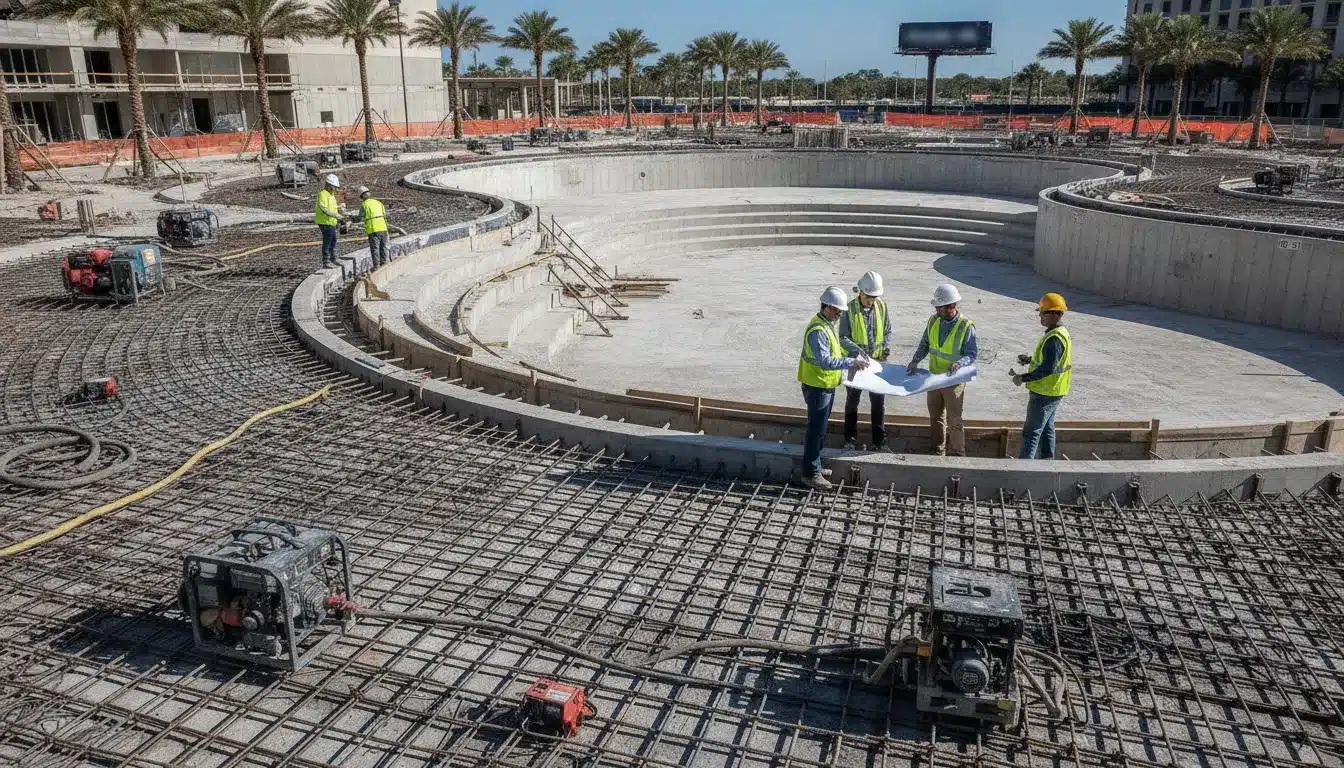
Commercial aquatic projects do not move through a single permit counter. A hotel pool, multifamily amenity pool, HOA recreation facility, or water park must be planned around health regulation. Building-code review, engineered details, and inspections all affect the construction schedule.
Florida commercial pool permit requirements begin with Department of Health approval before a public swimming pool is constructed, developed, or modified. The local building department then issues the permits and performs the inspections the project needs. Florida law also prohibits operating a public swimming pool without a valid Department of Health permit.
Florida Statutes Section 514.03 and Section 514.031 set those rules.
Request a proposal for commercial pool permit expediting and inspection management today.
The practical distinction is a two-track approval process. Health officials evaluate the aquatic facility and its operating safeguards. The building department reviews construction compliance. Understanding where those tracks intersect is the first step toward coordinating plans, engineering sign-offs, and inspections without creating avoidable schedule exposure.
Meeting Florida Commercial Pool Permit Requirements Starts with the Right Track
The first permitting decision is classification. Florida defines a public swimming pool broadly as a watertight structure used for human bathing or swimming. That scope includes pools, spas, and wading pools. It matters for hotels, multifamily communities, aquatic facilities, and other projects serving the public or a defined group. Florida Statutes Chapter 514 establishes the statutory scope.
For a commercial project, the permit path is not simply a larger version of a residential application. Health Department coordination operates as a separate track from standard Building Department permitting. Commercial plans also require specialized review, engineering sign-offs, and more frequent inspection milestones. The comparison below identifies the practical differences that affect design coordination and the construction schedule.
| Permit consideration | Commercial pool track | Residential pool track |
|---|---|---|
| Plan review depth | Specialized review coordinated across the applicable regulatory and building authorities. | Typically handled through the residential building-permit process for a private-use facility. |
| Engineering sign-offs | Commercial plans require specialized engineering sign-offs and stronger coordination. | May follow requirements applicable to the private residential scope and local AHJ. |
| Agencies involved | Health Department approval and Building Department permitting are separate, critical tracks. | Usually centers on the local building-permit authority, subject to project-specific conditions. |
| Inspections | Frequent milestones may include steel, plumbing, and barrier inspections before closeout. | Inspection scope and timing depend on the residential permit and local AHJ requirements. |
| Code basis | Public-pool requirements apply, including the statutory framework in Chapter 514. | Private residential requirements apply unless the facility is within the public-pool definition. |
Before submitting plans, map the project against the broader commercial permit requirements on the customer blog. Confirm which AHJs must review the work. Then align engineering documents with the Health Department and Building Department tracks.
That early classification prevents a residential workflow from creating commercial review gaps.
The Two-Track Approval Process: Health Department and Building Department
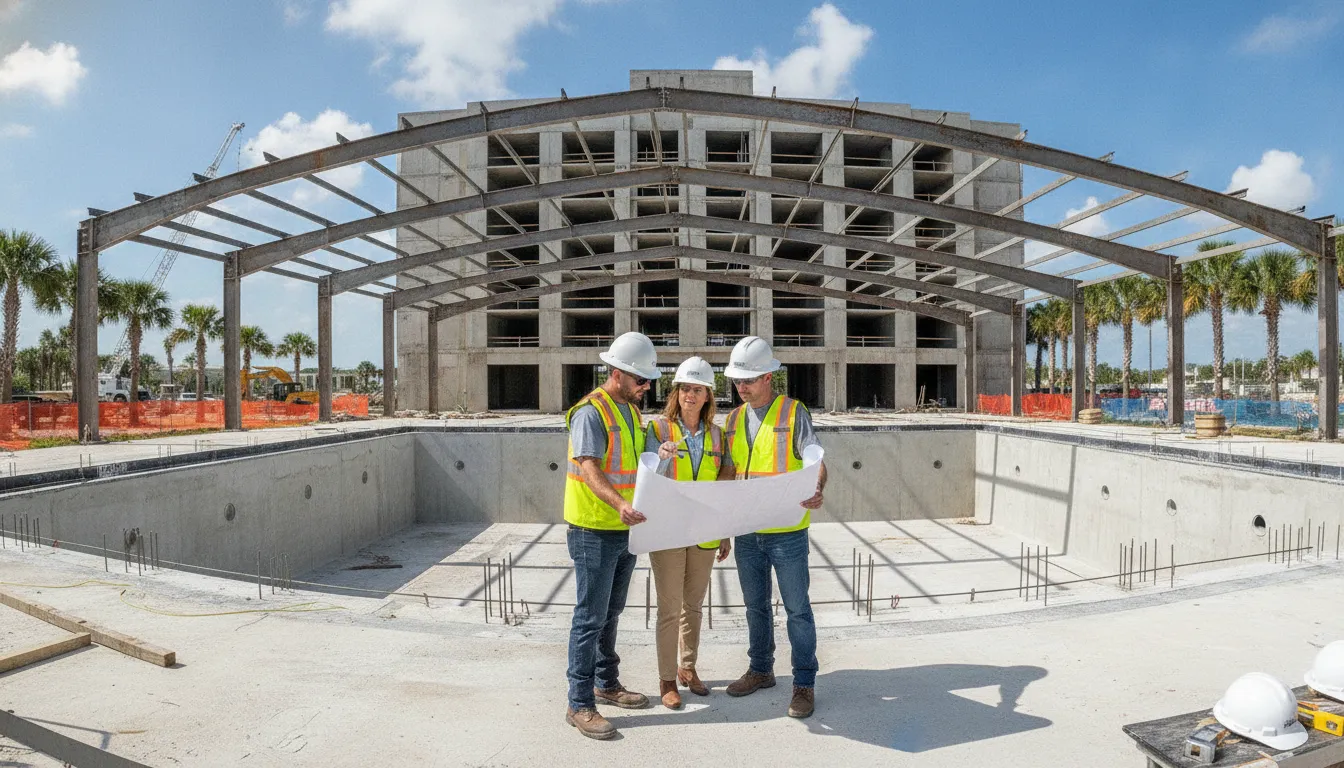
Florida commercial pool projects require two coordinated approvals, not one consolidated permit. The Florida Department of Health regulates the public pool or bathing place. The local Building Department, or other authority having jurisdiction (AHJ), reviews construction work under the Florida Building Code. Treating these as parallel workstreams is essential for controlling the permit schedule. It also prevents a late-stage conflict between health, structural, plumbing, electrical, and life-safety requirements.
Health Department Review
Before a public pool or bathing place is constructed, developed, or modified, the project must receive approval from the Department of Health. That requirement appears in Florida Statutes Section 514.03. The statute applies to modifications as well as new construction. Replacing major systems, changing the pool configuration, or altering associated facilities can trigger a new approval.
The operating-permit application must describe the pool structure and appurtenances. It must identify the water supply and explain the purification, treatment, disinfection, and heating methods. The application must also document the safety equipment and standards that will be used. Finally, it must include a copy of the final inspection from the local enforcement agency.
Those requirements make the health review depend on accurate design information. It cannot be completed from a basic site plan alone. The documentation rules appear in Florida Statutes Section 514.031.
A valid Department of Health permit is required before operating the public swimming pool. Operating without that permit is unlawful under the same statute. Construction completion and operational readiness are therefore separate milestones.
Building Department Plan Review
The local Building Department reviews the physical construction scope. That includes structural, plumbing, electrical, mechanical, accessibility, and safety elements covered by the Florida Building Code and local enforcement procedures. Its permit and inspection process runs alongside the Department of Health review.
Commercial plans commonly require more specialized review than residential pool work. They also require engineering sign-offs. Early coordination between the design team, contractor, Health Department, and AHJ is therefore a schedule-control measure, not an administrative afterthought.
Use the permit application process to organize design descriptions, agency submissions, inspection documentation, and revision responses across both tracks. Confirm which agency owns each approval. Align the plan sets before submission. Preserve the local final-inspection record needed for the Department of Health application.
VGBA Compliance: Suction Entrapment Protection in Commercial Pools
VGBA compliance is a plan-review requirement for commercial pools, not a field correction. The Virginia Graeme Baker Pool and Spa Safety Act establishes suction-entrapment protections for public pools and spas. That includes compliant drain covers and engineered circulation safeguards. For Florida projects, the safety package must be coordinated with the pool design, equipment schedule, and permitting documents before construction approval.
The core design objective is to prevent a swimmer from being held against a submerged outlet. It also prevents a swimmer from being pulled into the circulation system. The applicable configuration may include multiple drains arranged to reduce suction concentration. It may use an unblockable drain, or a safety vacuum release system (SVRS) where the approved design requires one. Drain covers must be selected for the intended flow rate and installed per manufacturer requirements.
The Virginia Graeme Baker Pool and Spa Safety Act establishes the federal framework. It was enacted as part of Public Law 110-140.
Florida commercial pool requirements also place safety equipment within the broader approval record. Florida Statutes require Department of Health approval before a public swimming pool is constructed, developed, or modified. The application must describe the safety equipment and standards to be used. See Florida Statute 514.03 and Section 514.031. That makes entrapment protection a document-control issue as well as an installation issue.
For the project team, the practical checkpoint is early coordination. The aquatic engineer, mechanical designer, equipment supplier, and permitting consultant should work together. Confirm drain layout, cover specifications, flow calculations, equalizer lines, and any SVRS requirements before plan submission.
If those elements change during value engineering, treat the revision as a compliance review. Resolving discrepancies during plan review protects procurement and inspection milestones. Discovering them after installation can force redesign, replacement, and schedule exposure.
ADA Pool Lift and Accessibility Requirements for Public Facilities
Hotels, apartment communities, HOA recreation centers, and water parks must provide accessible pool entry. In Florida, ADA accessibility is a baseline requirement for public and commercial facilities. The approach should be coordinated during plan review rather than treated as a late equipment purchase. The applicable ADA Standards address accessible means of entry, including pool lifts and sloped entries. See the 2010 ADA Standards for Accessible Design.
Lift Count Rules by Pool Perimeter
The required number of accessible means of entry depends on the size and configuration of the pool. A smaller pool may be served by one compliant lift or sloped entry. Larger pools generally require additional accessible entries based on pool perimeter. The design team should confirm the count against the applicable ADA provisions. They should document the selected locations on the plans.
A compliant lift is not simply a portable chair placed near the water. The equipment must provide an accessible route to the water. It must be installed where the seat can reach the required entry depth. It must remain available for use when the facility is open.
Its seat, clear floor space, controls, lifting capacity, and transfer arrangement must align with the ADA criteria. The lift location should also avoid conflicts with deck circulation, guardrails, fencing, drainage, and other pool equipment.
For commercial projects, plans should identify the lift or sloped-entry type. They should show mounting location, deck clearances, and operating provisions. Hillsborough County guidance expects plans to follow the current Florida Building Code. That includes Section 454 for public swimming pools. Plans must be digitally signed and sealed by a Florida-registered architect or engineer. See the commercial pool plan requirements for a local example.
Accessibility review belongs in the initial design package. Revising the deck, plumbing, structural support, or circulation route after plan review can create resubmittals and construction delays. This is especially true when the pool is part of a larger hotel or multifamily project.
Barrier and Fencing Codes for Commercial Pools
Commercial pool barriers are a life-safety control, not a decorative site feature. Florida requirements address unauthorized access through barrier height. They also govern openings, gate configuration, self-closing and self-latching hardware, and connection to surrounding site conditions. The plans should show these details clearly. They should also show the required safety equipment and the project’s VGBA compliance. That addresses suction-entrapment risks.
For public swimming pools, the Florida Building Code (FBC) Section 454 is a central design reference. Hillsborough County’s checklist requires plans to follow the current FBC Section 454 provisions. Plans must be professionally prepared and digitally signed and sealed. This means the barrier cannot be treated as an afterthought during field inspection. Its location, gate swings, latch elevation, and access points should be resolved in the submitted plans. Its relationship to decks, walls, equipment areas, and adjacent structures should be resolved there too. Hillsborough County’s commercial pool requirements provides the local standard.
Local enforcement can add practical checkpoints. Miami-Dade County identifies swimming pool barriers and inspections as distinct permit considerations. It advises keeping rescue equipment near the pool for emergencies. Its checklist should be reviewed when the project falls within the county’s jurisdiction. Miami-Dade swimming pool permit guidance is the relevant local reference.
Flood exposure creates another coordination requirement. Hillsborough County states that public swimming pools in flood hazard areas must comply with FBC Section 1612. These are the areas established under FBC Section 1612.3. Confirm the site’s flood designation early. Then coordinate barrier elevations, site grading, access, and pool plans with the flood provisions before the building review begins.
What Does Commercial Pool Permitting Cost in Florida?
Commercial pool permit costs vary widely by jurisdiction, project size, and complexity. Fees typically cover plan review, permit issuance, and required inspections. Health Department operating-permit fees are separate from Building Department permit fees. Larger facilities, custom structural details, and flood-review requirements add cost and review time.
The schedule is often the larger financial exposure. Each resubmittal, agency comment cycle, and inspection wait delays the facility opening. A realistic budget should include both the permit fees and the cost of a permit coordinator. The earlier a project commits to a coordinated approval path, the fewer expensive revisions it tends to face.
How Permit Expediting Streamlines Multi-Agency Pool Approvals
Commercial pool approvals move faster when the project team treats approvals as coordinated workstreams. Health Department approval, local AHJ permitting, plan review, and field inspections all need coordination. A pool may need documented milestones for steel, plumbing, and the barrier before closeout. The operating-permit application also depends on local final-inspection documentation.
Early coordination protects the construction schedule. It also reduces the risk that one incomplete approval path stalls the entire facility.
That coordination matters because Florida commercial pool permitting requires both regulatory and construction documentation. The state requires approval before a public swimming pool is constructed, developed, or modified. Operating a public pool requires a valid Department of Health permit. The application addresses the structure, water treatment, and safety equipment. The final inspection from the local enforcement agency must be included in the operating-permit process. Florida Statute 514.03 and Florida Statute 514.031 establish those requirements.
Common Multi-Agency Friction Points
The most expensive delays often occur at the boundaries between agencies and disciplines. A project can be substantially complete in the field but still lack the local AHJ final-inspection record. That record is needed for the Health Department operating permit. Similarly, barrier or VGBA details can trigger plan-review comments after procurement has begun.
Resolving these issues early requires the design team, pool contractor, and building officials to work from the same plan set. Health Department staff should review the same inspection sequence.
- Incomplete closeout documentation: Track the final local inspection and supporting records as deliverables. The Health Department application requires a copy of that inspection.
- Barrier and VGBA comments: Review access-control, barrier, and suction-entrapment details before submittal. Review them again before the related inspection milestone.
- Agency handoff gaps: Confirm which review belongs to the Health Department and which belongs to the local AHJ. Assign an owner and due date for each response.
A dedicated inspection management process keeps milestone requests, corrections, and closeout records visible to the project team. For hospitality and multifamily developments, multifamily construction permitting can align pool approvals with the broader opening schedule. Teams that need an early code and pathway review can also use consultation services before submitting a package.
Permit expediting does not replace the design professional, contractor, AHJ, or Health Department. It creates a controlled coordination layer around them. It uses early code review to identify conflicts and active tracking to move each approval forward. That is the practical value of navigating both agency pathways together.
Get a proposal to streamline your multi-agency pool approvals before the next milestone.
Frequently Asked Questions
Does a commercial pool need both a health department approval and a building permit?
Yes. Before constructing, developing, or modifying a public swimming pool, the project requires approval from the Florida Department of Health. That rule appears in Florida Statute 514.03. The building department or other local enforcement agency handles the applicable construction permits and inspections. The health and building reviews should therefore be coordinated as separate approval tracks.
What facilities fall under Florida’s public swimming pool rules?
The statutory definition is broader than a typical hotel pool. Florida law covers watertight structures used for bathing or swimming by people. That includes pools, spas, and wading pools. It applies to facilities serving the public or specified groups. Hotel, multifamily, HOA, and water-park amenities can all fall in scope. Review the definition in Florida Statutes Chapter 514 before assuming an amenity is exempt.
Is a permit required when modifying an existing commercial pool?
Yes. A modification is not automatically covered by the original approval. Florida Statute 514.03 requires Department of Health approval before modifying a public swimming pool. This also applies to a public bathing place. Submit the proposed scope for review before construction begins. This is especially important when the work changes circulation, treatment, safety equipment, barriers, or accessible features.
What documentation is needed before a commercial pool can receive its operating permit?
The operating-permit application must describe the pool structure and appurtenances. It must document the water supply, purification and treatment methods, and safety equipment. It must also include a copy of the final inspection from the local enforcement agency. These requirements appear in Florida Statute 514.031. That statute also prohibits operating a public swimming pool without a valid department permit.
Ready to Request a Proposal for Your Commercial Pool Project?
Request a proposal for commercial pool permit expediting and inspection management today.
Commercial pool permitting requires coordination across project design, permitting, and inspection milestones. A focused review can help your team identify the appropriate approval path. It can keep permit expediting aligned with construction scheduling. To discuss your project and next steps, request a proposal for commercial pool permit expediting and inspection management.