

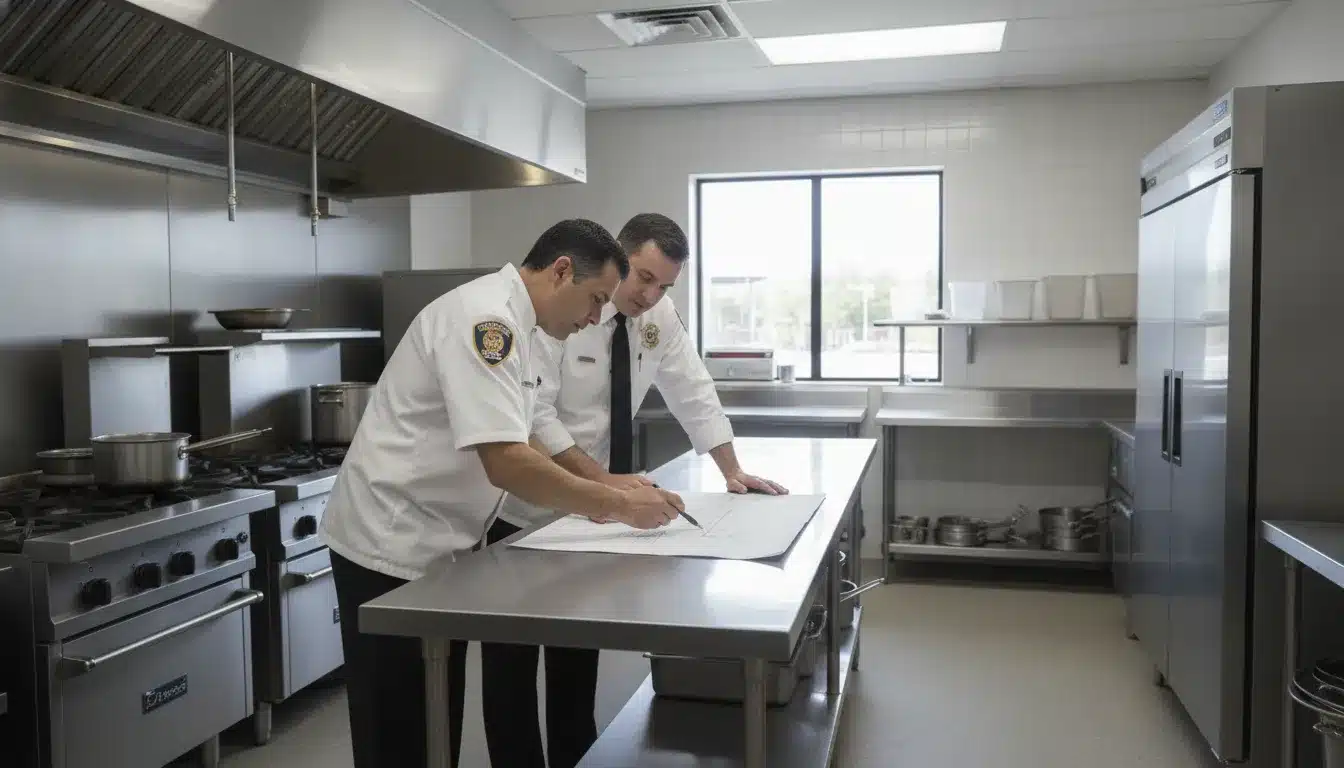
A delayed Florida restaurant health department permit can leave a finished dining room empty while rent, payroll, and vendor commitments continue. The safest way to protect opening day is to identify the correct food regulator, complete plan review, coordinate local building approvals, and prepare for every inspection before construction ends. This guide explains the sequence, documents, and decisions that help restaurant owners move from concept to compliant operation without avoidable permit surprises.
Request a proposal for help coordinating your Florida restaurant permits.
Quick answer: A Florida restaurant permit is not usually a single approval. Most projects need a food-service license or permit from the agency with jurisdiction, plus applicable zoning, building, plumbing, mechanical, electrical, fire, and occupancy approvals. Confirm the regulator first, submit accurate plans before work begins, track every correction, and schedule final inspections only when the site matches the approved documents.
Florida restaurant health department permit checklist
A successful permit process starts with the business model, not the application form. A full-service restaurant, grocery store, bakery, caterer, food truck, and market can face different regulators and requirements even when they prepare similar foods. Before signing a lease or ordering equipment, define what the business will sell, where customers will consume it, how food will be prepared, and whether the operation uses public or private water and wastewater systems.
Use the following checklist as an overall sequence. Individual agencies may require additional steps, and local rules vary by city and county.
- Document the menu, service model, seating, hours, and food-preparation methods.
- Confirm whether DBPR, FDACS, or another authority regulates the operation.
- Verify zoning, parking, use, and occupancy conditions before committing to the site.
- Determine whether a food-service plan review is required.
- Prepare coordinated architectural, equipment, plumbing, mechanical, electrical, and fire plans.
- Submit state and local applications with consistent business and project information.
- Respond to reviewer comments and obtain approvals before covered work proceeds.
- Track construction against approved plans and document authorized revisions.
- Complete trade, fire, building, and food-safety inspections in the required order.
- Secure the required operating approval and certificate of occupancy before opening.
Each step affects the next. For example, a late menu change can require different cooking equipment, which can affect the hood, fire suppression, electrical load, grease handling, and plan review. A disciplined project team treats permitting as part of design and construction rather than as paperwork to complete at the end.
Which Florida agency regulates your restaurant?
Quick answer: The Florida Department of Business and Professional Regulation, commonly called DBPR, generally regulates public food service establishments such as restaurants. The Florida Department of Agriculture and Consumer Services, or FDACS, generally regulates retail food establishments such as many grocery stores and markets. The exact jurisdiction depends on how the business operates, so confirm it before filing.
The phrase “health department permit” is commonly used, but it can obscure which agency actually has authority. A restaurant may also interact with the Florida Department of Health for certain well or septic matters and with local departments for building, fire, zoning, and utilities. Assuming that one approval covers every department is a common and expensive mistake.
Compare the primary approval paths
| Authority | Typical focus | Common project examples | Coordination need |
|---|---|---|---|
| DBPR | Public food service operations | Restaurants, many caterers, and many mobile food vendors | Food-service plan review, licensing, and inspections as applicable |
| FDACS | Retail food operations | Many markets, groceries, bakeries, and retail food stores | Retail food requirements and inspections as applicable |
| Florida Department of Health | Certain water and wastewater matters | Sites using regulated wells or onsite sewage systems | Testing, system approval, or sanitation requirements as applicable |
| Local departments | Land use, construction, life safety, and occupancy | Nearly every new restaurant, conversion, or remodel | Zoning, building, trade, fire, sign, and occupancy approvals |
When the business combines restaurant service with retail sales, jurisdiction can require careful review. Describe the operation accurately and ask the relevant agency to confirm the path. Do not choose an application merely because its title sounds closest to the project.
FDACS publishes a retail food establishment permit resource for businesses that fall within its authority. Its food establishment minimum construction standards also provide useful context for regulated retail food facilities. Always verify that the guidance applies to the specific operation and current project.
Confirm jurisdiction before design is final
Agency confirmation should happen while the concept and site are still flexible. Regulators may expect specific equipment, sinks, finishes, food-protection measures, or support spaces. Discovering those requirements after design completion can trigger redesign, additional professional fees, and new review cycles. Discovering them after construction can be far more costly.
Create a short written operating summary that includes the proposed menu, expected volume, food sources, preparation steps, delivery process, seating, takeout, catering, and retail sales. This summary helps designers, regulators, and contractors make decisions from the same facts. Update it when the concept changes.
Complete plan review before construction
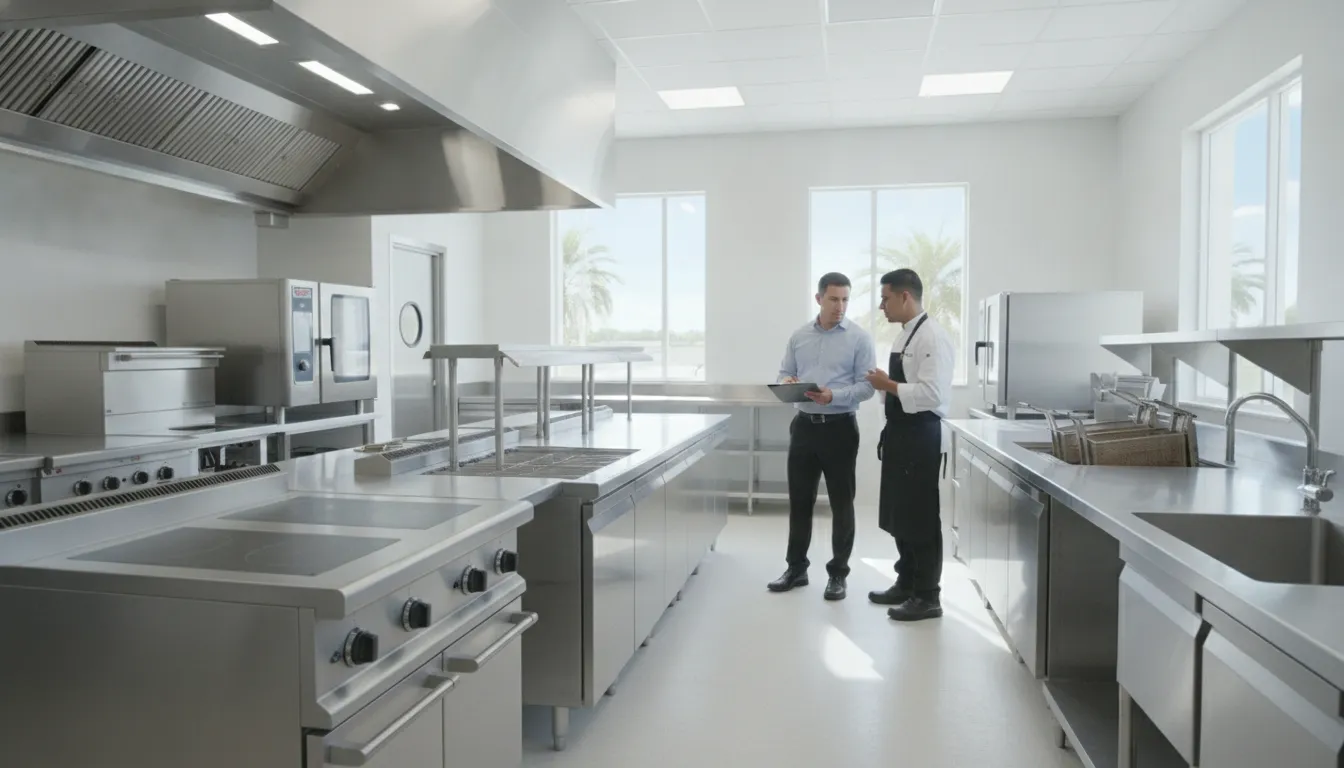
Plan review allows the regulator and local departments to evaluate the proposed facility before expensive work is installed. It is one of the most important stages in the Florida restaurant health department permit process because it connects the menu and operating model to the physical kitchen. Accurate plans give reviewers a clear picture of food flow, equipment, sanitation, utilities, and life-safety systems.
Build the plan set around the menu
The menu determines how food is received, stored, prepared, cooked, cooled, reheated, displayed, and served. Those steps influence refrigeration, dry storage, preparation space, handwashing sinks, warewashing, ventilation, grease control, and waste handling. A plan set that does not reflect actual operations may win an approval that the completed restaurant cannot follow.
Designers should coordinate equipment specifications with architectural and engineering plans. The equipment schedule should identify makes, models, dimensions, and utility needs. Floor plans should show clear placement and working space. Plumbing plans should align with sinks, dishwashing equipment, water heaters, grease systems, and floor drains. Mechanical and fire plans should align with cooking equipment and exhaust systems.
Common plan review documents include:
- A completed application with consistent legal business and project information.
- A menu or detailed description of all food and beverage operations.
- Scaled floor plans showing rooms, equipment, fixtures, and work areas.
- An equipment schedule with manufacturer and model information.
- Plumbing, mechanical, electrical, fire protection, and utility details as required.
- Finish schedules for floors, walls, ceilings, and food-preparation areas.
- Water supply, wastewater, grease management, and waste-storage information.
- Site, zoning, seating, and occupancy information when requested.
Review a restaurant conversion carefully
Taking over an existing restaurant can reduce construction, but it does not remove the need for due diligence. Prior approvals may not cover a new concept, changed menu, increased seating, altered equipment, or a different legal operator. Existing systems can also be undersized, damaged, or no longer acceptable for the proposed use.
Before relying on the prior layout, inspect the hood and suppression system, grease interceptor, electrical capacity, plumbing, water heater, refrigeration, accessibility, exits, and restroom configuration. Ask for available approved plans, permits, inspection records, and equipment documentation. Then compare those records with actual site conditions. Treat every undocumented alteration as a potential schedule risk.
Respond to review comments as a coordinated team
Review comments are normal. Problems arise when different team members answer them separately or revise only one drawing. A plumbing response may affect the architectural plan; an equipment change may affect electrical and mechanical plans. Assign one person to maintain the comment log, distribute questions, collect responses, and confirm that every revised sheet tells the same story.
Responses should be direct and traceable. Identify the comment, explain the resolution, and cite the revised sheet or document. Avoid vague notes such as “will comply” when a drawing change or specification is needed. A complete response package helps reviewers confirm the correction without another round of questions.
Coordinate state and local restaurant approvals
A food-service approval does not replace local construction approvals. Most restaurant projects also require some combination of zoning, building, plumbing, mechanical, electrical, fire, sign, utility, and occupancy reviews. The departments may work on different timelines and may not automatically share updates. A coordinated schedule keeps one missing approval from blocking the final opening sequence.
Verify zoning and use before signing a lease
Zoning determines whether the proposed restaurant use is allowed at the site. Requirements can address seating, parking, drive-through service, alcohol sales, outdoor dining, hours, signage, deliveries, and noise. A space that previously held another business may still require a change of use or additional approval for restaurant operations.
Make lease obligations and construction deadlines reflect the permit reality. Confirm who is responsible for base-building corrections, utility upgrades, accessibility work, grease systems, and other major improvements. A permit review can reveal conditions that materially affect the budget, so early due diligence is essential.
Coordinate trade and fire permits
Restaurant kitchens place significant demands on plumbing, electrical, mechanical, and fire systems. Equipment must connect to the utilities shown on approved plans, and required work must remain visible until the appropriate inspection. Closing walls or ceilings too early can lead to destructive reinspection work.
Fire review commonly addresses hood suppression, alarms, sprinklers, exits, emergency lighting, occupant load, and related life-safety features. Local requirements depend on the building and project. Schedule specialty contractors early, confirm their submittal responsibilities, and make sure their plans match the main design set.
For projects with many agencies and trades, professional permit management can centralize submissions, correction logs, status tracking, and department coordination. The goal is not to bypass review. It is to give each reviewer a complete, consistent package and keep the project team informed.
Plan for water, wastewater, and grease handling
Safe water and sanitary wastewater handling are fundamental to restaurant approval. Public utility connections may require capacity confirmation or utility sign-off. Sites with a well or onsite sewage system can face additional review. Grease interceptors and related systems must be sized, located, installed, and maintained according to applicable requirements.
These systems should be evaluated before finalizing the kitchen layout. A required interceptor upgrade or wastewater limitation can change project feasibility. Keep test results, approvals, calculations, and maintenance information organized for reviewers and inspectors.
Manage construction without losing approvals
Approval is not the end of permit management. During construction, field conditions, lead times, and budget decisions often prompt changes. Uncontrolled substitutions can cause the completed restaurant to differ from approved plans, leading to inspection failures or revised submissions near opening day.
Control equipment substitutions
If specified equipment is unavailable, evaluate the replacement before purchase. Confirm dimensions, clearances, power, gas, water, drainage, ventilation, sanitation certifications, and fire-system impacts. A replacement that appears similar can require different utilities or create an unacceptable layout. Document the decision and obtain required approval before installation.
Track approved revisions
Maintain one current set of approved plans and permits at the site. Mark superseded documents clearly so crews do not build from outdated sheets. When an agency authorizes a revision, distribute it to every affected contractor and update the project log. Record inspections, correction notices, photographs, and closeout documents in the same system.
A simple status tracker should show each permit, responsible party, submission date, current status, open comment, next action, and required predecessor. This makes delays visible while there is still time to solve them. All Florida Permits supports projects across Florida with structured coordination for complex approval paths.
Prepare for inspections throughout the build
Do not wait until the restaurant is complete to think about inspections. Trade inspections occur at specific construction stages, and some work must remain exposed. Confirm the sequence with contractors and local departments. Before requesting an inspection, conduct an internal readiness check against approved plans and prior correction notices.
Failed inspections consume time not only on the day of the visit but also in the rescheduling queue. Good inspection management confirms access, approved documents, responsible contractors, equipment readiness, and correction completion before the inspector arrives.
Prepare for the opening inspection
The opening inspection is a demonstration that the restaurant is ready to operate safely, not a preliminary walkthrough. The facility should be complete, clean, powered, supplied with hot and cold water, and equipped according to approved plans. Staff responsible for food safety should understand the operation and have required records available.
Use a detailed readiness review
Several days before the requested inspection, walk the restaurant from receiving through service and waste removal. Look for unfinished work, inaccessible equipment, missing labels, damaged finishes, inadequate cleaning, and differences from the approved set. Test equipment under operating conditions rather than assuming that installation is enough.
A practical readiness review should cover:
- Approved plans, permits, applications, and required records available on site.
- Handwashing sinks accessible, supplied, and functioning as intended.
- Warewashing systems installed, operating, and supplied appropriately.
- Refrigeration and hot-holding equipment functioning at required conditions.
- Food-contact surfaces clean, durable, and in good repair.
- Floors, walls, ceilings, lighting, and ventilation complete.
- Water, wastewater, grease, and waste systems operating properly.
- Fire, building, and trade corrections completed as required.
- Chemicals, storage, pest prevention, and employee areas properly arranged.
- The completed layout and equipment matching approved plans.
Keep closeout documents organized
Inspectors and local departments may need different closeout documents. These can include signed permits, test reports, equipment information, fire-system records, utility approvals, and certificates from contractors or design professionals. Ask each authority what it expects well before the final visit.
Store digital copies in a shared folder and keep an organized site copy. Name files consistently and separate current approvals from drafts. When a reviewer asks for a record, a fast and accurate response protects the schedule.
Resolve corrections methodically
If an inspector identifies corrections, document the exact requirement, responsible party, and evidence needed for reinspection. Fix related issues at the same time rather than addressing only the visible symptom. Confirm whether revised plans or additional review are required before requesting another visit.
Never conceal work or make an unapproved field change to avoid a correction. Clear communication and documented compliance are the reliable path to approval. If the issue involves multiple departments, coordinate the response so one correction does not create a new problem elsewhere.
Avoid common Florida restaurant permit delays
Most avoidable delays come from incomplete information, inconsistent plans, uncontrolled changes, or poor sequencing. A restaurant team can reduce risk by treating every approval as part of one connected project. The following mistakes deserve special attention.
Filing with the wrong agency
An application submitted to the wrong regulator can waste valuable time and create confusion across the design team. Confirm jurisdiction from the actual operating model, not the business name. If the concept includes both restaurant and retail activity, provide enough detail for the agencies to determine responsibility.
Submitting incomplete or inconsistent documents
Reviewers cannot approve what they cannot verify. Missing equipment details, conflicting seating counts, different business names, and mismatched floor plans all create questions. Conduct a quality-control review before every submission. Make sure forms, drawings, specifications, and supporting documents use the same current information.
Starting work before approval
Beginning regulated work before required approval can lead to stop-work orders, penalties, removal of completed construction, and longer reviews. It also weakens schedule control because crews may build from assumptions instead of approved documents. Confirm permit issuance and inspection conditions before each phase begins.
Changing the concept late
A late change from light food preparation to grease-producing cooking can affect nearly every system. Additional seating can affect occupancy, restrooms, exits, and parking. Alcohol service, outdoor dining, or a drive-through may require separate approvals. Evaluate the full permit impact before approving a concept change.
Scheduling final inspections too early
Pressure to meet an opening date often leads teams to request inspections before the site is ready. An unfinished facility makes a poor use of the visit and can push the project into a crowded reinspection schedule. Use an internal checklist, close all known corrections, and verify that required predecessor approvals are complete first.
Build a realistic permit schedule
There is no single reliable timeline for every Florida restaurant. The schedule depends on location, scope, agency workload, document quality, review comments, construction progress, and inspection availability. Instead of relying on a generic estimate, build a project-specific schedule with dependencies and contingency.
Start with the desired opening date and work backward. Include time for site due diligence, design, plan review, corrections, permit issuance, procurement, construction, phased inspections, final corrections, licensing, occupancy approval, staff setup, and operational readiness. Identify long-lead equipment and specialty contractors early.
Track dependencies, not just due dates
A due date alone does not show what must happen first. The hood inspection may depend on completed electrical work and fire suppression testing. The certificate of occupancy may depend on final approvals from several departments. The opening inspection may depend on a fully operational facility. Map these relationships so the team understands which delay affects the critical path.
Hold short, regular permit reviews during design and construction. Focus on open comments, upcoming inspections, outstanding documents, field changes, and critical-path risks. Assign every action to one owner with a clear target date. This routine keeps permitting visible and prevents last-minute surprises.
Create a submission and inspection calendar
A useful permit calendar separates agency review time from the project team’s response time. Record when each package was submitted, when comments arrived, who owns each answer, and when the complete response will return to the reviewer. This makes it easier to distinguish an agency queue from an internal delay. It also gives the construction team a more dependable basis for scheduling work.
Add inspection readiness dates before requested inspection dates. The readiness date is the team’s deadline to finish work, test systems, collect documents, and conduct its own walkthrough. This buffer gives contractors time to correct small problems without sacrificing the official appointment. It is especially important near opening day, when a missed inspection can affect staff training, food deliveries, and public launch plans.
Protect the schedule with clear decision rules
Fast projects need clear rules for approving changes. Identify who can authorize design revisions, equipment substitutions, added scope, and responses to reviewer comments. Require the decision maker to consider permit, budget, procurement, and construction effects together. A quick purchase that ignores those effects can create a slow approval problem later.
Maintain a risk list for unresolved site conditions, utility questions, long-lead equipment, and approvals outside the team’s direct control. For each risk, identify a trigger, a mitigation step, and an owner. Review the list regularly and escalate issues while alternatives remain available. Strong schedule management does not eliminate uncertainty; it reveals uncertainty early enough to act.
When permit coordination support helps
Restaurant owners often manage design, financing, hiring, vendors, construction, and operations at the same time. Permit coordination support is valuable when a project crosses multiple jurisdictions, involves a tight schedule, converts a difficult space, or has repeated review comments. A coordinator can organize the process while the owner and design professionals remain focused on their core responsibilities.
Effective support includes confirming submission requirements, maintaining a document checklist, tracking review status, coordinating responses, communicating with the project team, preparing for inspections, and documenting closeout. It should create transparency and accountability without promising approvals that only regulators can grant.
All Florida Permits provides statewide support for restaurant and commercial projects. Explore the firm’s permit management services, coordinate site visits through inspection management, or request a proposal for a project-specific plan.
Frequently asked questions
How long does it take to get a Florida restaurant health permit?
Timelines vary by agency, location, project scope, and the completeness of the submission. Plan review, construction, local trade permits, and final inspections must be coordinated, so applicants should start early and respond quickly to comments. Build a project-specific schedule rather than relying on a generic estimate.
Do I need a plan review before building a restaurant in Florida?
Many new restaurants, conversions, and remodels require a food-service plan review, and local building departments may require separate plan reviews. Confirm the requirements for the business type and jurisdiction before construction begins. Early review helps identify issues while they are less expensive to correct.
Can I use a private service to coordinate my Florida restaurant permit?
Yes. A permit management service can organize submissions, track comments, coordinate departments, and prepare the project team for inspections. The reviewing agencies still make all approval decisions, but organized coordination can reduce avoidable administrative delays.
Which Florida agency handles restaurant health permits?
The responsible agency depends on the operation. DBPR generally regulates public food service establishments, while FDACS generally regulates retail food establishments. Other agencies and local departments may also oversee water, wastewater, building, fire, and zoning requirements.
What happens during the initial Florida food business inspection?
An inspector checks whether the completed facility, equipment, sanitation systems, food-safety controls, and required records satisfy the applicable standards. The site should match approved plans and be ready to operate when the inspection occurs. Complete an internal readiness review before scheduling the visit.
Move from plans to opening day with confidence
A Florida restaurant health department permit is easier to manage when jurisdiction, design, local approvals, construction, and inspections follow one coordinated plan. Confirm the regulator early, build accurate documents around the real menu, control field changes, and prepare thoroughly for each inspection. That discipline protects the budget and gives the restaurant the strongest path toward a compliant opening.
Request a proposal from All Florida Permits to coordinate your restaurant approval process.