

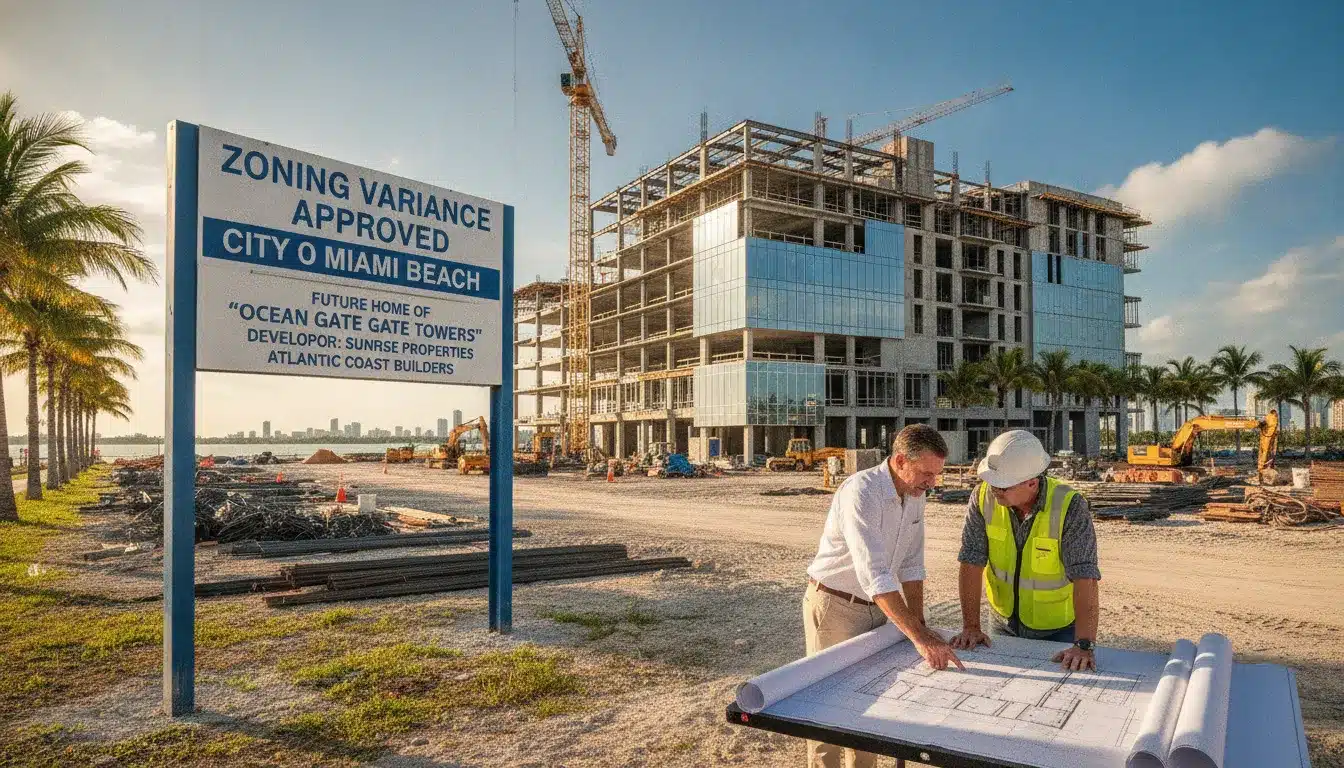
A missed setback rule on a Florida building site can stall a project for months. Owners must find a legal way to build when strict codes make a plan impossible. This often means seeking help through a local permit process.
A Florida zoning variance is a permit from a local board that lets a property owner break certain land use rules. These rules often cover site sizes like setbacks, height limits, and lot coverage. You need this permit when following the rules creates a hardship for the owner. Property owners usually ask for two main types: area permits for size changes and use permits for changing what the land does. Use permits are harder to get in Florida because they change the basic land use. In Florida, the law under Fla. Stat. Ch. 163, Part II tells local boards to handle these cases at public meetings. Knowing these rules well is the key to getting your project back on track.
Property owners must show a strong case to the local board to get their Florida zoning variance. Knowing the basics of these requests is the very first step in the work. To find the right way for your site, the first step is to ask
What Is a Florida Zoning Variance?
A Florida zoning variance is a legal waiver that lets you deviate from local land use rules. Each of the 67 counties and 400 plus municipalities in Florida has its own zoning code. These rules set limits on building height, setbacks, and lot coverage. When strict compliance with these codes creates an undue hardship, the local Board of Adjustment (BOA) may grant a variance. This allows a project to proceed despite a specific conflict with local law.
Types of Zoning Variances
In Florida, you will mostly deal with area variances or use variances. Area variances involve physical dimensions like setbacks or height limits. These are common when a lot has a unique shape or size. Use variances allow you to use a property in a way that the zoning code does not usually permit. These are much harder to get because they change the core nature of a zone. Most developers use pre-construction consultations to find which type they need before filing.
Under Fla. Stat. Ch. 163, Part II, local governments must adopt a plan for land use. This plan guides how they handle variance requests. The BOA reviews each case during a public hearing to ensure it meets the hardship standard. The request must be the smallest change needed to solve the issue. It also must not harm the local area or neighboring properties.
Why Variances Matter in Florida
Florida has a unique building environment that makes variances a key tool for developers. The state faces high wind loads and strict coastal flood zone rules. In regions like the High Velocity Hurricane Zone (HVHZ), rules are even tighter. These environmental factors often clash with standard zoning setbacks. A variance helps bridge the gap between building safety and local land use rules.
Managing these rules is complex because every town has its own process. Missing a detail can lead to a denial or a long delay. Since project delay costs often hit $5,000 per day, a quick approval is vital. Many firms use professional permit expediting services to manage the paperwork. This ensures the request meets the specific needs of the local Authority Having Jurisdiction (AHJ).
The Undue Hardship Standard: The Legal Threshold for Approval
To get a Florida zoning variance, you must show more than just a desire to build. Local boards use a strict test known as the undue hardship standard. This rule ensures that variances are rare. They are only given when a property cannot be used under current laws. Without proof of this hardship, the city will likely deny your request.
What defines undue hardship?
To meet this standard, you must prove that the land itself has a problem. This is not about what you want to do. It is about what the site will let you do. Under Florida Statute Chapter 163, local towns must keep land use fair. A hardship exists when the law makes it impossible to use your land fairly compared to your neighbors. The board looks for four signs. First, the land must have a unique trait. Second, the owner must not have caused the problem. Third, the change must be the least amount needed to fix the issue. Last, it must not hurt the people nearby. If your project meets these goals, you have a better chance of getting a yes.
Physical traits and property limits
Most legal hardships come from the physical shape of the lot. This could be a narrow plot of land or a steep hill. Such traits make it hard to build a standard home or shop. It might also be a lot with an odd shape that does not fit the rules for setbacks. Setbacks are the rules for how far back a building must sit from the street. These are unique traits that other nearby lots do not have. You must also show that you did not create the problem. For example, if you buy a large lot and split it into two tiny ones, you cannot claim a hardship later. In that case, you made the problem yourself. Boards often reject these “self-created” issues. Our team at All Florida Permits offers consultation services to help you find these unique traits before you apply. We help you build a case based on facts, not just wishes.
What is not a legal hardship?
Many people try to get a variance for the wrong reasons. A common mistake is using money as a reason. If building a standard deck is cheaper than following the rules, that is not a hardship. The board sees this as a choice, not a need. They will not grant a variance just to save you money. They also will not grant one just to make your project earn more profit. Personal taste is another reason that often fails. You might want your pool closer to the fence for a better view. However, that is just a preference. A real hardship is a barrier that stops you from having a pool at all. The board wants to see that you have no other choice but to break the rules. Knowing the line between a “want” and a “need” is key to a good Florida zoning variance. This process is about fairness to the land and the town.
Types of Zoning Variances: Area vs. Use Variance in Florida
Florida property owners typically seek one of two main types of zoning relief. The split between an area variance and a use variance is key because each has its own rules. While both need proof of undue hardship, local boards look much closer at some requests than others. Picking the wrong type for your plan can cause long delays for your project.
What is an area variance
An area variance deals with the physical size of a project. These are the most common requests in Florida because they cover size rules rather than how you use the land. You might need one if a lot is too small for current rules or if you want a warehouse that is too tall. Since these do not change the feel of the area, local boards often approve them more easily.
Common cases include small side yards, more lot coverage, or fewer parking spots. Under Florida Statute Chapter 163, cities must follow their own land rules but also allow for help when a lot has odd traits. If your lot has a strange shape or a large tree that stops a normal build, an area variance is your best tool.
How use variances differ
A use variance is a much bigger ask because it lets you use land for a goal not allowed by current rules. For example, you might want to open a shop in a spot meant only for homes. Florida courts and boards see these with great care. Many Florida cities do not allow use variances at all. Instead, they ask for a full zone change or a land plan change, which costs more and takes longer.
When a city does allow them, the hardship rule is much harder to meet. You must often show that the land has no real use under its current rules. Since this change could affect home values and traffic, the public hearing is usually more intense. For developers, knowing if a town even allows use variances is a key first step when picking a site.
| Criteria | Area Variance | Use Variance |
|---|---|---|
| What it changes | Physical size like height or yard space | The way the land is actually used |
| Hardship rule | Practical issues or unique site traits | Loss of all viable use under current rules |
| Common cases | Building taller or closer to the line | Retail shop in a housing zone |
| Approval chance | Fair to high with proof of hardship | Low; often not allowed by local code |
| FL cities | Allowed in nearly all FL towns | Rare; not allowed in many FL cities |
Pick the best path for your project
Finding out which variance you need is a big part of a pre-build talk. While area variances are common, they still need a clear case and a public meeting. Florida boards look for the smallest change possible to fix the issue. Our team helps you find this path to get your ok and keep your work on time.
How to Apply for a Zoning Variance in Florida: Step-by-Step
Applying for a Florida zoning variance is a task that needs close care for local rules. Since Florida has over 400 cities and 67 counties, each area has its own zoning code and unique ways. There is no single state form you can use for this job. You must follow the steps set by your local office to make sure your project moves forward.
Florida is a large state with many local rules. With 67 counties and more than 400 cities, finding the right way to apply can be tough. Each area has its own zoning code that you must follow. This means that a process in Miami might look very different from one in Orlando. You must always check with your local office to get the latest rules for your site.
Early research and checks
Before you start your forms, you must check if your request can be done. Most local boards follow rules from Florida Statute Chapter 163. This law tells cities how to manage land use and growth. You should meet with a town planner to talk about your plans. They can tell you if your case meets the hardship rule needed for a win.
This first check helps you find any big problems early on. You can learn about height limits and lot rules that apply to your site. Finding these issues now can save you from a big loss later. If you need help with this part, you can schedule a consultation to check your project goals.
The forms and files
Once you know the local rules, you must put together all the right files. These files show the board why you need to change the rules. You will need to prove that your land has unique traits. This makes following the standard rules too hard for your case. It is not just about what you want; it is about the actual state of the lot.
Your file must include several key items to be complete. You will need a new land survey and a site plan that shows your changes. You also must write a short paper that explains your hardship in plain words. Adding clear photos of the land can also help the board see the problems you face. For more help with your files, check out our services for builders.
The public hearing step
After you hand in your file, the local staff will look at it for two to four weeks. If the file is good, the city will set a date for a public hearing. You must tell your neighbors within a 300 to 500-foot area about your plans. This notice time usually lasts two to three weeks so people can prepare for the meeting.
The last step is the public hearing before the local board. You will tell your story and answer questions from the group. They will then vote to give or deny your request based on the facts you shared. Having a pro on your side during this talk can help you handle hard questions and stay on track with your schedule.
- Research and initial check. Meet with local planners to see if your request fits the local rules and the land use map for your area.
- Gather your forms. Collect your land survey, site plan, photos, and a written hardship statement that proves your case to the board.
- Pay the fee and submit. Hand in your full package to the zoning department and pay the fee, which can range from $10 to $1,500.
- Staff review and notice. Wait two to four weeks for the staff check, then tell neighbors within a 300 to 500-foot radius about the plan.
- Provide public notice. Ensure all required signs or ads stay up for at least two to three weeks before your scheduled hearing date.
- Attend the public hearing. Present your hardship case to the Board of Adjustment and answer any questions from the staff or the public.
- Receive the board vote. The board will vote on your request, and you will get a formal notice of the final choice they made for your site.
Common Reasons Zoning Variance Applications Get Denied
Working with zoning in Florida is hard because the state has 400+ cities and towns. Each place has its own rules and a Board of Adjustment (BOA) that hears every case. While every board is unique, they all follow strict legal tests. If your plan fails even one standard, the board will likely deny your request. Knowing these traps can help you build a stronger case.
Failure to Prove a Site Hardship
Failure to show a real hardship is the top reason for denial. In Florida, a hardship must come from the land itself, not from the owner’s needs. This usually means the lot has a unique shape, small size, or poor soil. If your lot is just like others on the street, the board may not grant a Florida zoning variance. You must prove that the land’s features make it nearly impossible to build without a rule change. Boards will not grant a variance just to save you money. A site check can find these issues before you file.
The Trap of Self-Created Hardships
A board will reject a request if the owner caused the problem. This is a self-created hardship. A common example is buying land when you already know the zoning rules. If you knew the setbacks would block your plan before you bought the lot, the board may say you took on that risk yourself. This also applies to owners who build without the right permits. The AHJ (Authority Having Jurisdiction) will expect you to fix the error by moving the structure. You can learn more about our services to avoid these mistakes.
Variances That Exceed the Minimum Need
Your request must be the smallest change possible to solve the hardship. Florida courts say a variance must be the “minimum needed” for a fair use of the land. If you ask for a ten-foot height change when two feet would work, the board will say no. They want to keep the local code as intact as they can. Your plan must also avoid hurting your neighbors. While a neighbor protest alone is not a valid legal reason for denial, the board will listen to their fears about light or noise. A good plan shows that the change is small and will not harm the area’s value.
Conflict With Local Master Plans
Every city in Florida must have a master plan that guides how land is used. This is a rule under Fla. Stat. Ch. 163, Part II. If your variance goes against the goals in this plan, it will be denied. For example, you cannot ask to put a loud shop in a quiet housing zone. The board must ensure that every change fits the long-term vision of the town. A clash with the master plan is one of the hardest hurdles to clear. You can get a proposal for a full review of your site’s zoning status and local plan match.
How a Permit Expeditor Can Help With Your Variance Application
Florida has over 400 cities and 67 counties. Each one has its own rules for a Florida zoning variance. Following these local codes takes deep knowledge of the law and the local staff. A professional permit expeditor acts as your guide through this hard process. They handle each step from the first check to the final hearing at the Board of Adjustment (BOA).
Early Checks and Strategy
The best time to fix a zoning issue is before you apply. All Florida Permits offers pre-construction consultations to find problems fast. We check your site plan against local rules. If your project needs a change, we help you find the best path. This work makes sure your request meets the high bar for an undue hardship. We also help you choose between an area variance or a use variance.
Wait costs in Florida building projects can be very high. Owners often lose $1,000 to $5,000 for each day of delay. A typical variance takes 4 to 8 weeks to finish. A mistake that causes a delay can cost you $20,000 to $200,000 in extra costs. Our experts help you avoid these costs by getting the files right the first time. We know how to work with the local Authority Having Jurisdiction (AHJ) to keep your work on track.
Expert Document Prep
A variance request needs many files. You must give a survey, a site plan, and photos of the land. You also need a written text that cites Florida Statute Ch. 163, Part II. This part of the law tells how cities manage land use. Our team writes this text to show that your request is the small change needed. We make sure all forms are right and all fees are paid to stop any staff review delays.
Help at Public Hearings
Zoning hearings are public meetings where neighbors can speak. Our team acts for you at these BOA meetings. We show the facts and answer questions from the board. We also handle the neighbor notice rules, which often cover a 300 to 500-foot area. Our goal is to show the board that your project will not hurt the area. After the meeting, we check with the city to get your final papers and move to the next step.
Florida Zoning Variance Timeline: What to Expect Week by Week
The time it takes to get a Florida zoning variance depends on your local building department. While some cities move fast, others take several months. On average, the process lasts about 4 to 8 weeks from start to finish. You should plan your project schedule around these typical stages to avoid costly delays.
Pre-application and File Submission
Before you submit an application, you must gather your site plans and proof of hardship. This early phase usually takes 1 to 2 weeks. Once you file your paperwork, city staff will review it for about 2 to 4 weeks. They check to see if your request meets local land development regulations and planning goals.
Public Notice and Hearing Dates
Florida law requires you to tell nearby property owners about your request. This notice period lasts 2 to 3 weeks before the board meets. Most boards, like the Board of Adjustment, hold a public hearing between week 4 and week 8 of the process. You or your team must present your case and answer questions during this meeting.
The Final Decision and Delay Costs
Most boards make a choice on the same day as the hearing. If they approve your variance, you can move forward with your building permit application. But if there is a delay, the financial impact is high. Large construction projects can lose $1,000 to $5,000 every day in holding costs. A wait of 4 to 8 weeks can cost a developer $20,000 to $200,000 or more in interest and fees.
You can manage these risks by working with experts who know local rules. A professional team helps ensure your application is complete the first time. For help with your next project, you can request a proposal for a full zoning review and application help.
Frequently Asked Questions
How do I prove undue hardship for a Florida zoning variance?
To prove undue hardship, you must show your land has unique traits that make keeping the rules very hard. The problem cannot be one you made yourself. You must also show that the variance is the smallest change needed to solve the issue. Last, you must show that the change will not hurt your neighbors or the local area. This high bar keeps the rules fair for every owner in the county or city.
What are the typical costs for a Florida zoning variance application?
Most Florida cities and counties charge a fee for a zoning variance. These costs range from ten dollars to about fifteen hundred dollars. You also need to pay for a land survey, site plans, and mailers to tell your neighbors about the public hearing. These extra costs can add up fast. Hiring a pro can help you avoid mistakes that lead to costly delays. For some large projects, a single day of delay can cost over one thousand dollars.
Do recent Florida permit reforms speed up zoning variances?
New laws like HB 683 and HB 1035 set strict time limits for building permits in Florida. But these rules do not apply to zoning variances. As per All Florida Permits, local boards still have the power to decide on each case at their own pace. A variance hearing usually takes four to eight weeks from start to finish. Since the process is not simple, having a clear plan is vital to stay on schedule.
When should I use a permit expeditor for a zoning variance?
You should use a permit pro when your project needs to move fast or when the local rules are complex. Florida has over four hundred cities, and each one has its own zoning code. A pro knows the local board and can help you build a strong case for undue hardship. They manage the forms, notices, and hearings for you. This help can save you from months of delays and help you stay on track and within your budget.
Get Your Florida Zoning Variance Application Started
Navigating a Florida zoning variance application requires detailed knowledge of local zoning codes, the undue hardship standard, and the Board of Adjustment hearing process. With 400+ municipalities across Florida’s 67 counties, each with its own application requirements and fee schedule. Professional guidance can mean the difference between approval and months of costly delays.
All Florida Permits handles zoning variances for non-conforming uses statewide. Our team prepares complete application packages, coordinates with local building departments, and helps you navigate the hearing process from start to finish.
Request a proposal for your Florida zoning variance application