

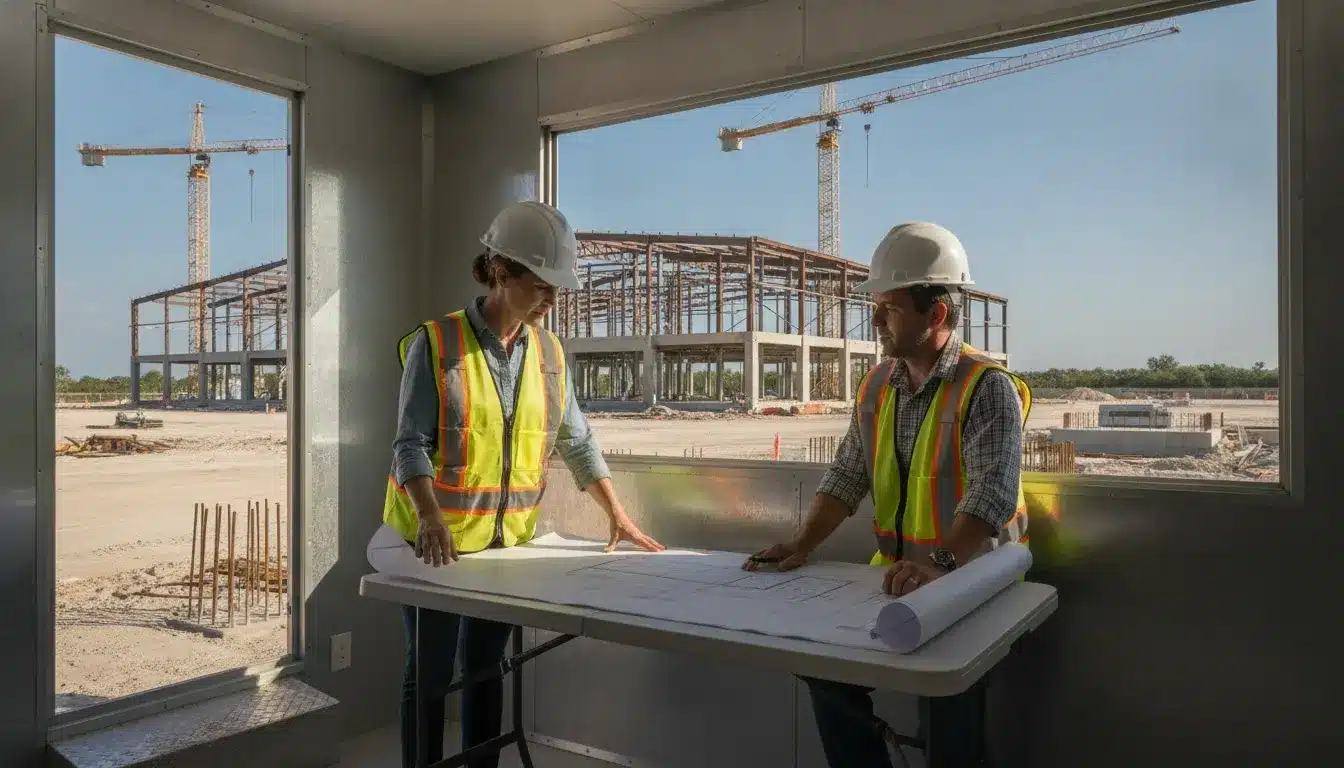
The Leon County building permit process for a commercial project starts with jurisdiction and land-use readiness, not the permit application itself. The project team must determine whether the property is inside the City of Tallahassee. It must then confirm the applicable approvals, assemble a complete plan package, submit through the correct online portal, respond to review comments, and coordinate inspections through final approval.
Request a commercial permit proposal for your Leon County project.
How the Leon County building permit process starts with jurisdiction
Before preparing a commercial permit package, confirm which authority has responsibility for the property. The City of Tallahassee states that applicants should verify city limits through the property information for the parcel. For a property outside city limits, the city directs applicants to Leon County Development Services for building permits. That jurisdiction check controls where the application is submitted and which local requirements must be coordinated.
For county-administered work, the Leon County Building Plans Review and Inspection Division provides permit intake, plan review, inspections, and related fiscal services. For projects inside Tallahassee, the city’s commercial building permit guidance explains the city-specific land-use and development approvals that generally precede the building permit.
| Project location or issue | Primary coordination point | What the team should confirm |
|---|---|---|
| Inside City of Tallahassee limits | City of Tallahassee Growth Management | Land use, zoning, site plan, environmental approvals, and city building permit requirements |
| Outside city limits in unincorporated Leon County | Leon County Development Services and Building Plans Review and Inspection | County application path, development review, environmental requirements, plans, fees, and inspections |
| Projects involving fire or life-safety review | Applicable building and fire review authorities | Whether separate fire plans, life-safety documents, or inspections are required for the scope |
The city and county are not interchangeable submission destinations. A commercial team that sends a complete package to the wrong authority can lose schedule time before substantive review begins. Confirm the parcel and responsible AHJ before finalizing the application set.
What approvals and documents are needed before submittal?
A commercial building permit sits on top of earlier development decisions. The City of Tallahassee describes the development process as resting on approvals such as the Comprehensive Plan, zoning, an approved site plan or subdivision, and applicable environmental review. Its commercial permit guidance also notes that a site plan is typically required when more than 2,500 square feet of new building area is proposed. An environmental management permit is typically required when a project creates more than 2,500 square feet of earth disturbance. Confirm these thresholds with the responsible city or county reviewer because the project facts control.
Leon County’s official forms page identifies several documents that may be part of a new construction, addition, or alteration package. The list includes an Affidavit of Ownership and Designation of Agent, an Owner or Building Exemption Disclosure Form, a Flood Letter Certification Form, and a Notice of Commencement. It also lists contractor verification and authorized-agent forms, plus a Temporary Certificate of Occupancy request for projects that need an interim approval.
- Jurisdiction and parcel information, including the correct city or county authority.
- Project scope, improvement type, building classification, proposed use, and existing use.
- Construction documents and discipline-specific plans prepared for the project.
- Site, zoning, environmental, floodplain, utility, or other prerequisite approvals when applicable.
- Ownership, designation-of-agent, contractor, and licensing documentation required by the AHJ.
- Application-specific forms, supporting calculations, and documents requested by the plans examiner.
The City of Tallahassee commercial permit guidance lists project details such as square footage. Total improvement cost, building classification, number of units, scope of work, trades, and changes of use. For a tenant improvement or change-of-occupancy project, do not assume a new-construction checklist applies. The city specifically cautions that alterations and changes of occupancy typically follow a separate process.
How is a commercial application submitted?
Leon County states that building and environmental management permit applications, site plans, and development plans are submitted through the Leon County Online Permit Portal. The portal requires a user account, and the county provides application tutorials through tlcpermits.org. The county’s Building Plans Review and Inspection FAQ likewise states that building permits are applied for through the county’s online permit portal.
A disciplined intake sequence reduces avoidable corrections:
- Confirm the parcel jurisdiction and the project type.
- Identify all prerequisite land-use, site, environmental, utility, and fire-related reviews.
- Prepare the drawings, forms, calculations, contractor information, and supporting documents.
- Review file names, signatures, seals, revision dates, and document consistency before upload.
- Create or confirm the portal account and submit the application to the applicable authority.
- Record the application number, payment status, assigned reviews, and outstanding conditions.
For a commercial team, intake is more than uploading drawings. The goal is a review-ready package in which the scope, valuation, occupancy, trades, plans, and supporting forms tell the same story. A mismatch between the application description and the plan set can generate comments even when the underlying design is sound.
What happens during plan review and corrections?
Leon County’s Building Plans Review and Inspection Division reviews plans and inspects projects for compliance with the most recently adopted Florida Building Codes. The county also states that incomplete documentation or a request for corrected documentation can delay approval. In practice, the project manager should treat each correction cycle as a controlled resubmittal, not as an informal email exchange.
When comments arrive, sort them by discipline and assign each item to the responsible architect, engineer, contractor, or owner. Then prepare a response matrix that identifies the comment, the revised sheet or document, and the response location. Upload a coordinated revision set and verify that revised drawings do not create conflicts with structural, architectural, mechanical, electrical, plumbing, fire, or site information.
For county projects, the official FAQ lists a typical approval time of 15 days for commercial projects. That is a planning reference, not a guaranteed delivery date. The same FAQ explains that review can take longer when the application lacks required documentation or when reviewers require additional or corrected information. A complete first submittal and prompt correction response are therefore the most controllable schedule levers.
For city projects, the City of Tallahassee commercial permit page emphasizes that the building permit follows the underlying development approvals. A building permit review cannot cure an unresolved zoning, site-plan, or environmental issue. Resolve those dependencies early, then submit the building package with the approval evidence the city requests.
Use permit management support to track submittals, comments, and resubmissions across the project.
How are commercial permit fees calculated?
Leon County publishes a fee schedule and provides a building fee estimator. The county expressly warns that the estimator is for building permit fee estimates and does not include other associated fees, including Development Services, Environmental Management, and state fees. Exact charges are calculated at the time of permitting.
The published county fee schedule separates plan review and inspection charges by construction classification and trade. It also lists separate categories for items such as technology or state surcharges, notices of commencement, revisions, re-inspections, temporary certificates of occupancy, and other requests. Because the schedule is jurisdiction-specific and can be revised, use the official fee estimator and current fee schedule for budgeting rather than a third-party fee calculator.
| Fee planning question | Why it matters |
|---|---|
| What is the construction classification? | Commercial tiers and applicable review or inspection rates can depend on the project classification. |
| Which trades are included? | Building, mechanical, electrical, plumbing, and gas scopes can carry separate review and inspection components. |
| Are outside reviews required? | Development, environmental, state, fire, utility, or other associated fees may sit outside the basic building estimate. |
| Could corrections or re-inspections occur? | Revision and re-inspection requests can affect the final permitting cost and schedule. |
Budgeting should also account for payment timing and any prerequisite review fees. Ask the AHJ or permit coordinator for the current project-specific total before presenting a final schedule to the owner.
How do inspections and final approvals work?
After issuance, the permit moves into construction administration and inspection coordination. Leon County’s building division is responsible for inspecting construction projects for compliance, while the permit documents and approved plans define the work that can proceed. The general contractor should maintain the approved set on site, request inspections at the required stages. And resolve failed or partial dispositions before covering work or advancing to the next phase.
Before requesting final approval, reconcile the inspection record with the permit scope. Confirm that required trade inspections are complete, corrections are documented, and any separate life-safety or environmental conditions have been addressed. If the project needs occupancy before every closeout item is complete, Leon County’s forms page includes a Temporary Certificate of Occupancy request. TCO eligibility depends on the AHJ’s requirements and the project’s actual life-safety status, so it should be treated as a formal approval request rather than an automatic shortcut.
Final closeout commonly requires a clean inspection history, completion of approved work, required affidavits or certificates, and payment of outstanding charges. The exact closeout package depends on the authority, project type, and permit conditions. Build closeout tracking into the construction schedule instead of waiting until the owner needs a certificate of occupancy.
Coordinate inspection scheduling, dispositions, and follow-up with All Florida Permits.
Leon County building permit process checklist
Use this checklist to keep a commercial permit moving from intake through closeout:
- Verify whether the parcel is inside Tallahassee city limits or in unincorporated Leon County.
- Confirm zoning, land-use, site-plan, subdivision, environmental, floodplain, utility, and fire prerequisites.
- Define the project scope, occupancy or use, construction classification, valuation, square footage, and trades.
- Collect signed and sealed plans, calculations, ownership and agent forms, contractor information, and supporting approvals.
- Submit through the correct online portal and retain the application number and payment record.
- Track each review discipline and respond to every correction with a coordinated revision set.
- Use the official fee estimator and confirm associated fees before final budgeting.
- Request inspections at the required stages and document every disposition.
- Resolve corrections, submit closeout documents, and request a TCO or final approval when appropriate.
For a project team managing multiple consultants, trades, and deadlines, the risk is usually not one missing form. It is a breakdown between jurisdiction, design documents, reviewer comments, field inspections, and closeout. A permit expeditor can provide a single tracking point across those handoffs.
Request a proposal for commercial permit expediting and inspection coordination in Leon County.
Frequently asked questions
How long does a commercial building permit take in Leon County?
Leon County’s FAQ lists 15 days as the current typical approval time for commercial projects. The county also explains that incomplete applications and requests for additional or corrected documents can extend review. Treat 15 days as a published typical reference, not a guaranteed project schedule.
Where do I apply for a Leon County commercial building permit?
Leon County states that building permit applications are submitted through its online permit portal. Confirm the parcel jurisdiction first. The City of Tallahassee directs applicants with properties outside city limits to Leon County Development Services, while projects inside city limits follow the city’s commercial permitting guidance.
Does a commercial project need approvals before the building permit?
Often, yes. The City of Tallahassee identifies comprehensive plan consistency, zoning, an approved site plan or subdivision, and applicable environmental review as foundations of the development process. The required approvals depend on the parcel, scope, land disturbance, use, and authority with jurisdiction.
Can I estimate Leon County commercial permit fees online?
Yes. Leon County provides a building fee estimator, but the county warns that it does not include all associated Development Services, Environmental Management, or state fees. Exact fees are calculated during permitting, so use the estimator as a preliminary budget tool and confirm the final amount with the AHJ.
What happens if a commercial permit application receives corrections?
Assign each comment to the responsible design or construction professional, document the response, revise the affected plans or forms, and submit a coordinated resubmittal through the permit portal. Review the full set for conflicts before uploading, because a correction in one discipline can affect another.
Can a commercial project request a temporary certificate of occupancy?
Leon County lists a Temporary Certificate of Occupancy request among its building services forms. Whether a TCO is appropriate depends on the project’s completed work, life-safety conditions, inspection status, and AHJ approval. It is a formal request and not an automatic substitute for final closeout.
Sources
- Leon County Building Plans Review and Inspection
- Leon County Electronic Application Submittal Process
- Leon County Building Plans Review and Inspection FAQ
- Leon County Building Services Forms and Documents
- Leon County Development Support and Environmental Management Fee Schedule
- City of Tallahassee Commercial Building Permit guidance