

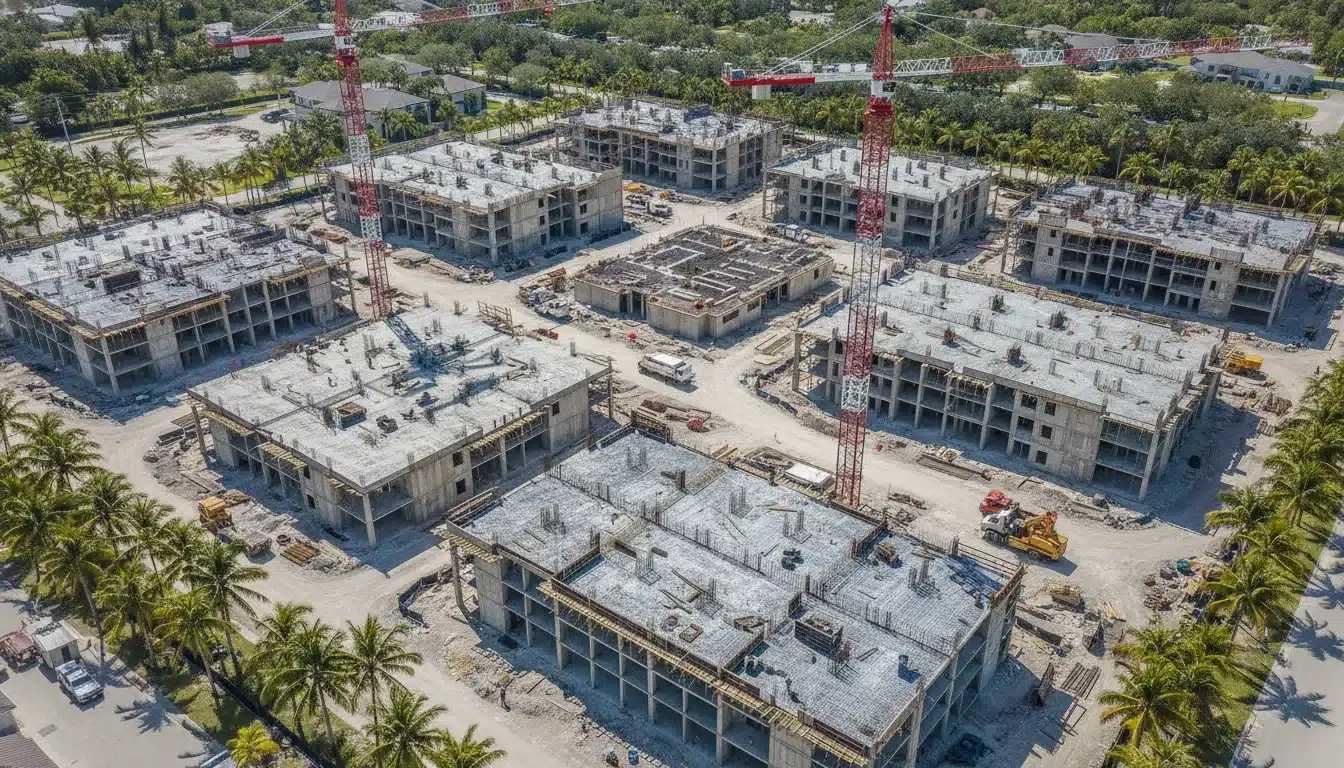
Florida developers face a 60-business-day statutory timeline for multifamily residential permits under 50 units. But the full approval cycle for apartment towers and condo complexes often stretches 6 to 18 months. Navigating the intersection of local zoning, state statutes, fire marshal reviews, and environmental permitting demands precision at every step. A single misstep in plan submission can add weeks of delay at thousands of dollars per day in carrying costs.
Request a proposal for multifamily construction permits Florida from All Florida Permits and cut months off your approval timeline.
Multifamily construction permits Florida are governed by Florida Statute 553.792, which gives local building departments 60 business days to review plans for projects with 50 units or fewer. The full permitting cycle typically spans 6 to 18 months and includes fire suppression design under NFPA 13/13R. Fair Housing Act accessibility compliance, stormwater management permits, and separate fire marshal approval. Developers can engage licensed private providers under Florida Statute 553.791 to complete plan review in as few as 2 business days. Avoiding the $1,000 to $5,000 per day in delay costs that accumulate at busy local offices. All Florida Permits specializes in accelerating every stage of this process for developers, general contractors, and project managers across the state.
What Makes Multifamily Permitting Different from Single-Family in Florida?
Multifamily construction permits Florida require commercial-grade standards that single-family homes do not. Florida law treats any residential building with four or more units under a stricter regulatory framework that governs fire suppression, accessibility, structural engineering, and mechanical loads. Understanding these differences upfront sets realistic timelines and budgets for large-scale projects.
Statutory Review Timelines
Under Florida Statute 553.792, local governments must approve or deny multifamily permits for up to 50 units within 60 business days, compared to 30 business days for single-family homes. Any residential project over 7,500 square feet follows this same 60-day commercial track. Permit delays in the current market cost developers $1,000 to $5,000 per day in carrying costs and lost revenue.
Fire and Life Safety Standards
Single-family homes need smoke alarms and basic fire blocking. Multifamily buildings must have active fire suppression systems following NFPA 13 or NFPA 13R sprinkler standards. High-rise buildings over 75 feet face additional requirements: standpipes, smoke control systems, and advanced fire alarm setups that require separate fire marshal plan review.
- Low-rise (up to 4 stories): NFPA 13R standard, which allows fewer sprinklers in attics, closets, and bathrooms
- Mid-rise and high-rise (over 75 feet): NFPA 13 full-coverage standard plus standpipes and smoke control
- Fire marshal review: Mandatory separate approval covering hydrant locations, fire department access, and water supply
Accessibility and Parking Requirements
The Fair Housing Act requires accessible routes and usable kitchens in all buildings with four or more units, while common areas must meet full ADA standards. Parking ratios add complexity: most Florida cities mandate 1.5 to 2 spaces per unit plus guest parking and ADA van-accessible spots. These requirements do not apply to single-family construction.
The Regulatory Framework for Multifamily Construction Permits
Florida’s regulatory environment for multifamily construction permits Florida projects combines state-level statutes, local municipal codes, and district-level environmental rules. Developers who understand this layered system can plan their approval path with confidence and avoid the delays that derail projects at busy local building departments.
Deadlines Under Florida Statute 553.792
Section 553.792 establishes a 60-business-day review window for multifamily permits covering up to 50 units. Projects exceeding 50 units face timelines determined by individual city or county rules. The statute also covers any residential project over 7,500 square feet under this same commercial track.
Expedited Permitting and Bulk Options
HB 683 and HB 1035, passed in 2025, set new standards requiring cities to use state-approved software and accept digital plan submissions. SB 812 allows bulk permitting in counties with at least 75,000 residents, letting developers obtain permits for up to 50 percent of units before final plat approval. By July 2028, this cap rises to 75 percent, enabling phased construction starts that shave months off delivery timelines. All Florida Permits helps developers navigate these programs to accelerate their project schedules.
Private Provider Plan Review Under FS 553.791
Florida Statute 553.791 allows developers to bypass local government plan review entirely by hiring a licensed private provider. A qualified private provider can complete multifamily plan review in approximately 2 business days, compared to the weeks or months required at a busy municipal office. Private provider fees typically run 10 to 30 percent lower than local government charges, and every week saved avoids $7,000 to $35,000 in delay costs.
Step-by-Step: How to Get Multifamily Construction Permits in Florida
The path to securing multifamily construction permits Florida follows a defined sequence of reviews and approvals. Most projects require 6 to 18 months from initial site analysis to certificate of occupancy, but strategic planning at each stage compresses that timeline considerably.
- Pre-application and site analysis. Check zoning, density limits, flood zones, and wetland presence. Allocate 30 to 90 days for this phase to identify potential roadblocks before committing capital.
- Site plan review. Local staff evaluate setbacks, parking counts, and utility connections. This phase takes 60 to 120 days and requires alignment with the local comprehensive plan.
- Agency permits. Obtain Environmental Resource Permits from the Water Management District, stormwater permits, and FDOT access permits where applicable. These reviews span 60 to 180 days and should run concurrently with site plan review.
- Building plan review. Submit full architectural, structural, MEP, and fire protection plans. The statutory 60-business-day window applies here for projects under 50 units.
- Construction and inspections. Ongoing inspections for trade work, life safety systems, and structural elements continue throughout the build phase.
- Certificate of occupancy. Final sign-off confirming all systems meet code and the building is safe for occupancy.
Get a proposal from All Florida Permits to manage your multifamily permitting timeline end to end.
What Fire Suppression and Life Safety Rules Apply to Multifamily Buildings?
Fire safety is the most rigorously enforced component of multifamily construction permits Florida. Every new multifamily project must comply with NFPA standards, Florida Building Code requirements, and local fire marshal directives. Understanding which standard applies to your building type is essential for accurate budgeting and timeline planning.
Sprinkler Standards by Building Type
Low-rise buildings up to four stories typically use the NFPA 13R standard, which focuses on life safety in residential spaces and permits reduced sprinkler coverage in attics, closets, and bathrooms. Buildings taller than four stories or exceeding certain square footage thresholds must follow NFPA 13, requiring full-coverage sprinkler protection throughout all areas including storage and utility spaces.
- NFPA 13R , Approved for buildings up to 4 stories; reduced sprinkler coverage in non-habitable spaces
- NFPA 13 , Required for buildings over 4 stories or 75 feet; full coverage in all spaces
- Standpipes , Mandatory in buildings over 75 feet; fire hose connections on every floor
- Smoke control systems , Required for high-rises; engineered systems to maintain tenable egress paths
High-Rise Egress and Structural Fire Protection
Buildings over 75 feet must include fire-resistance-rated walls and floors, multiple enclosed stairwells, and advanced fire alarm systems. The Florida Building Code requires a minimum of two means of egress from each floor, with exit travel distances not exceeding 200 feet in sprinklered buildings. Fire-resistance ratings range from 1 to 3 hours depending on building height and occupancy classification.
Accessibility and Site Compliance for Multifamily Projects
Multifamily construction permits Florida require developers to meet both the Fair Housing Act for residential units and the Americans with Disabilities Act for common areas. These overlapping frameworks govern everything from door width to parking lot grading, and non-compliance during plan review can trigger costly redesigns.
Fair Housing Act Design Standards
All buildings with four or more units built after March 1991 must comply with FHA design and construction requirements. Key specifications include 32-inch clear door openings, usable kitchens with appropriate clearance, reinforced bathroom walls for future grab bar installation, and accessible routes into and through each unit. Thermostats and light switches must be mounted at accessible heights, and all common areas must be on an accessible route from the building entrance.
ADA Compliance for Common Areas and Site
Leasing offices, fitness centers, pools, clubhouses, and parking areas must comply with ADA standards. The ADA requires van-accessible parking spaces at a ratio of 1 per 6 accessible spaces, with 96-inch-wide access aisles and proper slope gradients. Site grading must maintain accessible routes with slopes no steeper than 1:20 to ensure wheelchair and walker accessibility throughout the property.
All Florida Permits provides inspection management services that help developers verify compliance with FHA and ADA requirements before plan submission, reducing the risk of review rejections and revision cycles.
Private Provider vs AHJ: Which Plan Review Path Is Faster?
Developers pursuing multifamily construction permits Florida have two paths for plan review: the traditional Authority Having Jurisdiction route through local government. Or the private provider route authorized by Florida Statute 553.791. The choice directly impacts project timelines and bottom-line costs.
| Factor | AHJ (Local Government) | Private Provider (FS 553.791) |
|---|---|---|
| Review timeline | Up to 60 business days | 2 to 5 business days |
| Cost comparison | Government fee schedule | 10 to 30 percent lower fees |
| Scheduling | Fixed to office hours and backlog | Flexible to project timeline |
| Coordination | Separate fire marshal + building review | Unified review including life safety |
| Appeal process | Through local board of adjustment | Through local board of adjustment |
Private provider review typically completes in 2 to 5 business days versus the statutory maximum of 60 business days for local government review. At $1,000 to $5,000 per day in carrying costs, every week of review time saved represents $7,000 to $35,000 in avoided expenses. All Florida Permits coordinates private provider building inspections that maintain project momentum from plan review through final certificate of occupancy.
How a Permit Expediter Streamlines Multifamily Permitting
Multifamily construction permits Florida involve overlapping reviews across multiple agencies, and coordinating these independently is one of the biggest sources of delay for developers. A permit expediter serves as the single point of accountability for the entire approval lifecycle. Managing submission timing, agency coordination, and issue resolution so internal teams can focus on construction.
All Florida Permits brings deep familiarity with local building department procedures, fire marshal expectations, and water management district requirements across all 67 Florida counties. The firm handles plan preparation review, submission scheduling to avoid sequential bottlenecks, and ongoing status tracking through every phase of review. For developers managing SB 812 bulk permitting on large-scale projects, this coordination becomes even more valuable as the number of individual permit packages multiplies.
Request a proposal from All Florida Permits to put an experienced permit expediter on your next multifamily project.
Frequently Asked Questions
How long does it take to get multifamily construction permits in Florida?
The full permitting process for multifamily projects in Florida typically takes 6 to 18 months from initial site analysis to certificate of occupancy. Florida Statute 553.792 requires local building departments to complete plan review within 60 business days for projects with up to 50 units. Using a private provider under Florida Statute 553.791 can compress the plan review phase to 2 to 5 business days.
What is the difference between multifamily and single-family permitting in Florida?
Multifamily projects follow commercial-grade standards that single-family homes do not. Multifamily buildings need NFPA 13 or 13R fire suppression systems, Fair Housing Act and ADA accessibility compliance. 60-business-day statutory review timelines (versus 30 days for single-family), and stormwater management permits. Parking requirements also differ significantly, with multifamily sites needing 1.5 to 2 spaces per unit plus ADA-compliant van parking.
Do you need a fire marshal permit for multifamily construction in Florida?
Yes, a separate fire marshal plan review is mandatory for all new multifamily construction in Florida. The fire marshal examines hydrant placement, fire department access routes, water supply adequacy, sprinkler system design, and smoke control systems. This review runs alongside the building plan review and must be approved before the building permit can be issued.
What is a private provider and how does FS 553.791 apply to multifamily permits?
A private provider is a licensed professional authorized under Florida Statute 553.791 to perform plan review and inspections in place of the local building department. For multifamily projects, a private provider can complete plan review in 2 to 5 business days, compared to the 60-business-day statutory timeline for local government review. Private provider fees are typically 10 to 30 percent lower than municipal charges.
How do you get a certificate of occupancy for a multifamily building in Florida?
A certificate of occupancy is issued after all required inspections pass, including structural, fire suppression, electrical, plumbing, mechanical, and life safety systems. The fire marshal must sign off on all life safety elements. Working with a permit expediter ensures inspections are scheduled promptly and any issues are resolved before they delay the final approval.
Get a Proposal for Multifamily Construction Permits Florida
Every month of delay on a multifamily project costs thousands in carrying costs, lost revenue, and material price escalation. All Florida Permits provides end-to-end permitting support for developers, general contractors, and project managers building apartment complexes, condominiums, and townhome developments across Florida. From initial site analysis through certificate of occupancy, the firm manages every agency relationship and submission deadline so the construction team stays focused on building.
Request a proposal today and put expert permit management on your next multifamily development.