

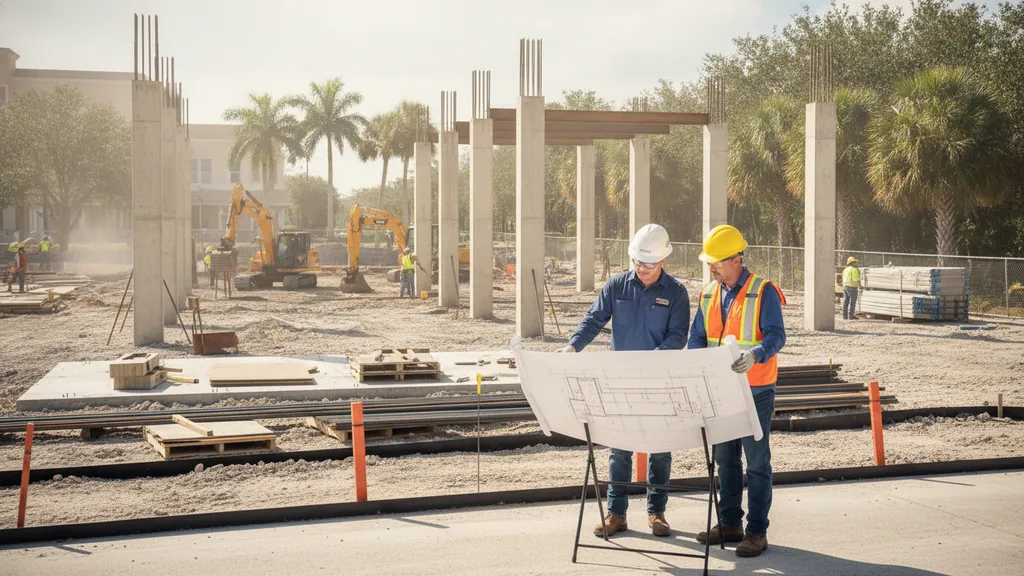
The north port building permit process for commercial work is a coordinated path through project scoping, Accela Citizen Access submission, plan review, fee payment, inspections, and certificate of occupancy closeout. Contractors, developers, architects, and project managers should treat each step as a schedule-control checkpoint, because an incomplete application can create corrections across building, planning, fire, public works, and other reviewing functions.
Request a North Port commercial permit proposal
What is the north port building permit process for commercial projects?
Short answer: A commercial project in the City of North Port generally moves from jurisdiction and scope confirmation to pre-application coordination where appropriate, Accela account setup, digital submittal, fee payment, coordinated plan review, correction responses, permit issuance, inspections, and final occupancy documentation. The exact path depends on the work, site conditions, occupancy, and agencies involved.
North Port’s Development Services Department uses the Accela Citizen Application, also called the Accela Citizen Access portal, for online applications and status updates. The City’s permitting page says contractors, businesses, and other users can create an account, apply for permits, and receive updates through the platform. It also says items submitted through Accela are processed in the order received and that statuses are available in the portal. Review the City’s current permitting and Accela guidance before submitting.
That citywide workflow is not a promise that every commercial permit has the same review sequence. A tenant improvement, new shell building, change of occupancy, site development package, and fire protection scope can involve different documents and reviewing departments. The practical objective is to define the complete permit package early, then keep the City’s record, plans, comments, inspections, and closeout items aligned.
How should a project team scope a North Port commercial permit?
Short answer: Start with the parcel, proposed use, construction type, project value, and work disciplines. Then identify whether the scope needs planning and zoning coordination, a Development Review Committee conversation, natural-resources review, fire and life-safety review, public works approvals, special inspections, or a certificate of occupancy plan.
Confirm the jurisdiction and project pathway
Before the design team prepares a final submittal, confirm that the property and proposed work are being handled through the City of North Port Development Services process. For larger or more complex development approvals, the City’s Development Review Committee coordinates technical review for compliance with the Unified Land Development Code. The City strongly encourages, but does not require, a pre-application meeting before filing for development approval, and it states that these meetings are informational rather than an approval of development rights. See North Port’s Development Review Committee guidance.
A pre-application conversation is especially useful when the project includes a new commercial building, site development and infrastructure, subdivision work, a change of use, unusual access or egress conditions, or multiple departments. It gives the team a place to ask which reviews must be sequenced before the building permit can be issued. It does not replace a complete permit application, plan review, or any approval required by the City.
Separate commercial work from residential exemptions
The City’s current permitting page describes 2026 state-law exemptions for certain single-family residential work, including an exemption for qualifying work below a stated value threshold. Those notices are residential-specific. They are not a blanket exception for commercial construction, commercial alterations, tenant improvements, or commercial life-safety systems. Project teams should not apply the residential exemption language to a commercial scope without written confirmation from the City for the specific work.
Build a review matrix
Use a review matrix before uploading anything. At minimum, identify the owner, contractor of record, design professionals, parcel and address, occupancy or use, estimated construction value, new versus existing construction, structural scope, mechanical, electrical and plumbing scope, accessibility, energy, site and drainage considerations, fire protection systems, special inspections, and the intended CO or TCO path.
This is also where the team should identify documents that are often treated as afterthoughts. North Port’s permit-forms page lists a building application, private-provider packet, Notice of Commencement, product approval specification sheet, TCO checklist and process, and change-of-occupancy/use checklist among its resources. The exact documents needed depend on the project, but the list is a useful starting point for package control. Check the City’s current permit forms and checklists.
How do you create an Accela account and submit in North Port?
Short answer: Create the required Accela account, confirm the correct application type and property record, assemble the complete commercial plans and supporting documents, upload the package, pay the applicable application charges, and save the confirmation and record number. Use the portal as the source of truth for status and correction activity.
- Register the account. North Port states that users must create an account to use the online services. The City says account creation is free, while permit and application fees are paid through the portal.
- Identify the record. Match the application to the correct property, address, parcel information, project description, owner, and contractor information. A mismatch at intake can affect every later status and inspection record.
- Select the right scope. Distinguish new construction, alteration, shell work, interior build-out, change of occupancy, trade work, fire protection, and other related applications. When a project needs multiple records, document how they relate.
- Upload the plans and supporting documents. Use consistent file names and revision labels. The permit coordinator should keep a submission index showing each file, discipline, date, and revision.
- Pay and preserve the receipt. Record the payment confirmation, application number, and submission timestamp in the project log.
- Monitor the portal. North Port says applications are processed in the order received through Accela and that statuses are available in ACA. Assign one accountable person to check for status changes and correction requests.
North Port’s public permit lookup also identifies Accela as the City’s Citizen Access platform for building permits, planning, code enforcement, business tax, and fire services. Use the City permit lookup and portal entry point, and confirm the portal’s current interface before training the project team.
What commercial plans and supporting documents should be ready?
Short answer: The submittal should allow reviewers to understand the building, site, use, construction systems, and life-safety strategy without relying on missing consultant information. Assemble coordinated architectural, structural, mechanical, electrical, plumbing, civil or site, accessibility, energy, fire, and specialty documents as the project requires.
North Port’s plan-review page says staff studies blueprints, site plans, and landscaping plans for conformance with city, state, and national codes. It also says Building and Permitting staff provide plan review and technical inspections. The City identifies the 8th Edition 2023 Florida Building Code and National Electric Code 2020 as applicable to building applications in its current plan-review guidance. Review North Port’s plan-review and code information.
A commercial package should be internally checked for the following:
- Address, parcel, legal project description, occupancy, and scope match across every sheet and form.
- Architectural plans that coordinate egress, accessibility, occupancy separations, room uses, door and hardware information, and life-safety details.
- Structural plans and calculations that align with the architectural set and identify special inspection conditions where applicable.
- Mechanical, electrical, plumbing, and fire protection plans that coordinate routes, equipment, clearances, penetrations, controls, and required testing.
- Site, civil, landscape, drainage, erosion-control, and geotechnical information when the project scope requires it.
- Product approval, manufacturer, energy, special inspection, private-provider, change-of-occupancy, or other supporting documents required for the project.
- Professional seals, signatures, dates, revision clouds, and a clear response matrix for any prior comments or resubmittal.
North Port’s plans-review page separately calls out erosion-control measures and geotechnical reports. That makes them schedule items, not documents to investigate only after a reviewer asks. If the project includes those conditions, identify the responsible consultant and include the required material in the submission plan.
How the north port building permit process handles review, fees, and corrections
Short answer: North Port’s reviewers evaluate plans for code and local requirements, and the City’s portal provides the project status. Fee exposure depends on the application, valuation, plan review, and required inspections. Because the public City pages do not provide a guaranteed commercial plan-review duration, teams should control the schedule through document completeness, fast correction responses, and disciplined status tracking.
Plan review and correction cycles
Do not treat the first upload as the end of the design coordination phase. Once comments arrive, route each correction to the responsible architect, engineer, contractor, or specialty consultant. Return a marked response matrix that identifies the sheet or document changed, the response, and the new revision. Keep the corrected plan set internally synchronized before the next upload.
The City’s permitting page says records are handled in the order received through Accela. That makes a clean, complete initial submittal and a complete resubmittal more valuable than a rushed upload followed by piecemeal corrections. It also means that the project log should distinguish a status update, a reviewer comment, a fee request, an inspection result, and a formal resubmittal.
Fees and valuation
North Port directs applicants to Appendix A of the City Fee Schedule for a complete listing of fees and to Section D for the Building Division’s complete fee schedule. The City also states that additional fees may apply based on the application type, plan review, and required inspections. Do not publish a project fee from a generic estimate. Confirm the current City schedule and the actual project valuation before budgeting the permit account.
The City’s permit-fees page states that North Port uses International Code Council Building Valuation Data, based on square-foot construction costs, to determine construction-project valuation. The page currently references an update using the ICC Building Valuation Data February 2025 table and identifies June 2, 2025 as the update date. Because valuation tables and local fee schedules can change, link the current City page in the project handoff rather than copying a stale rate into a proposal.
| Budget item | What to verify | Schedule-control action |
|---|---|---|
| Permit and application fees | Application type, current City fee schedule, and project valuation | Confirm the fee basis before final submission and retain payment proof |
| Plan-review charges | Whether the scope triggers additional plan-review fees | Include fee confirmation in the permit log and avoid assuming one flat charge |
| Inspection charges | Required building, trade, fire, or specialty inspections | Map inspection milestones to the construction schedule before mobilization |
| Payment processing | Current payment method and convenience charges | Use the City’s posted payment table at the time of payment |
| Closeout and occupancy | Impact fees, TCO or CO conditions, and final documentation | Track closeout obligations from permit issuance, not at substantial completion |
Check North Port’s current permit-fee and valuation information before committing a commercial project budget.
Request a proposal for North Port permit expediting and coordination
What inspections are required during commercial construction?
Short answer: Inspections verify that installed work complies with the approved plans and current codes. North Port identifies building, trade, and fire-related inspection functions, and it provides Accela and automated-line tools for scheduling and results. The construction team should request inspections only when the work is ready, preserve the result, and resolve failed or incomplete items before covering work.
North Port’s inspections page says inspections are integral to each building permit and that specialized inspectors review systems such as air conditioning, electrical wiring, and plumbing. It states that inspections can be scheduled or checked through Accela or the automated inspection line, and that the cutoff for next-business-day inspections is 3 p.m. Monday through Friday. Review the City’s inspections guidance.
The City’s inspection guidance provides the operational starting point: select the permit, search by application number, parcel number, or address, choose the inspection scheduling function, select the inspection and available date, add relevant comments such as access instructions, and submit the request. Use North Port’s current inspection guidance and confirm the live scheduler instructions before training field staff.
Fire and life-safety inspections
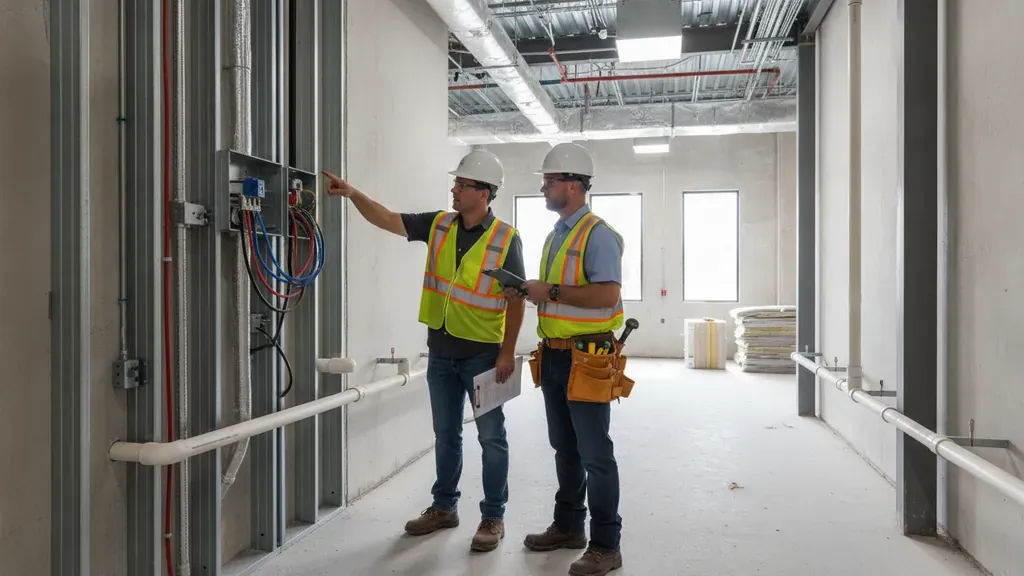
Fire review should be planned as part of the commercial permit path, not treated as a final courtesy check. North Port Fire Rescue says new construction, remodeling of existing commercial structures, and installation of fire sprinklers, alarms, and other fire and life-safety features require a building permit. Its Fire Prevention Division reviews construction plans and specifications, and fire inspectors inspect systems and features such as sprinklers, alarms, fire walls, and means of egress. See the City’s Fire Prevention requirements.
For schedule control, coordinate fire-system testing, fire alarm and sprinkler approvals, access, egress, and any Fire TCO requirements with the contractor of record and fire-protection contractors. The City permitting page also states that fire inspections can be requested through the online portal and that the requester receives an Accela email notification.
How do permit issuance and CO closeout work?
Short answer: Permit issuance is the point at which the approved scope can move into construction under the City’s conditions. Closeout then requires completed inspections, approved trade and life-safety work, required as-builts and planning or public-works items, paid impact fees where applicable, and the documentation needed for a final CO or an approved TCO path.
Build the closeout tracker at permit issuance. Include every inspection type, department condition, testing report, as-built, special inspection certificate, survey or elevation document, energy or insulation certificate, and owner or contractor letter that the City requires for the project. A permit can be technically active while closeout remains incomplete, so the permit log should not be closed when the last visible construction activity ends.
North Port’s official TCO checklist and process says a TCO may be issued for a portion of a building that can be safely occupied before final completion, when the request is justified and approved. It states that all final inspections must be scheduled and resulted, impact fees must be paid in full, and the Fire TCO inspection must be approved by the Fire Marshal before a TCO may be issued. The same document says a CO is issued when the inspections and TCO conditions have been met. Read the City’s current TCO checklist and process PDF.
The TCO document lists building, plumbing, mechanical, electrical, fire sprinkler and alarm, zoning, public works, planning, arborist, and Fire Final conditions among its checklist items when applicable. It also identifies as-builts and a signed and sealed certificate of compliance from a required special inspector as possible closeout materials. Treat the checklist as a project-specific control list, not as permission to occupy without written approval.
North Port commercial permit checklist
Short answer: A commercial permit package is ready for North Port when scope, jurisdiction, documents, fees, portal ownership, review responsibilities, inspection milestones, and closeout requirements are assigned. Use this checklist before submission and again before each resubmittal.
| Checkpoint | Project-team verification |
|---|---|
| Jurisdiction | Parcel, address, City process, proposed use, and related planning or zoning path confirmed |
| Pre-application | Pre-application or DRC question list completed when project complexity warrants it |
| Accela | Account created, record type selected, property record matched, and project owner assigned |
| Plans | Architectural, structural, MEP, site, accessibility, energy, fire, and specialty documents coordinated |
| Supporting documents | Applications, product approvals, geotechnical or erosion-control material, special-inspection information, and other required forms checked |
| Fees | Current fee schedule, valuation basis, plan-review charges, inspection charges, and payment confirmation recorded |
| Corrections | One owner assigned to monitor status, route comments, prepare the response matrix, and control revisions |
| Inspections | Building, trade, fire, zoning, public works, and specialty milestones mapped to construction sequencing |
| Closeout | Final inspections, as-builts, testing, impact fees, special-inspection certificates, TCO or CO conditions tracked |
Schedule-control guidance for Florida project teams
Short answer: Schedule control comes from reducing avoidable uncertainty before the City’s queue, not from promising an unsupported approval date. Use one permit register, one document index, one correction matrix, and one closeout tracker, with an accountable owner for every open item.
- Front-load scope decisions. Resolve use, occupancy, fire protection, site work, and trade responsibilities before the first upload.
- Control revisions. Do not allow the architect, engineer, contractor, and permit coordinator to maintain conflicting plan sets.
- Watch Accela deliberately. Create a recurring status check and record timestamps, comments, fees, and requested actions.
- Sequence inspections. Tie each request to actual readiness, access, testing, and work that can be inspected without concealment.
- Protect closeout time. Request as-builts, test reports, special inspection certificates, and department signoffs before the final week.
- Do not invent review durations. North Port states that records are processed in order received, but the cited public pages do not guarantee one commercial review duration. Model the schedule around package completeness and correction risk.
For owners and project managers, this structure creates a clearer decision trail. For contractors and architects, it reduces the chance that a permit question is discovered only after a trade is ready for inspection. For developers, it provides a repeatable way to compare North Port work with other Florida jurisdictions without assuming that another city’s portal or review rules apply here.
Get a proposal for commercial permit management in North Port
North Port building permit process FAQs
Does a commercial project need an Accela account?
North Port states that anyone who wants to use the online Accela platform and its services must create an account. The City says account creation is free, while application and permit fees are paid through the portal. Confirm the current account and delegate process before assigning access to subcontractors or consultants. See the City’s permitting FAQs.
Does North Port publish a guaranteed commercial plan-review timeline?
The City permitting page states that applications are processed in the order received through Accela and that statuses are available there. The cited public pages do not establish one guaranteed commercial review duration. Use a completeness checklist, correction matrix, and active portal monitoring instead of promising a fixed approval date.
How are commercial permit fees determined?
North Port directs applicants to the City Fee Schedule and Building Division fee schedule. It also says additional fees may apply based on application type, plan review, and required inspections, and that ICC Building Valuation Data is used to determine construction-project valuation. Confirm the current schedule and valuation basis for the actual project. Review the official fee page.
How are North Port inspections scheduled?
Inspections can be scheduled and results viewed through Accela or the City’s automated inspection line. North Port says the cutoff for next-business-day inspections is 3 p.m. Monday through Friday. The scheduling instructions direct users to select the permit, search by application, parcel, or address, choose the inspection, select an available date, add comments, and submit the request.
Are fire inspections part of the commercial permit process?
Yes, when the project scope triggers fire and life-safety review. North Port Fire Rescue identifies commercial construction, commercial remodeling, fire sprinklers, alarms, fire walls, and means of egress among the areas requiring building and fire review or inspection. Coordinate fire-system plans, testing, and final approvals with the permit and closeout schedule.
Can North Port issue a TCO before every item is complete?
North Port’s TCO process allows a TCO for a safely occupiable portion of a building before final completion when the request is justified and approved. The City checklist requires applicable inspections and conditions, paid impact fees, and Fire TCO approval. A TCO is not automatic, and a CO follows when the listed conditions are met.
North Port commercial permitting is easier to manage when the project team treats the permit as a controlled workflow rather than a single upload. Confirm the scope, coordinate the documents, monitor Accela, answer corrections as a package, schedule inspections when ready, and track CO requirements from the beginning.