

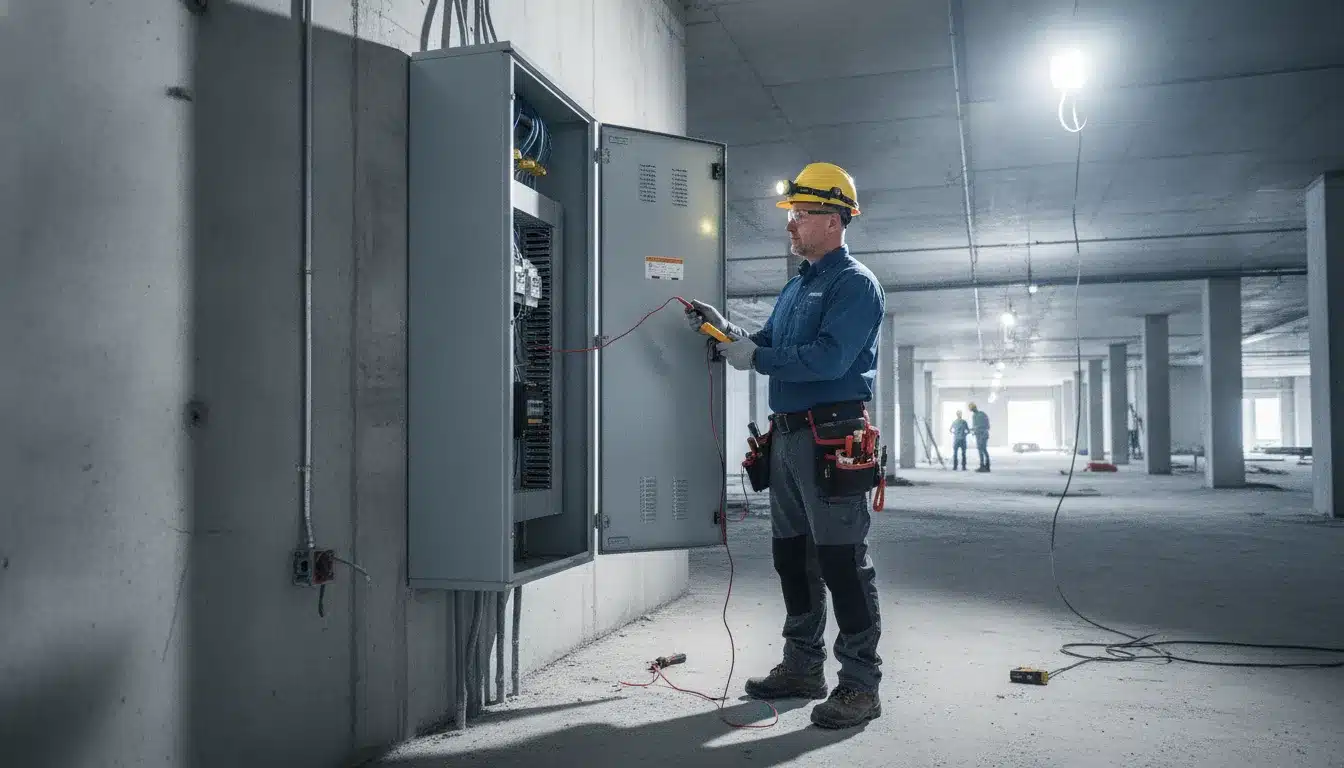
Electrical work can be installed correctly and still lose schedule time when the inspection sequence is misunderstood. Commercial projects typically move through distinct checkpoints before walls close, service equipment is energized, and the space is ready for occupancy. Planning each checkpoint around the approved plans, accessible work, and required documentation reduces avoidable rework.
A florida commercial electrical inspection verifies that wiring, service and panel equipment, grounding, bonding, and installed devices comply with the Florida Building Code and adopted electrical provisions. The inspection process generally includes rough-in, service or panel, and final reviews, with the local authority having jurisdiction confirming work at each applicable stage. See the Florida Building Code electrical provisions and Florida’s NEC adoption guidance for the governing framework.
The practical question is what the inspector will verify before approving the next phase. That answer starts with the code basis, inspection scope, and responsibilities shared by the electrical contractor, general contractor, and AHJ.
Request a proposal to keep your commercial electrical inspection sequence moving on schedule.
What a Florida Commercial Electrical Inspection Covers
A florida commercial electrical inspection verifies that the installed electrical system matches the approved design and complies with the electrical provisions of the Florida Building Code (FBC). Florida’s code incorporates the National Electrical Code (NEC), also identified as NFPA 70, as the technical foundation for electrical safety. The Florida Building Commission provides the state’s NEC adoption information, while FBC Chapter 27 sets out the electrical requirements applied to building work. See the Florida NEC adoption requirements and FBC Chapter 27 electrical provisions.
For owners, developers, and general contractors, the inspection is not a general visual check. It is a compliance review of the installation at the stage when the work is presented. Inspectors assess whether the wiring methods are appropriate, conductors and equipment are installed correctly, panels are properly configured, and the system’s grounding, bonding, and overcurrent protection are in place. The work must also remain consistent with the approved electrical plans. Those requirements are part of the broader Florida electrical code framework.
Installation details inspectors verify
The exact checklist depends on the inspection phase and project scope, but the core review typically includes:
- Wiring methods: Inspectors review conduit, cable, raceways, boxes, terminations, and conductor installation for compliance with the approved design and applicable code provisions.
- Panel installation: Service equipment and distribution panels must be installed in the approved locations, with appropriate clearances, identification, connections, and equipment ratings.
- Grounding and bonding: The system must provide the required grounding and bonding paths so exposed metal parts and electrical equipment are connected as required for fault protection.
- Overcurrent protection: Breakers and other protective devices must correspond to the equipment and circuit design. Improper sizing or mismatched protection can prevent approval.
- Plan alignment: Field conditions must match the approved electrical plans, including equipment locations, circuit arrangements, and material or design changes that required approval.
Electrical plan review occurs before installation, but inspection confirms that the permitted design was actually executed in the field. Unapproved substitutions, inaccessible connections, incomplete labeling, or concealed work presented at the wrong stage can create reinspection risk and disrupt downstream finishes, testing, or occupancy milestones. Coordinating the inspection sequence with the wider commercial permitting process helps keep electrical work synchronized with the project schedule.
Who conducts the inspection
The local Authority Having Jurisdiction (AHJ), through its building department or designated code officials, may conduct the inspection. Florida law also permits the use of a registered private provider under the conditions established in Florida Statute 553.791. The responsible party should be clear before scheduling: confirm the jurisdiction’s inspection procedures, the approved plans available for review, and the required access. Confirm whether the inspection is being performed by the AHJ or an authorized private provider. That clarity matters because an inspection approval is tied to the permitted scope, the applicable code, and the documentation maintained for the project.
Rough-In Inspection: What Inspectors Verify Before the Walls Close
The electrical rough-in inspection takes place after the wiring, conduit, boxes, and connections are installed, but before drywall, insulation, or other finishes conceal the work. That timing gives the AHJ a clear view of the installation and allows the inspector to compare the field work with the approved electrical plans. The rough-in stage is therefore a critical schedule gate, not a formality. The Florida Building Code’s electrical provisions establish the inspection framework for verifying safe installation, while Florida’s adopted National Electrical Code provides the technical basis for many of the details inspectors review. Review the FBC Chapter 27 electrical provisions before requesting the inspection.
The permit dictates the inspection sequence and the point at which each trade can proceed. Project teams should confirm the required sequence in their commercial electrical permit requirements, particularly when electrical work is coordinated with framing, fire protection, mechanical, and interior build-out activities.
Conductors, conduit, and circuit installation
Inspectors verify that conductors are appropriate for the branch-circuit loads shown in the approved plans. That includes checking wire gauge, conductor type, circuit routing, and the relationship between the wiring method and the equipment it serves. An undersized conductor, an unlabeled circuit, or a field change that does not match the approved design can result in a failed inspection and a correction cycle.
Where conduit is used, the installation must be properly supported and protected. Inspectors look for secure support, properly installed fittings, and bushings or other protection where conductors enter or leave raceways. They also examine cable and conduit clearances so wiring is not exposed to avoidable physical damage or placed in conflict with other building systems. Careless wire-pulling that cuts, scrapes, or otherwise damages conductor insulation is a common workmanship problem that should be corrected before the inspection.
Boxes, connections, and grounding
Junction boxes, outlet boxes, and other enclosures must be installed in the correct locations and securely supported. The inspector needs to see that boxes are accessible as required, sized appropriately for the conductors and connections they contain, and aligned with the planned devices or equipment. Missing box supports, loose boxes, crowded enclosures, and inaccessible junction points can stop a rough-in approval even when the circuit routing appears complete.
Grounding and bonding receive close attention because they support fault-current paths and reduce shock and fire hazards. Grounding conductors should be present and properly connected at each box and equipment location where required by the installation. Metal boxes, raceways, equipment grounding conductors, and bonding connections must work as an integrated system, rather than appearing as isolated components. The inspector will also look for secure terminations and connections that are protected from damage.
Why enclosure before approval creates a problem
Drywall or insulation should not close over electrical work until the rough-in has passed. Once the work is concealed, the AHJ may be unable to verify conductor sizes, support points, box connections, clearances, and grounding without opening finished surfaces. If the inspection fails after enclosure, the project may face selective demolition, rework, a rescheduled inspection, and downstream delays for other trades. A disciplined pre-inspection walk with the electrical contractor, plans, accessible pathways, labeled circuits, and visible connections gives the team a better chance of resolving deficiencies before they become a schedule event.
For the governing framework, consult the Florida Building Commission’s NEC adoption information alongside the applicable FBC provisions.
Service and Panel Inspections: Sizing, Sealing, and Grounding
The service and panel inspection is a focused checkpoint for the equipment that receives, distributes, and protects power throughout a commercial building. It is typically scheduled after rough-in work is accessible and before many finish fixtures are trimmed, so the AHJ can evaluate the installation without concealed conditions or completed finishes limiting access. The review follows the applicable electrical provisions of Florida Building Code Chapter 27 and the safety framework in NFPA 70, the National Electrical Code.
For project teams, this stage is more than a panel-label check. The inspector is confirming that the service equipment is sized for the approved building load, and that protective devices are suitable for the system. The inspector also confirms that grounding and bonding connections provide a reliable path for fault current. Defects here can stop energization, trigger corrections across the electrical scope, or create avoidable schedule exposure while equipment and finish trades wait.
Service capacity and overcurrent protection
Inspectors compare the installed service conductors and equipment with the approved electrical design. Conductors must be appropriately sized for the calculated load and installed using the approved wiring method, terminations, and equipment ratings. The main disconnect and overcurrent protective devices must correspond to the service and feeder configuration. The equipment’s interrupting rating also matters: a breaker must be capable of safely interrupting the available fault current at its installation point.
Distribution panels receive the same scrutiny. The inspector may verify that breakers match the panelboard listing, circuits are identified, unused openings are closed, and conductors are properly terminated. Field substitutions that appear minor, such as changing a panelboard or protective device without updating the approved design, can create a mismatch between the installed system and the permitted plans. Resolve those changes through the proper revision process before requesting inspection.
Grounding, bonding, and panel configuration
Grounding and bonding are central safety controls, not administrative details. The grounding electrode system must be installed and connected as required, while bonding connections join conductive equipment and enclosures so a fault can return through a dependable path and allow protective devices to operate. These requirements reduce shock and fire hazards and are therefore a major inspection focus under the FBC and NEC.
At service equipment, inspectors also look for the correct relationship between the grounded conductor and equipment grounding conductors. The service disconnect configuration must be bonded as required, while downstream panelboards generally maintain neutral-to-ground separation. A misplaced bonding screw, an unconnected grounding electrode conductor, or an improperly terminated equipment grounding conductor can fail the inspection even when the panel appears complete.
Sealing and working access
Service penetrations and raceway entries must be properly fitted and sealed where the approved assembly or code requires it. Inspectors also need clear working space and safe access around service equipment and panels. Do not stage material, install permanent obstructions, or close access doors in a way that prevents examination, operation, or maintenance of the equipment. Before scheduling, the electrical contractor should confirm panel labeling, torque and termination documentation, grounding continuity, and field conditions against the approved plans.
Coordinating this checkpoint as a distinct inspection stage gives the GC and electrical contractor a defined opportunity to correct service equipment issues before final devices, fixtures, and appliances conceal the work.
Final Inspection: Devices, Fixtures, and the Energized System
The final electrical inspection is the closeout checkpoint for the installation. It takes place after receptacles, switches, luminaires, equipment, and appliances are installed, with the system energized and ready for safe operation. The AHJ is no longer reviewing concealed rough-in work alone. The inspector is verifying that the completed installation functions as designed, matches the approved plans, and complies with the electrical requirements in Florida Building Code Chapter 27.
What the inspector verifies
At this stage, the inspector can test visible and operational components throughout the occupied area. Receptacles and switches should be properly installed, securely mounted, and wired with correct polarity. Required GFCI and AFCI protection must be present and operational in the locations and applications governed by the adopted code. The inspector may also verify that equipment grounding and bonding are complete, cover plates are installed, and no accessible wiring or device box has been left unfinished.
Lighting is another common focus. Emergency lighting and exit illumination must be installed where required, connected correctly, and capable of operating as intended during a loss of normal power. The service equipment and disconnect must operate properly and remain accessible. Panels should have complete, legible schedules that identify the circuits they serve. Unlabeled breakers and incomplete schedules create avoidable questions during a final inspection, particularly when the installed distribution does not clearly correspond to the approved electrical plans.
Why final approval affects occupancy
For a commercial project, passing the final electrical inspection is typically part of the jurisdiction’s closeout requirements for a certificate of occupancy or certificate of occupancy approval. A failed final can therefore hold up occupancy even when the building is otherwise ready for tenants, staff, or customers. That delay can affect turnover, tenant delivery, inspections by other trades, and the project’s revenue schedule.
Project teams should treat the final as a functional commissioning checkpoint, not a last-minute paperwork event. Before scheduling, the electrical contractor should walk every area against the approved plans, test protective devices, verify emergency lighting, complete panel directories, and confirm that all fixtures and appliances shown in the scope are installed. The inspection record, permit information, and correction documentation should also be retained with the closeout package.
Common final-stage failures
- Required GFCI or AFCI protection is missing, incorrectly located, or fails its test.
- Receptacles have reversed polarity, loose terminations, or incomplete grounding.
- Breakers are unlabeled, panel schedules are incomplete, or circuit directories do not match the installation.
- Emergency or exit lighting is missing, improperly connected, or not operational.
- Service disconnects, equipment grounding, or bonding connections are incomplete or inaccessible.
- Installed devices, fixtures, and appliances differ from the approved plans without documented approval.
Resolving these items before the AHJ arrives protects the turnover date and reduces the risk that a minor closeout defect becomes an occupancy delay.
What Inspectors Check at Each Stage
A Florida commercial electrical inspection is easiest to pass when the electrical scope is reviewed as a sequence of controlled checkpoints, not as one final event. Each stage exposes different risks. Rough-in work must remain visible before walls close, service and panel work must be correctly sized and grounded, and the final inspection confirms that installed devices and fixtures operate safely as a complete system. The Florida Building Code’s electrical provisions in Chapter 27 provide the governing framework for these checks.
| Inspection Stage | What the Inspector Verifies | Common Reasons for Failure |
|---|---|---|
| Rough-In | Wiring, conduit, boxes, connections, and grounding are installed correctly and remain accessible before walls are enclosed. The inspector checks conductor sizing, routing, support, protection, and the condition of insulation. | Undersized conductors, unlabeled wiring, damaged insulation, missing box supports, incomplete connections, or concealed work that cannot be verified. |
| Service/Panel | Service conductors and equipment are properly sized. The inspection also covers overcurrent protection, the grounding electrode system, bonding, panel configuration, and required neutral-ground separation. | Improper grounding or bonding, incorrect breaker ratings, inadequate conductor sizing, poor panel access, or a panel installation that does not match the approved plans. |
| Final | Devices, fixtures, and related equipment are installed, identified, and ready for operation. With the system energized, the inspector verifies safe operation, polarity, protection, and items such as GFCI and AFCI where required. | Reversed polarity, missing GFCI protection, unlabeled breakers, incomplete fixtures, inaccessible equipment, or unresolved defects discovered during energized testing. |
These stages are connected. A rough-in defect that is covered by drywall becomes a coordination and schedule problem, while a panel issue can delay energization or downstream commissioning. Keep the approved plans available, make all inspection areas accessible, and ensure panel directories and circuit labels are complete before the inspector arrives. Treat each checkpoint as a release gate for the next phase, and document corrections promptly so the project record reflects what was inspected and approved.
How to Prepare for a Commercial Electrical Inspection
A failed inspection can disrupt a tightly sequenced commercial schedule, delay close-in work, and force electricians, superintendents, and inspectors back to the site. Preparation should therefore begin before the inspection request is submitted. The current Florida Building Code, 8th Edition (2023), took effect on December 31, 2023, as noted by Santa Rosa County’s Florida Building Code reference. The electrical provisions in FBC Chapter 27 provide the technical framework for the inspection. Use the following sequence to reduce avoidable rework and protect the project schedule.
- Schedule the inspection within the permit window. Confirm the inspection type, required stage of completion, and scheduling procedure with the authority having jurisdiction or the authorized inspection provider. Request the inspection well before the planned close-in date, energization milestone, or final turnover. A late request can compress correction time and make a minor deficiency a critical-path issue. If your team needs help coordinating dates, documentation, and site readiness, consider inspection management services.
- Compare the installed work with the approved plans and permit. Have the electrical contractor and project superintendent review the latest approved drawings, revisions, equipment schedules, and permit scope together. Verify that conductor sizes, raceways, panel locations, equipment ratings, and circuit routing match the approved design. Do not assume that a field change is acceptable because the installation is functional. Unapproved deviations may require correction, documentation, or plan approval before the inspection can pass.
- Label panels and identify circuits before the inspector arrives. Every panel should have a clear directory that identifies each breaker and its served load. Dedicated circuits for equipment should be distinguishable, and labels should agree with the panel schedule and approved plans. Replace temporary, handwritten, incomplete, or contradictory markings. Clear identification allows the inspector to verify the installation efficiently and helps the owner operate and maintain the building after turnover.
- Provide clean working access to inspection points. Remove stored materials, construction debris, ladders, packaging, and other obstructions from in front of panels, junction boxes, disconnects, and service equipment. Keep covers, access doors, and working spaces available for visual examination. Do not conceal wiring, boxes, or connections that must be inspected at the current phase. The inspector should be able to reach and examine the equipment without moving unrelated construction materials.
- Verify grounding and bonding are complete. Confirm that grounding electrode conductors, bonding jumpers, equipment grounding conductors, bonding connections, and required terminations are installed as designed. Check that connections are secure and accessible where the inspection requires visual verification. Grounding and bonding are central safety requirements under the electrical provisions of FBC Chapter 27, not items to defer until the final inspection.
- Keep permits and inspection documentation on site. Maintain the active permit, approved plans, stamped revisions, prior inspection reports, correction notices, product information, and other required records in an accessible location. The field team should know who can answer questions about design changes and where the controlling documents are stored. Complete records help establish what was approved, what has already been inspected, and what remains open.
- Correct obvious deficiencies before the inspection. Conduct an internal pre-inspection walk-through with the electrical contractor. Look for open knockouts, missing covers, loose terminations, incomplete labeling, exposed conductors, inaccessible equipment, damaged raceways, and discrepancies between the field installation and the approved plans. Resolve findings before requesting the inspection, then confirm that the corrective work is complete. A disciplined pre-check is less expensive than a failed first visit, especially when downstream close-in, testing, commissioning, or certificate-of-occupancy milestones depend on the result.
Private Provider Inspections Under Florida Statute 553.791
Florida Statute 553.791 gives qualifying commercial project teams an alternative to relying exclusively on the local Authority Having Jurisdiction (AHJ) for building code inspections. The statute authorizes a private provider to perform inspections, including electrical inspections, that would otherwise be conducted by the local building department, subject to the statutory notice, documentation, and jurisdictional requirements. For electrical scopes, the inspection work must still evaluate compliance with the applicable Florida Building Code provisions and electrical standards, including the requirements addressed in Florida Building Code Chapter 27.
This is not a way to bypass code compliance or approved plans. It is a different inspection-delivery model that can give the owner, general contractor, and electrical contractor more control over scheduling. A local building official may establish a registration system for private providers and their duly authorized representatives to verify licensing and insurance compliance under the statute. Before using a provider, the project team should confirm the provider is registered or otherwise accepted by the relevant jurisdiction and that the proposed inspection sequence is compatible with the permit and AHJ procedures.
Who may serve as a private provider
Florida law limits who may act as a private provider. The provider must be licensed as a building code administrator under part XII of chapter 468, as an engineer under chapter 471, or as an architect under chapter 481. That licensing requirement is central to the model because the provider is taking responsibility for code inspection functions, not merely coordinating appointment times. The provider’s reports and supporting documents must be complete enough for the building department to process the inspection record and maintain the project’s compliance file. See the full requirements in Florida Statute 553.791.
How private providers protect the construction schedule
For commercial work, the principal advantage is schedule control. Private providers can often offer faster appointment scheduling, same-day virtual inspection options where the scope and jurisdiction permit them, and efficient plan reviews. Those options can reduce idle time between rough-in, service equipment, and final electrical milestones. They are especially useful when an inspection delay would hold up wall close-in, energization, tenant turnover, or a certificate of occupancy milestone. Availability is not automatic, however. The provider and project team must verify that the inspection type qualifies for a virtual or accelerated option and that the AHJ will accept the resulting documentation.
Coordination is where the model creates practical value. The electrical contractor supplies accurate status information, access details, approved-plan references, and correction responses. The provider performs or coordinates the inspection and delivers the required record. An expediting partner can keep those inputs aligned with permit status, reinspection needs, and other trades by using private provider inspection management. That coordination helps prevent a technically complete installation from losing time because the inspection request, site access, or report submission was incomplete.
Request a proposal for help keeping every stage of your commercial electrical inspection schedule on track.
Frequently Asked Questions
How much does a commercial electrical inspection cost?
Inspection cost depends on the jurisdiction, project scope, inspection stages, and whether the work is reviewed by the AHJ or an authorized private provider. Confirm the applicable fee schedule and required inspection sequence before scheduling so the electrical budget reflects the full compliance process.
Does all electrical work need to be inspected in Florida?
Most permitted commercial electrical installations, major upgrades, and significant renovations require inspection before concealment, energization, or approval for occupancy. The exact requirements depend on the permit and local AHJ. Use the approved plans and permit conditions as the controlling checklist.
What is the electrical code standard for commercial installations in Florida?
Florida electrical work is governed through the Florida Building Code, which incorporates the National Electrical Code as the primary electrical safety standard. The Florida Building Commission identifies the applicable NEC adoption framework. The current statewide code edition is the Florida Building Code, 8th Edition (2023), effective December 31, 2023 (Florida Building Commission; Santa Rosa County FBC page).
What can I expect during a commercial electrical inspection?
Expect the inspector to verify that wiring is installed safely, panels and service equipment are properly installed and sized, grounding and bonding are complete, and the work matches the approved plans. Rough-in work is reviewed before walls close, service and panels are checked before or during energization, and the final confirms devices, fixtures, and the completed system.
Why choose a private provider for electrical inspections?
Florida Statute 553.791 allows qualifying private providers to perform certain building-code inspection services when the statutory and jurisdictional requirements are met. A private provider can help coordinate inspection timing and documentation, but the provider must meet the licensing and authorization requirements established by Florida law (Florida Statute 553.791).
Ready to Keep Your Florida Commercial Electrical Inspection on Schedule
Commercial electrical inspections protect your project from costly rework, schedule slips, and occupancy delays. When you need dependable coordination across rough-in, service and panel, and final inspections in Florida, having a permitting partner who knows how each authority handles electrical work makes the difference.
Request a proposal to put our team on your commercial electrical inspection and permitting timeline.