

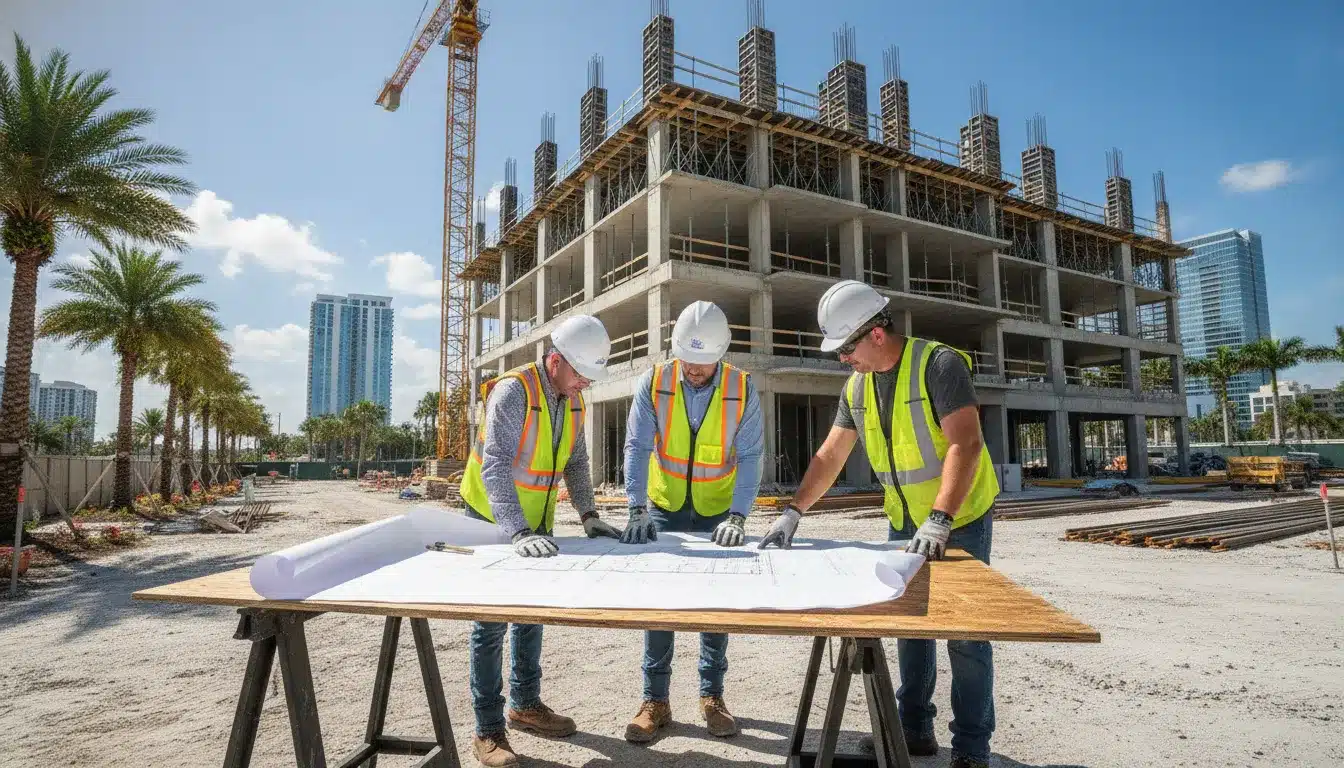
Commercial permit costs in Florida are not set by a single statewide fee table. A project’s valuation, square footage, trade scope, plan review requirements, impact fees. And the policies of the local authority having jurisdiction can move the total from several thousand dollars for a smaller tenant improvement to $50,000 or more for a large commercial build-out. Florida law requires local governments and enforcement districts to enforce the Florida Building Code, but it allows each local government to establish its own fee schedule: Florida Statute 553.80.
Request a proposal to include permit cost planning in your project budget before submission.
The commercial building permit cost Florida developers should budget includes more than the base permit. Plan review, impact fees, statutory surcharges, trade permits, and final-occupancy charges may all apply. Estimate costs from the project valuation and the specific municipality before finalizing the construction budget.
Understanding how the AHJ converts project scope into a fee is the first step toward a defensible allowance. The calculation may use valuation, square footage, a percentage, or a combination of local charges, as the following breakdown explains.
Commercial Building Permit Cost Florida: How Are Commercial Building Permit Fees Calculated in Florida?
Florida does not use one statewide commercial building permit fee table. Local governments establish their own fee schedules under Florida Statute 553.80. Most jurisdictions calculate the base permit charge from total construction valuation, including labor and materials, using one of three methods: per-square-foot rates, tiered square-footage fees, or valuation-increment formulas.
Under Florida Statute 553.80, the local government establishes the fee schedule used to enforce the Florida Building Code. For a contractor, developer, or project manager, the practical starting point is the jurisdiction’s valuation definition, then the fee formula, plan review charge, and any supplemental assessments.
Valuation-based fees start with the full construction cost
Many AHJs calculate the base permit charge from total construction valuation. That figure generally includes both labor and materials, not merely the contractor’s material invoice. The valuation stated on the application therefore needs to reflect the full scope of work, including the building, installed systems, and other permitted construction. The customer guidance on permit valuation provides the budgeting basis, while the local fee schedule controls the final calculation.
Three fee structures appear across Florida jurisdictions
- Per-square-foot fees. Some municipalities apply a fixed rate to the building area. Bradenton’s current schedule lists commercial new construction at $0.98 per square foot. A 20,000-square-foot project would therefore begin with a base calculation of $19,600 before separate plan review, impact fees, surcharges, or trade permits. Verify the current schedule before relying on a preliminary estimate because local rates can change.
- Tiered square-footage fees. Other jurisdictions group projects into size bands rather than multiplying every square foot by one rate. Osceola County lists commercial permitting fees in tiers, with published amounts beginning around $400 to $560 and increasing by project size. Its schedule also identifies separate plan review, technology, fire, and other charges. See the Osceola fee schedule for the applicable tier for your project’s use and square footage.
- Percentage or valuation increments. A jurisdiction may charge a minimum and then add a stated amount for each increment of declared valuation. The Central Florida Tourism Oversight District schedule uses a $60 minimum plus $5.50 for each $1,000 over $1,000. Miami’s published fee schedule also expresses applicable permit charges by estimated construction cost and fee-per-$1,000 calculations. Review the governing AHJ’s schedule rather than applying another county’s formula to the project.
The result is that a reliable commercial building permit cost Florida estimate is jurisdiction-specific. Confirm the valuation basis and formula with the AHJ before finalizing a construction budget, then add plan review and supplemental fees as separate line items.
Plan Review Fees: A Separate Cost in Your Permit Budget
Plan review is charged separately from the building permit fee. It covers the AHJ’s examination of construction documents for compliance with the Florida Building Code. Many jurisdictions calculate the charge as a percentage of the building permit fee. Osceola County, for example, charges 50% of the building permit fee for plan review.
For a commercial project, that review cost belongs in the initial permit budget, not as an unexpected invoice after the application is submitted. Plan review fees cover AHJ staff time spent reviewing plans for compliance with the Florida Building Code.
How the plan review charge is calculated
Each local government or enforcement district sets its own fee schedule, so there is no single statewide plan review rate. Some jurisdictions calculate the charge as a percentage of the building permit fee. Osceola County, for example, calculates its building plan review fee at 50% of the Building Permit Fee. That means a $12,000 building permit fee would produce a separate $6,000 plan review charge, before other applicable fees and surcharges. Confirm the current calculation directly in the Osceola County commercial building permit fee schedule before finalizing a project budget.
Minimums and district-specific schedules
Other AHJs use a flat minimum or a hybrid formula. The Central Florida Tourism Oversight District lists a $20 minimum plan review fee. While its broader permit schedule separates building permits from trade, fire, temporary certificate of occupancy, and other review-related charges. Large or technically involved projects may still incur percentage-based, discipline-specific, or supplemental review charges under the applicable schedule.
Before submitting plans, identify the reviewing authority, request its current fee schedule, and confirm whether architectural, structural, MEP, fire, or resubmittal reviews are billed separately. This approach produces a more defensible estimate of your commercial building permit cost Florida projects require and reduces budget variance when the AHJ issues comments or requests revised documents. For a deeper look at the review process and how inspection management services keep projects on schedule, review the applicable procedural guide.
What Impact Fees and Surcharges Should Developers Expect?
Base permit and plan review charges are only part of the commercial permitting budget. Impact fees, fire-related assessments, technology charges, archival fees. And a state-mandated 1.5% building code surcharge can push total permitting costs 10% to 20% or more above the headline building permit fee.
For many projects, these add-ons can push total permitting costs 10% to 20% or more above the headline building permit fee. Depending on the AHJ, project type, valuation, and local infrastructure schedule.
Impact fees fund growth-related infrastructure
Impact fees are local charges assessed to help fund infrastructure required to serve new development, including roads, schools, and parks. They are not interchangeable with the building permit fee or plan review fee. The Florida Building Commission identifies impact fees as development-related infrastructure charges, while the specific amount and collection method come from the applicable local government or district.
Osceola County, for example, publishes separate fire impact and mobility fee rates for commercial development. Its schedule shows a fire impact fee calculated at 2.5% of the permit fee or $4. Whichever is greater, along with mobility charges that vary by the applicable rate and project circumstances. Developers should confirm the current rate, square-footage category, use classification, and payment timing directly with the county before finalizing a pro forma. See the Osceola County commercial fee schedule for the current methodology.
Percentage-based surcharges compound the fee
Some supplemental charges are calculated as a percentage of the building permit fee. Florida imposes a 1.5% surcharge for the Building Code Administration and Inspection Trust Fund. The Florida Building Commission guidance states that local governments collect this surcharge from the permit fee.
Local technology and archival charges may apply as well. Osceola’s published schedule lists a technology fee calculated at 3% of the building permit fee and an archival fee calculated at 3% of the building permit fee. Other jurisdictions use different labels, percentages, minimums, or flat amounts, so do not assume that one county’s schedule applies elsewhere. Verify whether technology, records retention, fire review, radon, mobility, and impact fees are included in the initial estimate or billed at separate milestones.
Build the full fee stack into the pro forma
For budgeting purposes, model each charge separately: base permit, plan review, impact and mobility fees, fire review or impact fees, technology, archival, and the state surcharge. Request a written fee worksheet from the AHJ when the project valuation and use classification are established. That approach exposes jurisdiction-specific costs early and prevents the permit line item from understating the cash required for issuance. Learn more about managing construction project permitting costs as part of a coordinated permit strategy.
How Do Certificate of Occupancy Fees Affect Your Permit Budget?
Supplemental fees for certificates of occupancy, demolition, trade permits, reinspection, and temporary occupancy can add hundreds to thousands of dollars beyond the base building permit. The City of Bradenton charges $100 for a Certificate of Occupancy and $250 for demolition.
The permit application is only one line in the total commercial building permit cost Florida developers need to budget. Supplemental charges can arise at demolition, trade permitting, temporary occupancy, final issuance, reinspection, or other project-specific milestones. Treat these as separate cost items in the project budget rather than assuming they are included in the base building permit.
For example, the City of Bradenton fee schedule lists a $100 fee for a Certificate of Occupancy or Certificate of Completion. The same schedule lists demolition at $250. A commercial redevelopment project that requires both site clearance and final occupancy therefore needs to carry both charges, in addition to the building permit and plan review fees.
Temporary certificates and phased occupancy
A temporary Certificate of Occupancy can create another fee and another coordination requirement. The Central Florida Tourism Oversight District fee schedule separately identifies temporary Certificates of Occupancy for limited use and permanent Certificates of Occupancy. It also lists dedicated categories for structure demolition, reinspection, expired permits, after-hours inspections, and other administrative services. The applicable amount depends on the authority having jurisdiction and the circumstances of the request, so confirm the current schedule before committing to a phased opening date.
Trade permits for MEP scopes
Mechanical, electrical, plumbing, fire alarm, fire suppression, and gas work may require trade permits in addition to the building permit. The CFTO schedule groups these scopes under a separate trade-permit category. For procurement and underwriting, request a written fee estimate that separates the base permit, trade permits, demolition, temporary or permanent occupancy, and administrative fees. This prevents a seemingly complete permit budget from omitting the final approvals needed to place the space in service.
Sample Commercial Permit Cost Scenarios by Project Type
Small tenant improvements typically range from $3,000 to $8,000 in total permit costs. Mid-size retail or restaurant build-outs range from $10,000 to $25,000. Large commercial new construction projects can exceed $50,000. These ranges include base permit, plan review, impact fees, and certificate of occupancy charges.
Use these planning scenarios to establish an initial allowance before the design is submitted to the authority having jurisdiction. They are budgeting ranges, not fee quotes. Florida local governments establish their own Florida Building Code fee schedules, and the calculation method can vary by municipality, valuation, square footage, project scope, and trade permits. Osceola County, for example, calculates plan review at 50% of the building permit fee and applies separate technology and impact-fee charges under its published schedule: Osceola County building permit fees.
| Project type | Base permit fee | Plan review | Impact fees | CO fee | Total estimated range |
|---|---|---|---|---|---|
| Small tenant improvement or office fit-out | $1,500-$4,000 | $750-$2,000 | $0-$1,000 | $100-$300 | $3,000-$8,000 |
| Mid-size retail or restaurant build-out | $5,000-$12,000 | $2,500-$6,000 | $1,500-$5,000 | $200-$500 | $10,000-$25,000 |
| Large commercial new construction | $15,000-$28,000 | $7,500-$14,000 | $5,000-$12,000 | $500-$1,500 | $30,000-$50,000+ |
Planning note: The ranges above are illustrative allowances for early budgeting. Actual costs vary by municipality and may also include fire review, technology fees, state surcharges, demolition, utility, MEP trade, temporary certificate, or other project-specific charges. Confirm the current fee schedule and impact-fee requirements with the AHJ before finalizing your construction budget. For help managing construction project permitting costs, align the fee review with your permit strategy before submission.
How to Budget for Commercial Permit Costs in Florida
A reliable commercial permit budget starts before permit documents reach the AHJ. Establish the construction valuation early, confirm impact fees and surcharges with the local AHJ during pre-application. And carry separate allowances for application, plan review, final issuance, impact fees, and supplemental approvals.
Florida does not use one statewide fee schedule. Local governments establish their enforcement fee schedules under Florida Statute 553.80, so the same project can produce different costs in different jurisdictions. Build the estimate in stages and confirm local requirements during pre-application.
Establish the construction valuation early
Ask the design and estimating teams for a defensible total construction valuation before submitting the application. In many Florida jurisdictions, permit fees are based on the full project cost. Including labor and materials, rather than the contractor’s fee or the cost of a single trade. The application valuation should therefore reflect the actual scope, including building work and applicable MEP packages. The customer guidance on commercial permit valuation provides the governing budgeting principle.
Do not treat an early low estimate as a cost-control strategy. If the AHJ determines that the declared valuation does not represent the project, the fee basis may be adjusted. Maintain a written scope, estimate assumptions, and supporting documents so the permit application can be reconciled with the construction budget.
Confirm impact fees and surcharges with the local AHJ
During pre-application, request a written list of every charge that may sit outside the base building permit fee. Impact fees can fund infrastructure required by new development, including roads, schools, and parks. Depending on the jurisdiction and project, separate fire or mobility charges may also apply. Ask specifically whether the project triggers technology fees, trade permit charges, plan review fees, or other administrative surcharges.
Also account for the 1.5% surcharge collected for the Building Code Administration and Inspection Trust Fund. Confirm whether the local fee schedule applies that surcharge to the base permit fee or calculates it through a different billing line. Separating base fees, plan review, impact fees, and surcharges gives the owner a usable cash-flow forecast instead of a single uncertain allowance.
Use an expediter to control fee and schedule exposure
A permit expediter can map the AHJ’s fee structure, validate the application valuation, identify required submittals, and track corrections through issuance. That work matters financially because incomplete applications and preventable review cycles can create redesign, resubmittal, consultant, and carrying-cost exposure even when the statutory fee itself is fixed.
For a broader framework on managing construction project permitting costs, evaluate an expediter’s jurisdictional coverage, fee-audit process, and communication cadence. Teams planning larger developments can also review budgeting for commercial building permit costs when coordinating multiple permit packages.
Carry separate allowances for application, plan review, final issuance, impact fees, and supplemental trade or occupancy approvals. Then update the estimate when the AHJ confirms its schedule and project-specific charges. For a review of how permit consultation services can help structure your project budget, contact the All Florida Permits team.
Request a proposal to review your project’s commercial building permit cost Florida estimate and identify potential savings through proactive permit management.
Frequently Asked Questions
How are commercial building permit fees calculated in Florida?
Most jurisdictions start with the project’s declared construction valuation, including labor and materials, then apply a locally adopted fee schedule. Florida does not impose one statewide price because local governments establish the fee schedule for enforcing the Florida Building Code under Florida Statute 553.80. Confirm whether the AHJ uses valuation, square footage, a tiered schedule, or a combination before finalizing your construction budget.
What are impact fees in Florida construction?
Impact fees are local charges assessed on qualifying new development to help fund infrastructure required by that growth, such as roads, schools, and parks. They are separate from the building permit and plan review fees, and the amount can vary by jurisdiction, project type, service area, and development characteristics. Review the applicable county or municipal schedule early, because impact fees can materially change project feasibility and should not be treated as a minor permit add-on. The Florida Building Commission provides related state building-code guidance.
Are there additional surcharges on Florida commercial building permits?
Yes. A state building-code surcharge may be collected in addition to the base permit fee. Florida building-code guidance identifies a 1.5 percent surcharge for the Building Code Administration and Inspection Trust Fund. Although the final invoice may also include local technology, fire, mobility, or other jurisdiction-specific charges. Ask the AHJ for a complete fee worksheet rather than estimating only from the base permit line. See the Florida Building Commission guidance for the statutory surcharge reference.
How do permit fees differ for commercial tenant improvements?
Tenant improvement fees depend on the scope and valuation of the work, not simply the leased square footage. Interior build-outs may require separate building, electrical, mechanical, plumbing, fire, or sign permits, each governed by the AHJ’s procedures and fee schedule. Identify every trade scope during preconstruction, confirm whether plan review is billed separately, and obtain the jurisdiction’s current fee schedule before issuing a final project budget.
What is included in a commercial plan review fee?
A plan review fee covers the AHJ’s technical examination of submitted construction documents for compliance with the Florida Building Code. It is distinct from the building permit fee and may be calculated as a percentage of that fee or as a separate minimum, depending on the jurisdiction. Include plan review at the application stage and confirm whether revisions, deferred submittals, or resubmissions create additional charges.
Ready to Request a Proposal?
Commercial permit costs depend on project scope, valuation, jurisdiction, plan review, and supplemental fees. A proposal can help your team define the permitting work required and incorporate those costs into the construction budget before submission. To discuss your project with All Florida Permits, request a proposal for permit expediting and fee planning services tailored to your commercial construction project in Florida.