

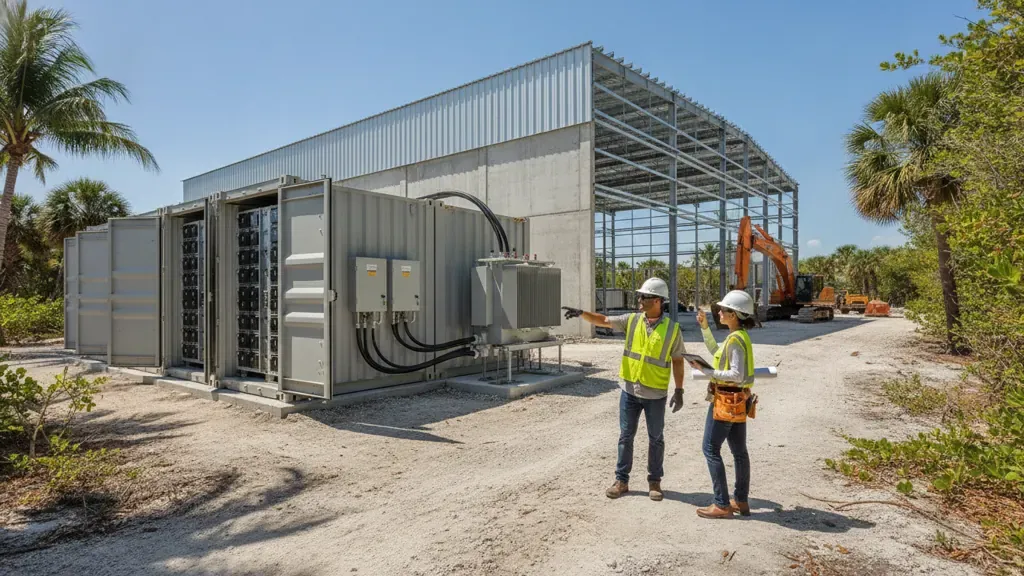
A Florida commercial battery storage permit is usually a coordinated approval effort, not a single electrical filing. Depending on the system and site, the project team may need building, electrical, fire and life-safety, site or zoning, environmental, and utility approvals. The enforcing agency must evaluate the plans against the Florida Building Code and applicable fire-safety requirements before work proceeds, as provided by Florida Statutes Section 553.79.
The approval strategy should be established before equipment is ordered or construction begins. Florida’s statewide rules provide the baseline, but the local authority having jurisdiction (AHJ) controls the submittal path, adopted code edition, required attachments, review sequence, inspections, and closeout documentation for the project.
Request a proposal for commercial battery storage permit coordination.
What approvals are typically in scope?
Battery energy storage systems (ESS) can affect several regulated disciplines at the same time. Treat the following as a scoping checklist, not a universal permit list. The AHJ and the project design professionals should confirm which applications apply to the site, system configuration, occupancy, and operating plan.
| Approval path | What it commonly addresses | Early question for the team |
|---|---|---|
| Building or structural | Equipment pads, foundations, enclosures, equipment rooms, clearances, wind resistance, rated assemblies, and alterations to an existing building. | Is the ESS outdoor, in a dedicated room, or inside an occupied building? |
| Electrical | Service equipment, distribution, disconnects, conductors, protection, controls, grounding, and connections to solar or other generation. | Will the system operate behind the meter, in parallel with the utility, or as standby power? |
| Fire and life safety | Detection, suppression or control measures, emergency access, ventilation, gas detection, signage, separation, and emergency response information. | Which fire official reviews the ESS package, and what local fire submittal is required? |
| Site, zoning, or land use | Equipment location, setbacks, screening, access, drainage, flood considerations, and compatibility with the approved use. | Does placing an exterior enclosure change the approved site plan or require a separate review? |
| Environmental or agency coordination | Potential state, regional, county, or municipal approvals based on site conditions, project scale, and associated infrastructure. | Does the site trigger a water, wetlands, stormwater, transmission, or energy-facility review? |
| Utility or interconnection | Utility-specific studies, operating controls, protection, metering, commissioning, and permission to parallel or export. | What utility package must be submitted before the electrical permit can reach final approval? |
Section 553.79 requires the appropriate enforcing agency to issue a permit only when the plans and specifications comply with the Florida Building Code and the Florida Fire Prevention Code as determined by the local authority. That is why a battery project should be coordinated across disciplines instead of treating the electrical drawings as the entire permit package.
Florida’s regulatory baseline for commercial ESS
Florida Statutes Section 633.202 requires the State Fire Marshal to adopt and maintain the Florida Fire Prevention Code. The statute also provides for adoption of national fire-safety standards and statewide use of the code, subject to the state’s adopted amendments and recognized local concerns. Review the current Florida Fire Prevention Code authority in Section 633.202 when establishing the fire-review path.
Florida also adopted Florida Administrative Code Rule 69A-73.002, titled Energy Storage Systems. The rule page identifies the rule as part of the Division of State Fire Marshal’s Uniform Firesafety Standards for Energy Storage Systems and shows an effective date of August 24, 2025. A project team should confirm the rule text, the adopted Florida Fire Prevention Code, and the AHJ’s current application requirements rather than relying on an older battery checklist.
NFPA 855 is the central technical reference for stationary ESS fire-safety planning. The NFPA 855 standard overview identifies topics including fire detection and suppression, explosion control, exhaust ventilation, gas detection, and thermal runaway. The adopted Florida requirements and the AHJ’s interpretation determine which provisions must be demonstrated in the project documents.
The Florida Building Code also changes over time. The Florida Building Commission’s official code-resources page lists resources for the 8th Edition (2023), supplements, and the 9th Edition (2026). Confirm the edition and supplements in effect for the permit application, along with any applicable local amendments, before finalizing the code summary.
What should the permit plan package include?
A complete submittal lets each reviewer understand the system, its hazards, its interfaces with the building, and the way it will be operated and maintained. The design team should adapt this list to the AHJ’s application checklist.
- Project and code summary: Identify the property, occupancy, system purpose, battery chemistry, rated capacity, voltage, maximum fault current where applicable, enclosure or room location, and applicable code editions.
- Site and civil plans: Show property lines, equipment pads, access routes, fire department access, clearances, drainage, adjacent structures, security features, and the relationship to existing or proposed utilities.
- Architectural and structural sheets: Document foundations, anchorage, supports, equipment-room construction, rated assemblies, doors, penetrations, weather protection, and structural design criteria. Florida wind and flood conditions can affect the design even when the ESS is in an exterior enclosure.
- Electrical plans: Include the one-line diagram, equipment schedules, disconnects, overcurrent protection, grounding and bonding, conductor routing, controls, emergency shutdown, service connection, and interfaces with photovoltaic or standby systems.
- Equipment documentation: Provide the manufacturer’s installation information, listing and labeling information, battery and inverter data, thermal management details, and limits that the AHJ requires for the proposed configuration. Do not substitute a product brochure for the signed construction documents.
- Fire and life-safety package: Address detection, suppression or other approved control measures, ventilation, gas detection where required, separation, access, signage, emergency shutdown, incident response, and firefighter coordination. Organize the package around the applicable Florida rule, adopted code, NFPA standard, and AHJ checklist.
- Utility and controls package: If the system will parallel or export to the utility, coordinate the utility’s interconnection documents, protection settings, metering, and commissioning requirements with the electrical permit set.
- Operations and closeout information: Prepare the operating, maintenance, emergency response, training, testing, and inspection records that the owner, AHJ, and utility may require before the system is placed into service.
The important quality test is consistency. The equipment schedule, one-line diagram, site plan, fire narrative, and emergency procedures should describe the same system in the same location. A mismatch between the battery capacity, enclosure count, clearances, or shutdown method can create a review comment even when each individual sheet appears complete.
How the Florida approval process usually works
1. Confirm jurisdiction and application path
Start with the property address and the legal scope of work. Confirm the building department, fire official, zoning or planning office, utility, and any outside agency that may have review authority. Under Section 553.79, local enforcement agencies must post application types and required attachments on their websites, and completed applications may be submitted electronically through the methods the agency accepts. Use the AHJ’s current checklist as the control document.
2. Hold a pre-submittal coordination review
For a complex commercial ESS, a pre-submittal meeting can expose conflicts before the formal application. Bring the site plan, one-line diagram, preliminary fire narrative, equipment data, and a list of open questions. Ask who owns each review, whether building and fire applications are separate, how utility approval is sequenced, and what the AHJ expects for emergency response or commissioning information.
3. Complete the multidisciplinary plan set
Have the responsible design professionals reconcile the building, electrical, fire, civil, and utility documents. A permit expediter can manage the submission matrix and comments, but the licensed design team remains responsible for technical design and certifications required by the jurisdiction.
4. Submit, track, and respond to comments
Track the application number, reviewer, discipline, fee status, due dates, comments, resubmittal version, and outstanding dependencies. Section 553.79 requires the local enforcing agency to identify the specific noncompliant project features and code sections when a permit is denied, revoked, or a modification is requested because of Florida Building Code noncompliance. Use that documentation to assign each response to the correct professional instead of sending a general narrative back to every reviewer.
5. Schedule inspections and commissioning
Do not wait for final installation to learn the inspection sequence. Confirm which inspections are required for the foundation or supports, electrical rough-in, equipment placement, fire-protection work, emergency shutdown, labeling, and final approval. The actual list and inspection names vary by AHJ and system configuration. The inspection plan should preserve approved plans on site, document tested settings, and record corrections and reinspection results.
6. Close out building, fire, and operational approvals
Before energization or commercial operation, confirm that every permit condition is closed, required testing is documented, utility permissions are complete, and the building and fire officials have accepted the final installation. If the project requires a certificate of occupancy, temporary certificate, certificate of completion, or another operating approval, identify that deliverable at project kickoff. A battery system should not be treated as ready merely because the equipment is installed.
Where local AHJ requirements create variation
Florida provides a statewide regulatory framework, but local execution still matters. Section 633.202 recognizes statewide use of the Florida Fire Prevention Code while addressing amendments and local concerns. Section 553.79 also directs the local enforcement agency to administer permit review and identify the documents and code provisions supporting a review decision. Confirm these items in writing for the actual project:
| Decision point | Why it matters | What to document |
|---|---|---|
| Adopted code edition and supplements | Code references and required design details depend on the edition used by the AHJ. | Code edition, supplements, local amendments, and the date checked. |
| Separate or combined applications | One jurisdiction may coordinate building, electrical, and fire review in one workflow; another may require separate records. | Application numbers, responsible department, and review sequence. |
| Fire submittal content | Fire officials may request a narrative, emergency plan, detection details, response information, or equipment documentation beyond the building checklist. | Fire checklist, required plans, reviewer questions, and acceptance conditions. |
| Site and zoning treatment | An exterior enclosure can affect setbacks, screening, access, drainage, or an approved site plan. | Planning confirmation, site-plan comments, and any separate approvals. |
| Inspection and closeout sequence | Inspections and final approvals must be coordinated with construction and utility commissioning. | Inspection list, required tests, sign-offs, and final operating approval. |
For statewide projects, this local variation is a scheduling issue as much as a compliance issue. Build a jurisdiction matrix before submission so the project manager can see which approvals are prerequisites, which can run concurrently, and which documents must be updated after a design change.
How battery storage interacts with commercial solar projects
Solar PV and battery storage may share a site, but they should not automatically be assumed to share one approval. The battery can introduce separate equipment, fire-safety, shutdown, access, and operating considerations. Use the site’s approved design and the AHJ’s written direction to determine whether the solar and storage work can be filed together or must be tracked as linked applications.
For the solar portion of a project, review the related Florida commercial solar permit requirements guide. For the storage portion, keep the ESS equipment schedule, fire narrative, electrical one-line, and utility documents synchronized. Any change to battery capacity, enclosure count, inverter configuration, or location should trigger a permit-scope review before the change is installed.
When to bring in permit coordination support
Commercial ESS projects benefit from early coordination when the owner is working across multiple jurisdictions, the system is part of a larger solar or industrial build-out, the site has an active construction schedule, or the fire and utility reviews have different submission requirements. A coordinator can maintain the application matrix, submit the correct revisions, track comments, schedule inspections, and identify dependencies. The design professionals and contractors still provide the technical documents, certifications, installation, and testing.
All Florida Permits provides statewide permit management and inspection coordination for commercial construction projects. Learn more about commercial permit management and inspection management services, then confirm the project scope before selecting the appropriate support.
Request a project-specific proposal for Florida ESS permit and inspection coordination.
Frequently asked questions
Is one permit enough for a commercial battery storage system in Florida?
Do not assume it is. The project may involve building, electrical, fire and life-safety, site or zoning, environmental, and utility approvals. The combination depends on the system and location. Section 553.79 requires a permit from the appropriate enforcing agency for covered construction and requires compliance with the Florida Building Code and Florida Fire Prevention Code. Ask the AHJ for a written list of applications and required attachments.
Does Florida Rule 69A-73.002 apply to every battery project?
The rule is titled Energy Storage Systems and establishes uniform firesafety standards for energy storage systems within the Florida fire-safety framework. The AHJ must determine how the current rule, adopted code editions, system technology, occupancy, and project configuration apply to the proposed installation. Review the current rule record and confirm the submittal requirements with the enforcing fire official.
What is the most important document to prepare first?
Start with a coordinated project scope and site plan, then develop the electrical one-line, equipment schedule, and fire-safety narrative together. Reviewers need to see where the system is located, what equipment is installed, how it is connected, and how hazards and emergency response will be managed. The exact documents should follow the AHJ checklist and the design professional’s code analysis.
Can a commercial solar permit automatically cover the battery?
No automatic assumption is safe. Solar and storage may be designed as one project, but the battery can create additional fire, access, shutdown, equipment, and utility-review requirements. Ask the AHJ whether the applications can be combined and keep any linked permits synchronized when the system design changes.
When should inspections be scheduled?
Confirm the inspection sequence during plan review or pre-submittal coordination, before equipment installation. The AHJ may require inspections for supports, electrical work, fire-protection features, equipment placement, testing, emergency shutdown, and final approval. The exact sequence varies, so use the permit conditions and approved plans as the controlling record.
A commercial battery storage approval is easier to manage when the team treats it as a coordinated building, fire, electrical, site, and utility project from the beginning. Confirm the AHJ path, reconcile the plans, track each review, and close out inspections and operating approvals before the system is placed into service.