

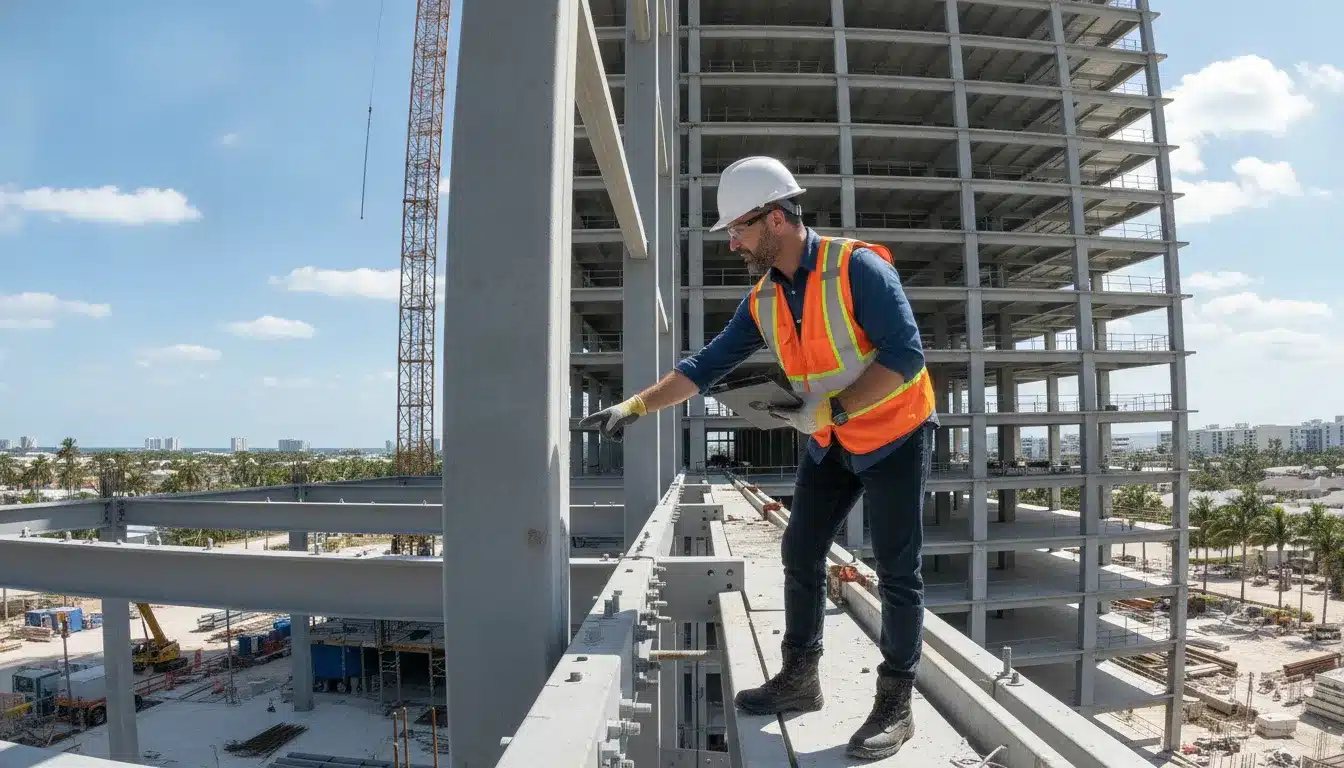
Commercial projects in Florida can lose schedule control when special inspections are identified after structural work is underway. The inspection scope should be mapped during design and plan review, then coordinated with the AHJ, engineer of record, contractor, and qualified inspection agency.
Florida special inspections requirements are driven primarily by Florida Building Code Chapter 17 and the project’s structural systems, materials, and risk profile. They are used to verify that designated work complies with approved construction documents. While threshold inspections apply to qualifying buildings and require documented structural observations by an authorized professional. Early coordination clarifies who inspects, what must be tested, and which reports are needed before concealment or approval.
That distinction matters for commercial teams budgeting inspection services and protecting critical-path activities. The first step is understanding what the code means by a special inspection and how it differs from routine AHJ inspections.
What Are Florida Special Inspections Under the Florida Building Code?
Florida special inspections are independent, third-party evaluations of critical construction work performed by qualified professionals during a project. Under Florida Building Code (FBC) Chapter 17, Sections 1701 through 1704. The inspection process addresses the quality of workmanship, materials, testing, and installation methods that affect structural performance and life-safety compliance. The special inspector reports whether the work matches the approved construction documents and applicable code requirements.
These inspections are distinct from routine municipal inspections. The authority having jurisdiction (AHJ) verifies code compliance through its required inspection program, while the special inspector provides focused technical observation for designated structural or material systems. The scope depends on the project design, the FBC requirements, and whether the building qualifies for threshold inspection oversight. Florida Statute 553.79 recognizes special and threshold inspections as part of verifying that commercial construction is performed in accordance with approved plans: Florida Statute 553.79.
How private providers fit into the process
Florida law also permits an approved private provider to perform alternative plan review and building inspection services under Florida Statute 553.791. That framework covers inspections required by law, not an informal substitute for documented compliance. The provider must coordinate the inspection record, identify deficiencies, and maintain the documentation needed for the AHJ and project team.
Documentation is especially important when private-provider services are used. The statute defines an audit as confirming that the provider performed the required building code inspections and that the minimum mandatory inspections were properly recorded. For developers, contractors, and owners, that record supports schedule control and reduces the risk that incomplete inspection documentation delays approvals, closeout, or the certificate of occupancy.
Which Buildings Require Special Inspections in Florida?
Florida special inspections requirements apply most directly to threshold buildings and to structures containing components that Chapter 17 of the Florida Building Code identifies as critical. The threshold designation is based on the building’s height, story count, or assembly occupancy, not simply on whether the project is large or commercial. Florida Statute 553.71(11) defines a threshold building as one that is more than three stories or more than 50 feet in height. Or an assembly occupancy greater than 5,000 square feet with an occupant load greater than 500 people. See the statutory definition of a threshold building before finalizing the inspection scope.
Threshold buildings require enhanced structural oversight
Projects meeting any one of those criteria require threshold inspections during construction. The threshold inspector provides continuous or periodic observation of the structural work, as established by the approved inspection plan and the requirements of the authority having jurisdiction. This oversight is intended to verify that critical structural elements are installed in accordance with the permitted documents. Rather than relying only on a final inspection after the work is concealed. Florida law recognizes threshold inspections as a mandatory part of oversight for qualifying commercial structures. Section 553.79 addresses the Florida Building Code’s special and threshold inspection requirements for verifying construction against approved plans.
Chapter 17 can require inspections below the threshold-building limit
A project does not have to qualify as a threshold building before special inspections become necessary. FBC Chapter 17 applies when the permitted design includes specified structural or life-safety components that require independent observation, testing, or verification. Depending on the plans and applicable code provisions, this may include high-strength concrete, structural steel, masonry, soils-related work, or sprayed fireproofing. The inspection obligation follows the component and the approved construction documents, so a lower-rise project can still have a substantial special-inspection program.
For that reason, the inspection decision should be made during design coordination and integration with the building plan review, before structural work begins. The plan review should identify threshold status, Chapter 17 triggers, required inspection frequency, responsible inspection agencies, and documentation needed for the AHJ. Treating special inspections as a closeout item creates avoidable schedule and compliance risk when concealed work cannot be readily verified.
Key Special Inspection Categories the Florida Building Code Requires
Florida special inspections requirements are organized around the materials and structural systems that present the greatest risk. Installation, testing, or workmanship that deviates from the approved construction documents can affect structural performance. FBC Chapter 17 addresses special inspections and tests for critical work, including soils, concrete, steel, masonry, and fire-resistant systems. The applicable inspection plan should identify the scope, responsible special inspector, and whether observation is continuous or periodic. See the International Code Council’s Chapter 17 reference for the underlying model-code framework.
| Category | Typical trigger or verification focus | Credential or frequency consideration |
|---|---|---|
| Soils and foundations | Basic soil special inspection verifies site soil conditions, bearing-related work, fill, compaction, and foundation preparation where required by the approved plans. | Use an inspector with an ICC Basic Soils certification or equivalent qualification. Frequency depends on the geotechnical and approved inspection plan. |
| High-strength concrete | Concrete with a specified compressive strength of f’c ≥ 5,000 psi requires focused inspection and testing of placement, materials, and required tests. | Coordinate inspection with concrete testing and placement sequencing. Continuous observation may be required for critical placement operations, while periodic visits may cover defined work phases. |
| Structural steel | Inspection covers steel fabrication and erection activities, including connections, welding, bolting, and other elements identified in the structural inspection plan. | Confirm the inspector’s ICC structural steel or applicable AISC certification. The approved plan determines which operations require continuous observation and which allow periodic inspection. |
| Masonry | Inspection addresses reinforced masonry construction, reinforcement placement, grout, mortar, and workmanship before concealed work prevents verification. | An ICC Structural Masonry Special Inspector certification is a common qualification. Continuous inspection is used where the code or project plan requires observation during placement; periodic inspection applies to specified intervals. |
| Spray-applied fireproofing | Special inspection verifies substrate preparation, material application, thickness, density, and required testing for spray-applied fire-resistive materials. | Inspection timing must match the manufacturer’s requirements and the approved fire-resistance assembly. Document conditions before the material is covered or altered. |
| Post-tensioning | Inspection focuses on tendons, anchors, stressing operations, elongation records, and grouting for post-tensioned structural members. | Use a qualified inspector with PTI certification where required by the inspection plan. Stressing and grouting operations commonly require close, operation-specific observation. |
| Structural wood and trusses | Inspection can include engineered wood connections, diaphragms, shear transfer, and long-span or tall trusses. Trusses over 35 feet long or over 6 feet high warrant particular attention to installation and bracing. | Define hold points before concealment. Continuous inspection is appropriate for critical installation sequences; periodic inspection can verify completed, accessible phases when the approved plan permits it. |
Continuous inspection means the inspector is present while the designated operation is performed. Periodic inspection means visits occur at established intervals or stages. The distinction is not a scheduling preference. It must follow the FBC requirements, approved plans, structural notes, and the statement of special inspections. The project team should resolve the frequency before mobilization so missed hold points do not create rework, delayed approvals, or incomplete closeout records.
Who Is Qualified to Perform Special Inspections in Florida?
Florida special inspections requirements distinguish between a qualified special inspector and a general field inspector. For threshold building work, the primary qualification path is a current, active Florida Professional Engineer (PE) license in good standing. With the engineer’s principal practice focused on structural engineering or structural field inspections. The Florida Board of Professional Engineers must certify the PE as a Special Inspector under Chapter 61G15-35 before the inspector performs this work.
Professional Engineer qualification path
A PE whose principal practice is structural engineering must document at least three years of verifiable experience performing structural inspections. A PE whose principal practice is structural field inspection must document five years of field inspections on threshold buildings. These are different experience tracks, so the applicant’s practice history must align with the qualification route selected in the application.
The inspector must also hold the certification appropriate to the material or system being inspected. Depending on the scope, that may include International Code Council certification for structural masonry, basic soils, or another applicable category. ICC or American Institute of Steel Construction certification for structural steel; and Post-Tensioning Institute certification for post-tensioned components. A PE license alone does not establish competency for every special inspection category.
FBPE lists a $230 application fee for the Special Inspector application. Project teams should verify the inspector’s current license, FBPE certification, documented experience, and material-specific credentials before naming the inspector in the inspection plan.
Architect qualification path
Florida-licensed architects may qualify through the threshold building inspector certification process administered through the Department of Business and Professional Regulation. The application uses DBPR form AR-2 and requires a $100 fee. At least three years of relevant experience on three or more threshold buildings, and three letters of recommendation. The architect must still satisfy the applicable certification and competency requirements for the inspection scope.
For owners, contractors, and design professionals, qualification review should occur before construction begins. Confirming credentials early prevents an AHJ from rejecting inspection reports, protects the project schedule. And gives the threshold inspector a clear basis for documenting compliance with the approved construction documents.
Coordinating Special Inspections With Your Inspection Management Team
Inspection management turns special and threshold inspection requirements into a controlled project workflow. Instead of treating each required inspection as a separate scheduling event, the owner, contractor, design team. And inspection management provider can establish the inspection matrix, assign qualified personnel, coordinate site access, and track documentation from preconstruction through closeout.
Florida Statute 553.791 authorizes properly licensed private providers to perform plan reviews and required building inspections. The statute also limits the local building official from replicating an inspection being performed by the private provider, except as expressly authorized. That framework can reduce duplicated effort when the private provider’s scope, qualifications, schedule, and reporting process are clearly defined. See the guide to Florida special inspections requirements for additional context on the private provider model.
Build the inspection schedule around construction sequencing
A capable inspection management team maps required observations and tests to the actual sequence of work. The team coordinates notice before concrete placement, structural steel activities, masonry installation, or other covered work. Then confirms that the inspector has access to the current approved plans and relevant submittals. This approach helps prevent a trade from reaching a hold point without the required inspector available, a problem that can trigger rework, rescheduling, or delayed downstream activities.
Coordination also gives the project team one place to monitor open inspection items. When field conditions, substitutions, or schedule changes affect the inspection plan. The provider can update the matrix and notify the responsible parties instead of allowing an undocumented gap to remain hidden until final review.
Maintain an auditable record for the AHJ
Documentation is not an administrative afterthought. Florida law defines an audit as confirming that building code inspection services were performed and that the minimum mandatory inspections were performed and properly recorded. A private provider should therefore maintain dated reports, inspection results, identified deficiencies, corrective-action records. And supporting documentation in a format that can be submitted to the authority having jurisdiction.
That audit trail improves cost predictability as well as compliance. Owners and contractors can identify missing inspections while corrective work is still manageable, rather than discovering gaps during closeout when access, labor, and schedule pressure are greatest. For statewide coordination, inspection management services can centralize scheduling, reporting, and follow-up across the project team.
Frequently Asked Questions
What are Florida special inspections requirements for commercial buildings?
They require qualified inspection of designated materials, systems, and construction activities to verify that work follows the approved plans and applicable code. The Florida Building Code addresses special inspections alongside threshold inspections for commercial construction, with the governing statutory framework reflected in Florida Statute 553.79.
Who is authorized to perform special inspections in Florida?
Inspections must be performed by qualified professionals who meet the applicable licensing, experience, and certification requirements for the inspection category. Depending on the work, that may include a Florida-licensed professional engineer and inspectors holding relevant material-specific credentials, such as certifications for structural steel, masonry, soils, or post-tensioning.
When are threshold inspections required under the Florida Building Code?
Threshold inspections apply to qualifying threshold buildings and focus on structural work requiring heightened oversight. Under Florida Statute 553.71, the definition includes buildings more than three stories or more than 50 feet high, plus certain assembly occupancies exceeding 5,000 square feet and 500 occupants.
What is the difference between special inspections and threshold inspections?
Special inspections address specific materials, components, or processes identified by the code and approved project documents. Threshold inspections are a broader structural inspection obligation for qualifying buildings, with the threshold inspector monitoring critical structural work and reporting compliance through the project process.
Do private provider inspections replace special inspection requirements?
No. A private provider can perform authorized plan review and building code inspection services, but required special and threshold inspections still must be completed by appropriately qualified professionals. Florida Statute 553.791 also requires the inspection record to document that mandatory code inspections were performed and properly recorded.
Get started with inspection management for your project
Coordinating special and threshold inspections early can help keep documentation aligned with the approved plans and support predictable project scheduling. For a focused review of your inspection requirements and coordination needs, get a proposal for inspection management services from All Florida Permits.