

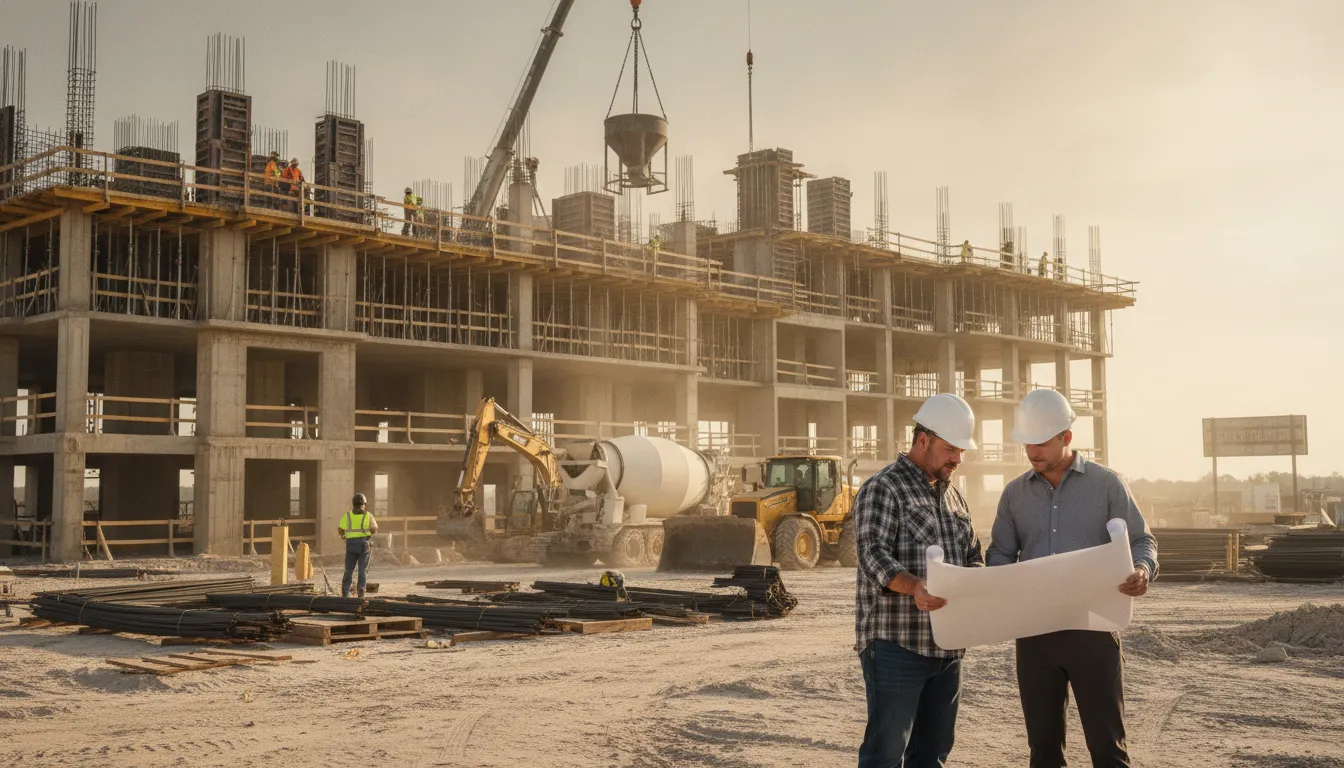
The DeSoto County Florida building permit process for commercial work starts with jurisdiction, scope, and document control. Confirm the project address, identify applicable trades, and assemble current forms, plans, and supporting records before submission. DeSoto County says its Building Department administers and enforces the Florida Building Code and National Electrical Code, so current county instructions should control the submittal record.
The DeSoto County Florida building permit process moves from application intake and document completeness through plan review, correction responses, fee payment, inspections, and final approval. DeSoto County provides an online application and permitting entry point, but the AHJ makes official review and issuance decisions. A permit coordination team can organize the package, track comments, coordinate inspections, and preserve closeout records.
Request a project-specific permit proposal
The details are local at every handoff. The sections below explain what commercial teams should verify before submission and how to maintain control through closeout.
What Does the DeSoto County Florida Building Permit Process Start With?
The process starts by identifying the correct authority having jurisdiction (AHJ), confirming the project scope, and assembling a complete application package. DeSoto County maintains an online application and permitting entry point through its Building Department page. It also provides separate pages for the permit application process, permit applications and forms, and permit application checklists.
Use the project address to confirm which authority controls the work. A parcel in unincorporated DeSoto County may follow the county process, while work inside an incorporated municipality may involve a different local intake route. Do not assume a county checklist controls every municipality or project type. The AHJ reviews the submittal and makes the official decision. An expediter can coordinate the record but cannot replace that review.
Confirm the intake route and forms
Start with the county’s Building Department resources and its permit application process page. Then review current permit applications and forms and permit application checklists for the applicable work. Create the project record with the legal site address and consistent owner, contractor, and design-professional information.
For commercial work, treat intake as a completeness gate. Match the application to the drawings, identify the scope clearly, and confirm each required signature and contractor assignment. Keep submitted forms, portal confirmation, drawings, and correspondence together. This record gives the team a reliable basis for responding to comments and tracking the permit.
Resolve licensing issues early
DeSoto County states that an expired license on record can place holds on an account, preventing new permit applications from being submitted and inspections from being scheduled. State-certified contractors should provide updated DBPR license copies according to the county’s current notice. Confirm contractor status before submission and correct any hold before the inspection phase.
What Plans and Supporting Documents Should Commercial Applicants Prepare?
Commercial applicants should assemble a coordinated package before submitting to DeSoto County. A checklist is a control tool, not a substitute for reviewing the project scope. Check current forms for the specific building, trade, alteration, addition, or tenant-space work proposed.
Coordinate construction documents and the application so the owner, contractor, address, project description, and scope match across the set. Where a project includes multiple trades or contractors, identify each responsible party using required county forms. Keep architectural, structural, mechanical, electrical, plumbing, energy, accessibility, site, and life-safety information consistent. The exact combination depends on the project and current county requirements.
For broader document-control guidance, review the building permit submittal requirements resource. It helps separate design documents, owner authorizations, contractor records, and jurisdiction-specific forms before intake.
When private-provider documents apply
Private-provider paperwork is conditional, not universal. If the contractor or property owner elects to use a private provider for plan review or inspections. DeSoto County identifies a Notice to Building Official for the applicable permit application. A Fee Owner Authorization Form is used when the owner authorizes a contractor to retain the provider.
The county’s private-provider plan review and inspection guidance describes one-time registration before the provider commences work. Listed materials include applicable professional licenses, resumes, professional liability insurance, workers compensation documentation or exemption, and government-issued identification. DeSoto County says registration documents should be submitted to the Building Department by email rather than included with the permit application packet.
For private-provider plan review, the county identifies a Plan Compliance Affidavit completed by the provider’s plans examiner with signed and sealed construction documents when required. Confirm applicability before selecting this route. Maintain a separate private-provider file so registration records are not confused with the application packet.
How Do Plan Review and Resubmittals Work in DeSoto County?
Plan review is the technical checkpoint between intake and permit issuance. DeSoto County’s Building Department administers and enforces the Florida Building Code and National Electrical Code. The state statutory framework is set out in Florida Statutes Section 553.79. The team must still satisfy county forms, submission rules, and review comments.
For commercial work, treat the package as one technical deliverable rather than unrelated files. Check that plan sheets, specifications, calculations, application, and supporting documents describe the same scope. Missing or contradictory information can create a correction cycle even when the design is technically sound.
Build a comment log
When comments arrive, route each item to the responsible architect, engineer, contractor, owner, or consultant. Record the comment, affected sheet, responsible party, proposed response, and status. A correction log prevents the team from answering one issue while overlooking a related conflict elsewhere in the set.
Responses should pair each comment with a specific correction and location in the revised package. Update related drawings and specifications together. Identify revisions as required by the county, and include a response letter when appropriate. Do not assume one revised sheet resolves a conflict that appears on multiple sheets.
Control the resubmittal
Before resubmitting, compare the revised package against the complete comment set. Verify that no file, signature, fee, or supporting document was omitted. Keep a dated record of the resubmittal and exact files returned. If the county requests additional information, route it to the responsible professional instead of making an unsupported substitution.
For additional context, review the Florida building plan review process. These controls do not guarantee approval or establish a DeSoto County review timeline. They provide a defensible method for addressing comments and keeping the permit record organized.
What Fees Should You Budget in the DeSoto County Permit Process?
DeSoto County’s Building Department fee schedule is the controlling reference for county charges. The schedule used here is marked effective July 1, 2026. Fees vary by permit type, scope, square footage, trade work, plan review, and reinspection activity. The figures below are planning references, not a project quote. Confirm the current schedule and county calculation before payment.
| Commercial permit item | Published 2026 amount | Planning note |
|---|---|---|
| Minimum building permit | $55 | Minimum listed in the building fee section. |
| Commercial new construction or addition | $105 + $0.96 per square foot | Building permit category listed by the county. |
| Commercial alteration | $55 + $0.96 per square foot | Separate from new construction and additions. |
| Roofed-structure plan review | 50% of building permit fee | Listed plan review charge. |
| Unroofed-structure plan review | 25% of building permit fee | Confirm county classification. |
| Nonresidential plumbing | $55 + $10 per fixture | Trade permit charge. |
| Commercial gas installation | $105 | Listed in the gas permit section. |
| Nonresidential electrical alteration or addition | $105 | Listed in the electrical section. |
| New nonresidential structure or tenant space electrical | $155 | New-structure category. |
| Commercial AC for new construction | $105 per unit | Listed in the mechanical section. |
| Commercial mechanical alteration, change-out, or ductwork | $155 | Confirm applicable scope. |
| Reinspection | $55 first, $105 second, $205 third | Escalating charges by occurrence. |
The same schedule lists blueprint restamping at $30 when the contractor provides plans. It lists revisions at one quarter of the original plan review fee or $40 per hour. Keep county fees separate from design revisions, surveys, testing, utility charges, and proposal-based permit coordination services.
Review the DeSoto County Building Department fee schedule before final budgeting because fee schedules and effective dates can change.
How Are Commercial Inspections Scheduled and Documented?
Inspection coordination in DeSoto County is a documentation exercise as much as a field-scheduling task. The permit record, inspection request, private-provider paperwork, and inspection results should tell the same story. Before setting a date, confirm which inspection authority applies and whether the responsible contractor, owner, or provider has satisfied applicable conditions.
- Confirm the inspection path and license status. Determine whether inspections will be performed by the county or a properly registered private provider. DeSoto County requires one-time registration before a private provider begins work. The county lists applicable professional or inspector licenses, insurance, workers compensation documentation or exemption, and government-issued identification among the registration materials.
- Submit applicable private-provider notices. When private plan review or inspections are used, submit the Notice to Building Official identified by the county. Include the Fee Owner Authorization Form when the owner authorizes the contractor to retain the provider. These forms are not universal requirements for projects that do not use a private provider.
- Document plan compliance when required. For private-provider plan review, the plans examiner completes the Plan Compliance Affidavit with signed and sealed construction documents when required. Keep the affidavit, approved documents, registration records, and provider correspondence with the permit file.
- Give the county its courtesy notice and retain the result. DeSoto County requests courtesy 24-hour advance notice of intent to inspect. The notice should be emailed to the Building Department. This is not a guarantee of an inspection slot or proof of a pass. Preserve the notice, date, assignment, field result, and correction response.
Florida Statutes Section 553.791 provides the state framework relevant to private-provider building-code services. Read the county’s current private-provider guidance with the statute before relying on that option. For broader field-readiness support, use the inspection management resource.
What Should the Closeout Plan Include Before Occupancy?
Commercial closeout should be managed as a controlled phase, not an afterthought once the last trade leaves. Confirm that required work is complete, schedule inspections, resolve deficiencies, and assemble documentation for the permit record before treating the space as ready for occupancy.
The AHJ retains authority over review, inspection disposition, and final approval. A coordination team can organize submissions, monitor comments, and keep contractors aligned. It cannot substitute its approval for the county’s decision. The final occupancy path can depend on project type, scope, and other approvals, so verify requirements with the responsible authority.
Track the record, not only the field schedule
Use a permit-by-permit status review. Confirm each required inspection has been requested, completed, and assigned a disposition. When an inspection identifies a deficiency, record the responsible trade, corrective action, evidence needed for reinspection, and status. This creates one correction log instead of disconnected emails and field notes.
Closeout controls should include license-related holds, outstanding fees, unresolved corrections, approved revisions, and documents still required by the permit record. Keep approval notices, inspection results, correction responses, revised drawings, affidavits, and certifications together. The county’s Building Department mission emphasizes code compliance and safe use of buildings and structures.
Before occupancy, obtain confirmation of final approval from the AHJ and preserve it with project records. A permit coordination team can maintain the deficiency log, check portal notifications, coordinate reinspections, and escalate missing documentation. See the Florida certificate of occupancy resource for broader closeout context.
Frequently Asked Questions
Where should a commercial applicant start in DeSoto County?
Start with the DeSoto County Building Department’s online application and permitting resources. Confirm the authority for the project address, then review current forms and the checklist for the specific scope.
Does every commercial project need private-provider forms?
No. The private-provider documents described by DeSoto County apply when the owner or contractor elects to use a private provider for plan review or inspections. Confirm applicability and registration requirements first.
How long does the DeSoto County permit process take?
The public pages reviewed for this guide do not establish one universal commercial review time. Timing depends on scope, completeness, correction cycles, fees, and reviewing authorities. Avoid promising a date until the county confirms current status.
What fees should a commercial applicant verify?
Verify the building permit charge, plan review fee, trade permits, square-footage or unit calculations, revisions, and reinspection charges. The 2026 schedule is effective July 1, 2026, but the current schedule and project calculation should control.
What confirms commercial permit closeout?
Confirm required inspections and corrections are complete, final documents have been accepted, and the permit record reflects final approval. If a certificate of occupancy or other approval is required, verify issuance before turnover.
Get DeSoto County Permit Coordination Support
Commercial permitting requires control across intake, plans review, corrections, inspections, and final documentation. All Florida Permits can organize the submission record, track jurisdiction comments, coordinate inspection activity, and keep responsible contractors and design professionals aligned. The DeSoto County authority retains official review and approval decisions.
Request a project-specific DeSoto County permit coordination proposal