

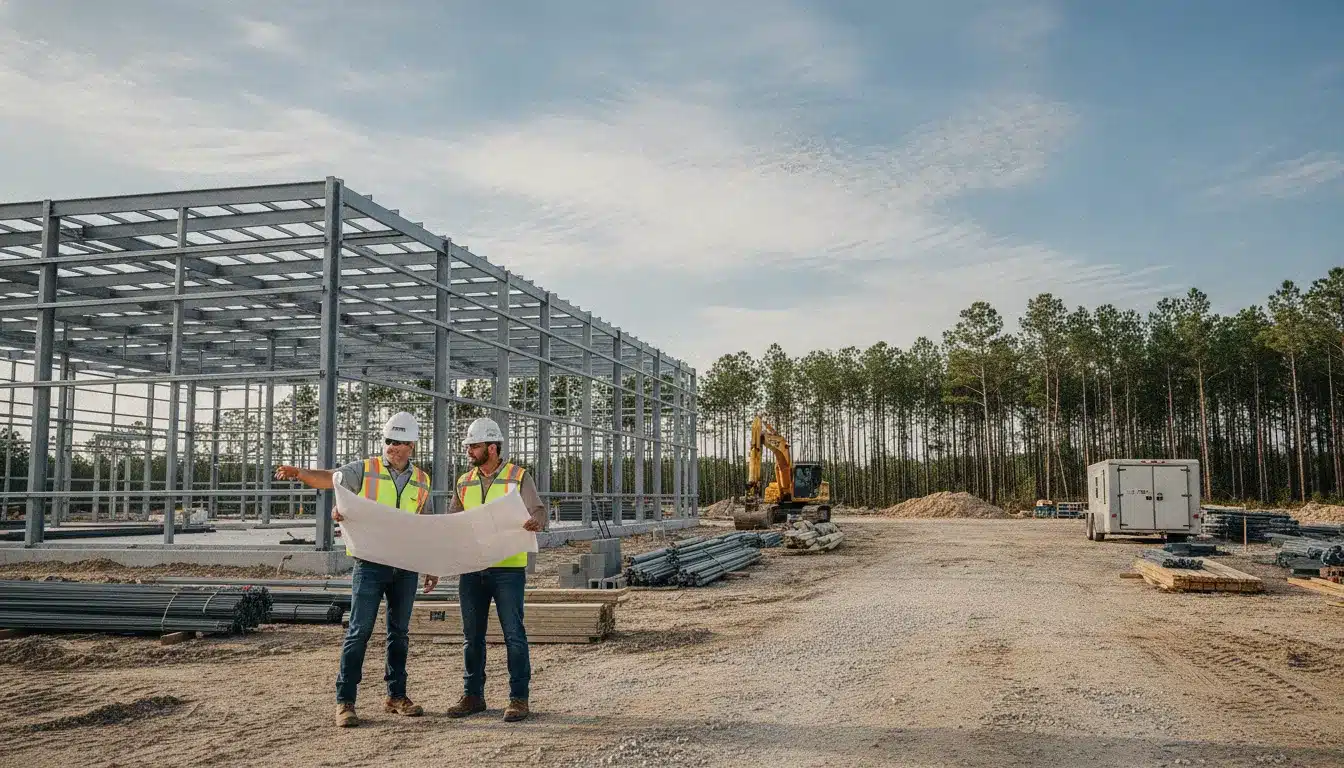
For a commercial project in Dixie County, permit schedule control starts with jurisdiction and documentation, not with mobilization. The project team must identify the enforcing authority, confirm whether the site is in unincorporated county territory or municipal limits, and assemble a complete package before requesting review.
Request a Dixie County project proposal
The Dixie County Florida building permit process is controlled by the applicable local building authority and depends on a complete, project-specific submittal. The county worksheet identifies core project, owner, contractor, design professional, scope, and cost information. The county portal lists supporting uploads such as site plans, surveys, address verification, utility or septic documentation, and plans. City approval paperwork may also apply inside municipal limits. Sources: Dixie County Building-Code-Zoning, county application worksheet, and county permit portal.
That source hierarchy matters for contractors, developers, and project managers because county requirements should be verified against the current authority before submission. The first step is determining which authority governs the site and what approvals must be coordinated.
What authority controls permitting in Dixie County?
For work in unincorporated Dixie County, start with the county’s Building-Code-Zoning department. That office is the local point of coordination for building, code enforcement, planning, and zoning functions, and its official page links to the county Code of Ordinances. The department lists its office at 387 SE 22 Ave, Cross City, Florida 32628. Posted weekday hours are 8:00 a.m. to noon and 1:00 p.m. to 5:00 p.m. Confirm current contacts and operating details directly with the county before submitting a commercial package. Dixie County Building-Code-Zoning
Jurisdiction is the first project-control decision. If the parcel is inside a city limit, the county worksheet says city approval paperwork is required. Do not assume that a county submittal alone resolves municipal requirements. Verify the parcel’s governing jurisdiction, identify the applicable city review or approval, and coordinate that documentation with the county package before mobilization. Dixie County’s permit worksheet
What the county authority screens
The worksheet requires project information such as the job-site address, parcel information, zoning, owner and contractor details, design-professional information, work description, square footage, and job cost. Those fields are not administrative filler. They establish the project identity, scope, responsible parties, and jurisdictional context the reviewing authority needs to evaluate the application. The county also identifies supporting items such as a signed survey, scaled site plan, and city approval paperwork when applicable. Review the county application worksheet
Screen the site for constraints before finalizing the construction schedule. Use the county’s zoning and ordinance resources to identify local land-use requirements, and check FEMA’s floodplain resources when the property may be in a Special Flood Hazard Area. FEMA states that a floodplain-development permit is required before construction or development in an applicable Special Flood Hazard Area. FEMA Flood Map Service Center The county sources reviewed do not establish a universal Dixie County concurrency approval, fee amount, or review timeline. Treat those items as project-specific questions for the applicable authority rather than assumptions in a bid or schedule.
For commercial teams, the practical sequence is clear: confirm jurisdiction, validate zoning and floodplain conditions, identify any municipal coordination, then assemble a complete county package. This authority check reduces avoidable resubmittals without implying that an expeditor, designer, or contractor can replace the AHJ’s decision.
How should teams start the Dixie County Florida building permit process?
Before assembling drawings or uploading documents, establish which authority will receive the application and define the work covered by the permit. That first pass prevents a commercial project from entering the wrong intake path or treating trade work as part of the building permit when separate permits are required.
- Confirm the jurisdiction. Determine whether the job site is in unincorporated Dixie County or inside a city limit. The county worksheet states that city approval paperwork is required when the property is inside city limits. So municipal coordination belongs on the pre-submittal checklist rather than being discovered after the county package is assembled. The county Building-Code-Zoning department identifies its office at 387 SE 22 Ave, Cross City, Florida 32628, and links to the county code resources. Verify the current receiving authority and any city documentation before submission through the Dixie County Building-Code-Zoning page.
- Classify the proposed work and define the scope. Use the application worksheet to describe the job-site address, parcel information, owner, contractor and license-holder details, architect or engineer, work type, square footage, and job cost. For a commercial project, the scope should be specific enough to distinguish new construction, alteration, addition, or another defined activity, and to identify the building systems affected. The worksheet is a county application source, but it is labeled as a residential application. Treat its fields as a planning reference and confirm the commercial submission path with the AHJ instead of assuming the residential checklist is exhaustive. Review the permit submittal requirements while building the project-specific package.
- Separate the building permit from trade permits. Dixie County’s worksheet states that separate permits must be secured for electrical, plumbing, mechanical, roofing, and gas work. List each applicable trade scope during estimating and permitting so the project schedule accounts for the required applications, plans, inspections, and releases. Do not assume that listing a system in the building scope replaces its separate permit.
- Screen the site and prepare the correct upload set. The county’s iWorQ portal lists application pathways and uploads, including a signed survey. A scaled site plan, a septic permit or sewer-company letter, a signed application, and project plans. It also displays city-approval paperwork when work is within city limits. The portal lists applications and uploads, but that residential-oriented list should not be treated as proof that every commercial project follows the same upload set. Match the final package to the confirmed jurisdiction, project classification, and AHJ direction before uploading at Dixie County’s iWorQ portal.
Use the county worksheet and portal as current-source checkpoints, then resolve any commercial-project differences with the enforcing authority before mobilization. This jurisdiction-and-scope sequence gives the design and construction team a defensible starting package without inventing fees, review times, or requirements not stated by Dixie County.
Which documents belong in a commercial Dixie County permit package?
A commercial submittal should be assembled around the information the county worksheet and iWorQ portal request, then confirmed with the authority having jurisdiction (AHJ) for the specific project. The available county materials include the following categories. Applicability, quantities, and any commercial-project supplements should be verified before submission.
| Package category | County-listed evidence and project purpose |
|---|---|
| Job and property data | Job-site address, parcel identification, zoning information, and project description. Dixie County permit worksheet Purpose: These details identify the site, establish the submitted scope, and support the jurisdiction and application record. |
| Ownership and responsible parties | Warranty deed or proof of ownership, owner information, contractor information, license-holder details, and signed application. Dixie County iWorQ portal; county worksheet Purpose: The package connects the proposed work to the property owner and responsible construction parties. |
| Design professionals and project scope | Architect or engineer details, work type, work description, square footage, and job cost. Dixie County permit worksheet Purpose: Clear scope and project data help the AHJ evaluate what is proposed and route the package for appropriate review. |
| Survey and site layout | Signed survey, 911 address verification, and accurate scaled site plan. The portal identifies site-plan details such as property-line setbacks and canal width where applicable. Dixie County iWorQ portal Purpose: These documents establish site identity, access, placement, and dimensional information for the proposed improvements. |
| Wastewater and utility documentation | Septic permit or a letter from the sewer company. Dixie County iWorQ portal Purpose: The applicable document demonstrates how the property is addressed for wastewater service. Confirm the correct evidence with the AHJ. |
| Construction and structural documents | Engineered plans, including county-listed 130 mph plans, plus truss engineering when applicable. Dixie County permit worksheet; iWorQ portal Purpose: Engineered design information gives the reviewing authority a technical basis for evaluating proposed construction. Confirm commercial design requirements before filing. |
| Energy and product compliance | Energy-code calculations, including worksheet-listed Manual J, Manual S, and Manual D materials, and product-approval paperwork. Dixie County permit worksheet; iWorQ portal Purpose: These materials document energy and approved-product information associated with the submitted design. Confirm applicability to the commercial scope. |
| Jurisdictional approvals | City approval paperwork when the property is inside city limits. Dixie County permit worksheet Purpose: Municipal work may require coordination beyond the county package. Resolve the jurisdiction question before finalizing the submittal. |
| Construction administration and release items | Recorded Notice of Commencement, where required, and driveway approval before final power release. Dixie County permit worksheet; iWorQ portal Purpose: These items affect the project record and later release coordination. Confirm recording, posting, and final-release requirements with the AHJ and applicable utilities. |
Use this table with a broader permit application documents checklist, but do not treat either resource as a substitute for project-specific direction. Dixie County’s worksheet states that incomplete applications will not be processed, so reconcile drawings, ownership records, site documents, approvals, and applicable trade materials before submission.
How does Dixie County review applications and issue permits?
Dixie County’s intake process begins with a completeness screen. The county’s application worksheet states that incomplete applications will not be processed and that paperwork will not be held at the office. For a commercial project, that makes package control a schedule issue: confirm the jurisdiction. Assemble the required drawings and supporting documents, and resolve missing information before submitting to the AHJ. The county worksheet captures core project data such as the job-site address, parcel information, owner and contractor details, design-professional information, scope, square footage, and job cost. Review the official Dixie County worksheet and use the county’s current instructions for the applicable project type.
Completeness screening and correction cycles
A complete intake does not mean automatic approval. County reviewers may identify corrections, clarifications, or code issues that must be addressed before the application can proceed. Florida law provides statewide context. Section 553.79 generally requires a permit before construction, alteration, repair, or demolition, subject to statutory exceptions. Read Florida Statutes Section 553.79.
Section 553.792 also establishes action periods for local governments after receipt of a complete and sufficient application. With the applicable period depending on the permit category and project facts. That statute should not be converted into a guaranteed Dixie County review time. The official Dixie County sources reviewed do not publish a current project-specific turnaround estimate. Teams should ask the AHJ to confirm the expected review path and manage the schedule around possible correction cycles. The Florida building plan review process provides useful context for organizing comments and resubmittals, but it does not replace county direction.
Issuance and permit-before-work controls
Do not authorize construction or installation based on a pending application. The Dixie County worksheet states that work may not commence before permit issuance. It also identifies separate permits for electrical, plumbing, mechanical, roofing, and gas work, so the building permit should not be treated as authorization for every trade scope. Coordinate each permit and correction response against the construction schedule before mobilization.
No current Dixie-specific fee schedule or fee amount was verified in the sources reviewed. Confirm applicable fees, review expectations, and any project-specific submission instructions directly with the AHJ before committing to a start date.
What inspections and closeout items should project teams plan for?
Inspection readiness in a commercial project depends on more than having the building permit issued. Before mobilization, the project team should confirm the recorded Notice of Commencement, identify every required trade permit, and map closeout dependencies that could affect utility release. Dixie County’s application worksheet states that the Notice of Commencement must be recorded and posted before the first inspection. And that separate permits are required for electrical, plumbing, mechanical, roofing, and gas work. These are document-control items, not assumptions to resolve after construction begins.
Confirm inspection prerequisites
Maintain the recorded Notice of Commencement in the project file. Verify that it is posted at the site before requesting the first inspection, as directed by the Dixie County building permit worksheet. Track each trade scope against its permit status. A commercial project may have several parallel scopes, so the superintendent and permit coordinator should reconcile the building permit with electrical. Plumbing, mechanical, roofing, and gas permits before those installations move forward.
Driveway approval is another closeout dependency. The county worksheet states that driveway approval must be submitted before final power release. Put that item on the closeout log early, rather than treating it as a final-day administrative task. A broader schedule-risk management approach can help the team assign ownership, monitor missing approvals, and surface dependencies before they affect turnover.
Screen for project-specific environmental obligations
Floodplain and construction-stormwater requirements require a separate applicability review. FEMA states that a floodplain-development permit is required before construction or development in a Special Flood Hazard Area. Review the property’s mapped conditions and applicable local requirements through the appropriate authorities. This federal guidance is not, by itself, a Dixie County permit determination. Source: FEMA’s floodplain-development permit guidance.
For site work, EPA explains that construction stormwater coverage generally applies when a project disturbs at least one acre. Or is part of a larger common plan that will ultimately disturb at least one acre, subject to the applicable program and exceptions. Screen the full development plan, not just the first construction phase, and confirm the responsible agency and filing requirements. See EPA’s construction stormwater guidance. FEMA and EPA applicability are project-specific and should not be presented as a county approval, fee, inspection sequence, or guaranteed timeline.
Dixie County commercial permit checklist for the field team
Use this field checklist to keep the Dixie County Florida building permit process organized from intake through closeout. The county worksheet is labeled residential, so commercial teams should confirm which requirements apply to their project with the AHJ before submitting.
- Confirm jurisdiction and scope before mobilization. Verify the job-site address, parcel information, zoning, and whether the property is inside municipal limits. The county worksheet calls for city approval paperwork when a project is inside city limits. Confirm with Dixie County Building-Code-Zoning whether additional local or trade review applies to the commercial scope. Do not rely on a county checklist alone for a project-specific determination.
- Assemble the package against current county sources. Prepare the signed application, ownership documentation, signed survey, 911 address verification, accurate scaled site plan. Utility or septic documentation as applicable, project plans, and supporting engineering or product-approval documents identified by the county. Keep the permit application documents indexed by discipline.
- Run a completeness check before delivery. Confirm that job-site, parcel, owner, contractor, design-professional, scope, square-footage, and job-cost fields are populated. Dixie County states that incomplete applications will not be processed and paperwork will not be held at the office. If digital copies are requested, the worksheet says a thumb drive can support processing, but it does not guarantee faster review.
- Track corrections through issuance. Log every AHJ comment, response, revised sheet, and resubmittal. Ask the county to confirm current review routing, applicable fees, and any commercial-specific requirements. Do not publish or promise a review duration that the official sources do not provide.
- Release construction only after permits are issued. The county worksheet states that work or installation may not begin before permit issuance. Secure separate electrical, plumbing, mechanical, roofing, and gas permits when those scopes are included. Confirm the required permit set is posted or available to the field team.
- Control inspections and closeout dependencies. Record and post the Notice of Commencement before the first inspection when legally required. Track inspection prerequisites, approved changes, and final documentation. Confirm driveway approval before requesting final power release, as required by the county worksheet. Obtain the AHJ’s project-specific closeout direction before demobilizing.
Frequently Asked Questions
What information should a commercial applicant assemble before submitting to Dixie County?
Start with the job-site address, parcel information, owner and contractor details, design-professional information, work description, square footage, and job cost. The county’s checklist also identifies supporting items such as ownership documentation, a signed survey. A scaled site plan, 911 address verification, utility or septic documentation when applicable, signed application materials, and project plans. Confirm the current commercial submittal requirements with the county before filing: Dixie County application checklist.
Does a project inside a Dixie County city limit require additional coordination?
It may. The county worksheet states that city approval paperwork is required when the property is inside city limits. Confirm the governing jurisdiction and any municipal documentation before submitting to avoid routing the package to the wrong authority: county worksheet.
Can construction begin before the permit is issued?
No. The county worksheet states that work or installation may not commence before permit issuance. It also identifies separate permits for electrical, plumbing, mechanical, roofing, and gas work. Treat each trade scope as a permit-coordination item and confirm the applicable requirements before mobilization: Dixie County worksheet.
When should the Notice of Commencement be recorded?
The county checklist warns that a Notice of Commencement must be recorded and posted at the job site before the first inspection, subject to the project’s legal requirements. Build that document-control step into the pre-inspection plan and verify the project’s specific obligations with the appropriate authority: county checklist.
Do floodplain or construction stormwater requirements affect the permit plan?
Potentially. FEMA states that a floodplain-development permit is required before construction or development in a Special Flood Hazard Area. EPA construction stormwater coverage generally applies when a site disturbs at least one acre. Or is part of a larger common plan that will ultimately disturb at least one acre. Screen both conditions early and confirm the applicable approvals: FEMA floodplain permit guidance and EPA construction stormwater guidance.
Ready to plan your Dixie County commercial permit process?
A complete jurisdiction and submittal strategy can help your project team coordinate permitting requirements before construction activity begins. Request a project proposal for Dixie County permit coordination and commercial permitting support.