


The Escambia County building permit process for commercial work starts with jurisdiction, zoning, and site checks before a permit package reaches plan review. For projects in county-served areas, the sequence typically runs from development review and submittal through corrections, fee payment, inspections, and a Certificate of Occupancy or Certificate of Completion.
Request a commercial permit proposal
Escambia County commercial permitting at a glance
Commercial permitting in Escambia County is not one universal counter transaction. The responsible authority depends on the parcel. Escambia County Building Services handles plan review, permits, and inspections for new buildings and major improvements in unincorporated county areas and the Town of Century, according to the county’s Building Services page.
Projects inside a municipality can follow a different intake path. The county’s building guide tells applicants to confirm zoning, future land use, floodplain designation, and parcel information before selecting the project path. That check prevents a commercial team from preparing a county package for a site governed by a city building department.
| Stage | Commercial decision | Primary local reference |
|---|---|---|
| 1. Jurisdiction and site due diligence | Confirm the parcel, zoning, future land use, flood exposure, and responsible building authority. | Escambia County Building Guide |
| 2. Development review | Determine whether a pre-application meeting, site plan review, Development Order, or other approval is required. | Escambia County Building Guide |
| 3. Building plan review | Submit complete plans, supporting documents, and the applicable permit and trade information. | Escambia County Plan Review |
| 4. Permit issuance and construction | Resolve comments, pay assessed fees, collect approved plans, and schedule required inspections. | Escambia County Building Guide |
| 5. Closeout | Complete inspections, pay reinspection fees, resolve open items, and obtain the final occupancy document. | Escambia County Building Guide |
How do you confirm the correct Escambia County permitting jurisdiction?
Start by confirming whether the project is in unincorporated Escambia County, the Town of Century, or an incorporated municipality. County Building Services describes its service area as unincorporated areas and the Town of Century. A project inside another municipal boundary may require that city’s building department instead. Verify the county service area before preparing the package.
Use the parcel number as the project identifier throughout the process. The county building guide specifically directs applicants to research zoning, future land use, floodplain designation, and parcel information before applying. Those checks can reveal a required variance, rezoning, architectural review, environmental approval, or outside-agency signoff.
For a project associated with Pensacola, confirm the city boundary before using county instructions. The City’s public applications and documents page maintains a separate set of building, demolition, electrical, mechanical, plumbing, roofing, and fire-protection materials. Treat the municipality as a separate AHJ until the parcel research confirms otherwise.
When does development review come before building plan review?
Escambia County recommends a pre-application meeting for commercial development and subdivisions. The county says this free meeting can identify ordinance requirements, surface potential issues, and help the team discuss solutions before a formal application. Use the county building guide to confirm whether the meeting fits the project.
A commercial site may need more than a building permit. The county identifies possible zoning, variance, architectural, public-hearing, environmental, utility, and other agency approvals. The exact combination depends on the parcel and scope. The project team should map those dependencies before finalizing drawings, as described in the county development-review sequence.
When a site plan application is required, the county’s process begins with a completed application, plans, available outside approvals, and other required documents. Development Review fees are collected at submittal. Staff then reviews the package and either approves it or requests revisions or additional information, according to the official Building Guide.
Once the submission complies with applicable regulations, the county issues a Development Order. The county explains that the approved Development Order allows the project to proceed to plan review with the Building Inspections Division. This makes development review a schedule gate, not an optional administrative step for every commercial site. Confirm the Development Order step for the parcel.
3. Assemble the commercial permit package
A strong submittal begins with a single scope narrative that matches the application, plans, project value, contractor information, and trade work. Inconsistent descriptions create avoidable correction questions and can force the reviewer to reconcile the record before technical review advances. The county’s plan-review guidance identifies document sufficiency as an intake concern.
The county plan review page states that plan review covers residential and commercial construction plans for compliance with adopted building codes. Plans intake staff verify whether documents are included. The page also identifies a construction plans sufficiency checklist and separate fee estimate forms for building, electrical, gas, mechanical, and plumbing work. Use the current county form list when assembling the package.
- Confirm the parcel number, site address, legal project description, and responsible jurisdiction.
- Include the site plan or other site documents required by development review.
- Provide construction drawings and details appropriate to the scope and building disciplines.
- Coordinate architectural, structural, electrical, mechanical, plumbing, fire, and life-safety information where applicable.
- Attach zoning, Development Order, utility, floodplain, environmental, or other outside approvals when required.
- Prepare contractor, owner, design-professional, product-approval, and energy documentation required for the project.
- Identify separate buildings and separate trade permits when the project requires them.
- Prepare the Notice of Commencement path before inspections when the statutory threshold applies.
Escambia County states that a separate building permit is required for each individual building. That rule matters on multi-building commercial sites. The team should create a permit matrix that assigns each building, trade, plan set, fee estimate, and inspection sequence to the correct permit record. Confirm the separate-building requirement before intake.
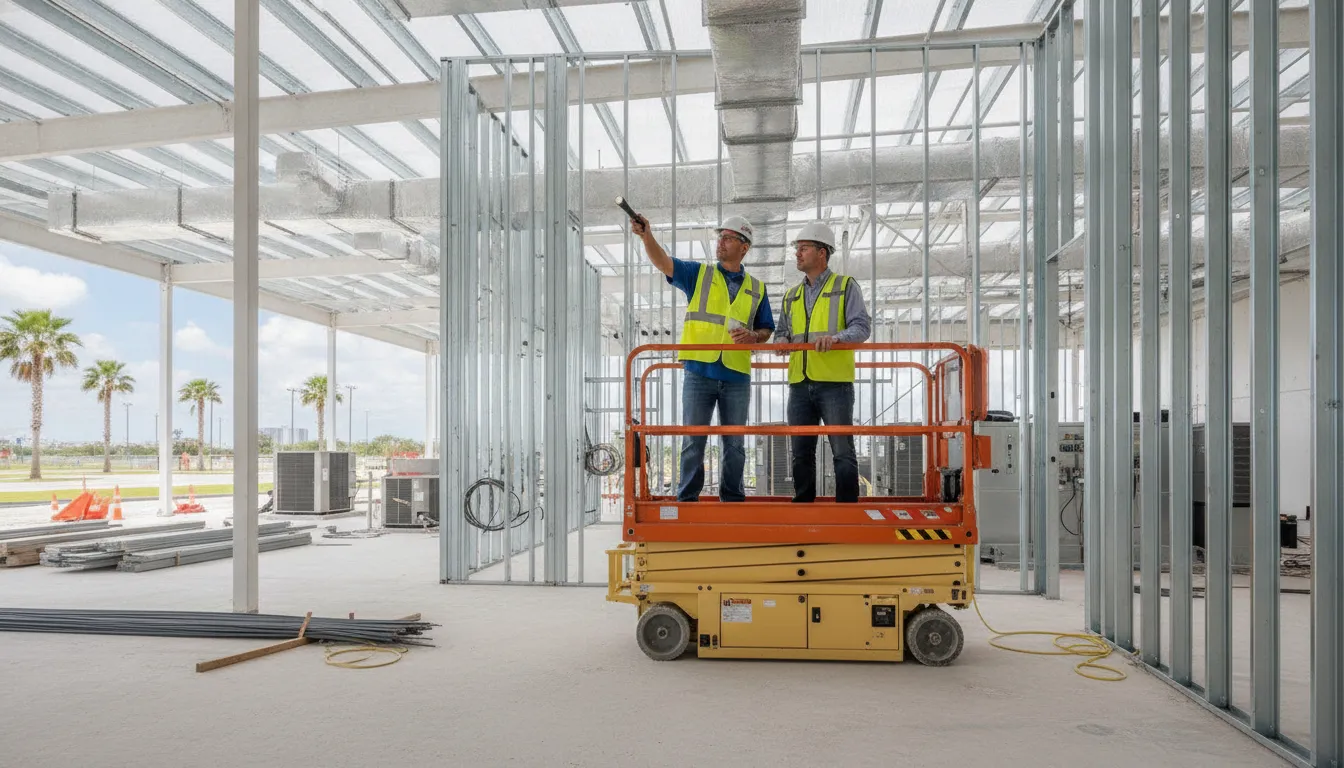
4. Submit through the applicable local intake path
For county-served work, use the county’s current Online Contractor and Citizen Access or MyGovernmentOnline instructions linked from its permitting page. Confirm the active intake method before uploading a large package. County pages also publish forms and plan-review instructions that may require a printed form to be hand-delivered, mailed, or faxed. Start with the county permitting page.
The county plan review page specifically states that email forms are currently unacceptable. That instruction applies to the forms described on that page. It is a practical reason to distinguish between portal uploads, formal application delivery, and informal project correspondence. Check the plan-review delivery instructions immediately before submission.
Before submission, run a document-control check. Confirm that every drawing sheet is present, the revision dates are consistent, the application describes the same work as the plans, and all required signatures and supporting approvals are included. Save the submitted package and confirmation details in the project record.
After intake, monitor the permit record for missing-document notices, fee requests, review comments, and requests for additional information. A complete record helps the project team respond to the first review cycle without recreating the submittal history.
How should commercial teams manage plan review corrections?
Escambia County’s building guide says a plans examiner reviews plans for compliance with the Florida Building Code. The examiner may approve the project or issue comments requiring revisions. The county also cautions that complex projects may require additional review time. Read the county’s review sequence before publishing a project schedule.
The county does not promise one universal commercial review timeline on the building guide. Do not present a guaranteed number of days to the owner without a written commitment from the responsible department. Instead, build the schedule around document completeness, the first review, correction turnaround, re-review, fee payment, and permit issuance. The county plan-review page is the controlling reference for current intake materials.
Use a correction log with one row for each comment. Assign the response to the architect, engineer, contractor, owner, or trade consultant who controls the answer. Tie each response to a revised sheet or supporting document. Then perform a quality-control review before resubmission.
A useful correction response should identify the comment, state the resolution, point to the revised sheet or detail, and explain any related change. Responses that merely say “see plans” make it harder for the reviewer to verify the fix. They can also leave connected disciplines unresolved.
Review cycles can include building, structural, accessibility, energy, electrical, mechanical, plumbing, fire, site, floodplain, and zoning issues. The exact disciplines depend on the project. Keep the correction log broad enough to capture every agency or trade comment, not just the building examiner’s notes.
Related Florida permit resources for commercial teams
Escambia projects often require coordination across trades and inspections. For broader planning, review All Florida Permits’ commercial electrical permit guide, Florida inspection scheduling resource, inspection management service, and commercial permitting consultation service.
Get commercial permit management support
How are Escambia County commercial permit fees handled?
Escambia County publishes fee estimate forms rather than a one-size-fits-all commercial price in the sources reviewed for this guide. The county’s building permit fee estimate form requests the project type, structure type, dimensions, floor area, number of floors, scope, and construction cost. It also states that the final exact cost is determined when the permit application process is complete.
The same county form warns that fees charged by another agency are not included. A commercial budget should therefore separate county building fees, trade permit fees, development review fees, outside-agency charges, utility or impact charges, inspection-related charges, and possible reinspection fees.
| Cost category | What the local source establishes | Budget-control action |
|---|---|---|
| Development Review | Development Review fees are collected when a site plan application is submitted. | Confirm the fee trigger before submitting the site package. |
| Building permit | The county fee estimate form uses project type, structure type, dimensions, floor area, scope, and construction cost. | Submit complete valuation and scope data for a useful estimate. |
| Trade permits | The county publishes separate estimate forms for electrical, gas, mechanical, and plumbing work. | Map each trade to the correct building and permit record. |
| Outside agencies | The county form says other-agency fees are not included in its estimate. | Track external approvals and charges in a separate allowance. |
| Reinspection | The building guide requires reinspection fees to be paid before final occupancy or completion issuance. | Protect closeout contingency for failed or incomplete inspections. |
Use the official Escambia County building permit fee estimate form for the current inputs and instructions. The form is an estimate request, not a substitute for the final assessment on the permit record.
7. Prepare for permit issuance and inspections
After the submission is deemed compliant, Escambia County says staff issues the building permit. The contractor may pick up approved plans and related permits after paying the assessed permit fees. Construction should proceed from the approved documents, not from an earlier plan revision.
Build the inspection sequence into the construction schedule before work reaches each inspection gate. Verify that the permit is active, the approved plans are available at the site, required trade permits are coordinated, and prerequisite work is ready before requesting an inspection.
Escambia County’s inspection page states that registered users can schedule inspections online. It says same-day online requests are available until 6 a.m. The county also describes an Interactive Voice Response option with a separate same-day cutoff. Because cutoff rules can change, confirm the current instructions in the county’s inspection scheduling resource before relying on a specific request time.
When an inspection fails, document the failed item, correct the work, and request the appropriate reinspection. Do not treat a passed inspection in one discipline as clearance for an unresolved building, fire, life-safety, zoning, floodplain, or trade item.
8. Handle the Notice of Commencement requirement
Escambia County’s permitting page states that a recorded Notice of Commencement is required for work costing five thousand dollars or more. It separately identifies a fifteen-thousand-dollar threshold for HVAC changeouts. The county requires a certified copy for its record. Check the county’s NOC instructions before the first inspection.
Plan the Notice of Commencement before the first inspection when the threshold applies. Confirm recording, certified-copy delivery, posting, and portal-upload requirements with the responsible authority. The NOC is a project-control item that should appear on the permit checklist, not as an afterthought during closeout.
Do not apply the county threshold language to a city project without checking the city’s current instructions. Jurisdiction controls the applicable submission and inspection process.
9. Complete occupancy and permit closeout
Closeout starts before the last inspection. Maintain a live list of final building, trade, fire, life-safety, zoning, floodplain, utility, and development conditions. Confirm that approved revisions, inspection results, affidavits, certificates, and agency signoffs are stored in the project record.
Escambia County’s building guide states that the Building Inspections Division issues a Certificate of Occupancy or Certificate of Completion after construction is complete, all reinspection fees are paid, and all inspections have been successfully completed. The county describes this document as the final step in the building process.
For a commercial owner, the operational milestone is not simply a final inspection pass. The team must confirm that the authority has issued the correct occupancy or completion document for the approved use. Resolve open permits, outstanding fees, missing trade records, and unclosed correction items before requesting final issuance.
Commercial Escambia County permit checklist
- Verify the parcel, jurisdiction, zoning, future land use, floodplain status, and project scope.
- Confirm whether development review, a site plan, a Development Order, or outside approvals are required.
- Schedule a commercial pre-application meeting when the county process recommends one.
- Coordinate drawings, specifications, site documents, contractor information, trade scopes, and supporting approvals.
- Prepare separate permit records for each building and each applicable trade.
- Record and submit the Notice of Commencement when the applicable cost threshold is met.
- Submit through the current county or municipal intake path and retain the confirmation.
- Track plan-review comments with an assigned owner, response, and revised-sheet reference.
- Confirm fee assessments, outside-agency charges, and reinspection exposure.
- Schedule inspections in the correct sequence and resolve failed inspections promptly.
- Verify that all final inspections, fees, certificates, and occupancy conditions are complete.
- Obtain the Certificate of Occupancy or Certificate of Completion before turnover.
Request a proposal for Escambia County permit management
Frequently Asked Questions
Who handles a commercial building permit in Escambia County?
Escambia County Building Services handles permitting, plan review, and inspections for county-served areas identified by the county. Confirm the parcel before applying because a project inside a municipality may follow a city process.
Does a commercial project need development review before building plan review?
Some projects do. The county recommends a pre-application meeting for commercial development and subdivisions. A site plan and Development Order may be required before Building Inspections can review the construction plans.
How long does the Escambia County building permit process take?
There is no single guaranteed commercial timeline in the county building guide. Duration depends on jurisdiction, development review, package completeness, project complexity, correction cycles, fee payment, and inspection readiness.
How are Escambia County commercial permit fees calculated?
The county fee estimate form requests project type, structure type, dimensions, floor area, scope, and construction cost. The form states that exact final costs are determined when the application process is complete.
When can a commercial project receive its occupancy document?
The county building guide says the Certificate of Occupancy or Certificate of Completion is issued after construction is complete, reinspection fees are paid, and all inspections are successfully completed.
Source notes
This guide is based on the official Escambia County Building Guide, county permitting guidance, county plan review guidance, county inspection guidance, and the county’s Building Services overview. Requirements vary by parcel, scope, and responsible authority. Confirm the current local instructions before submitting a commercial permit package.