

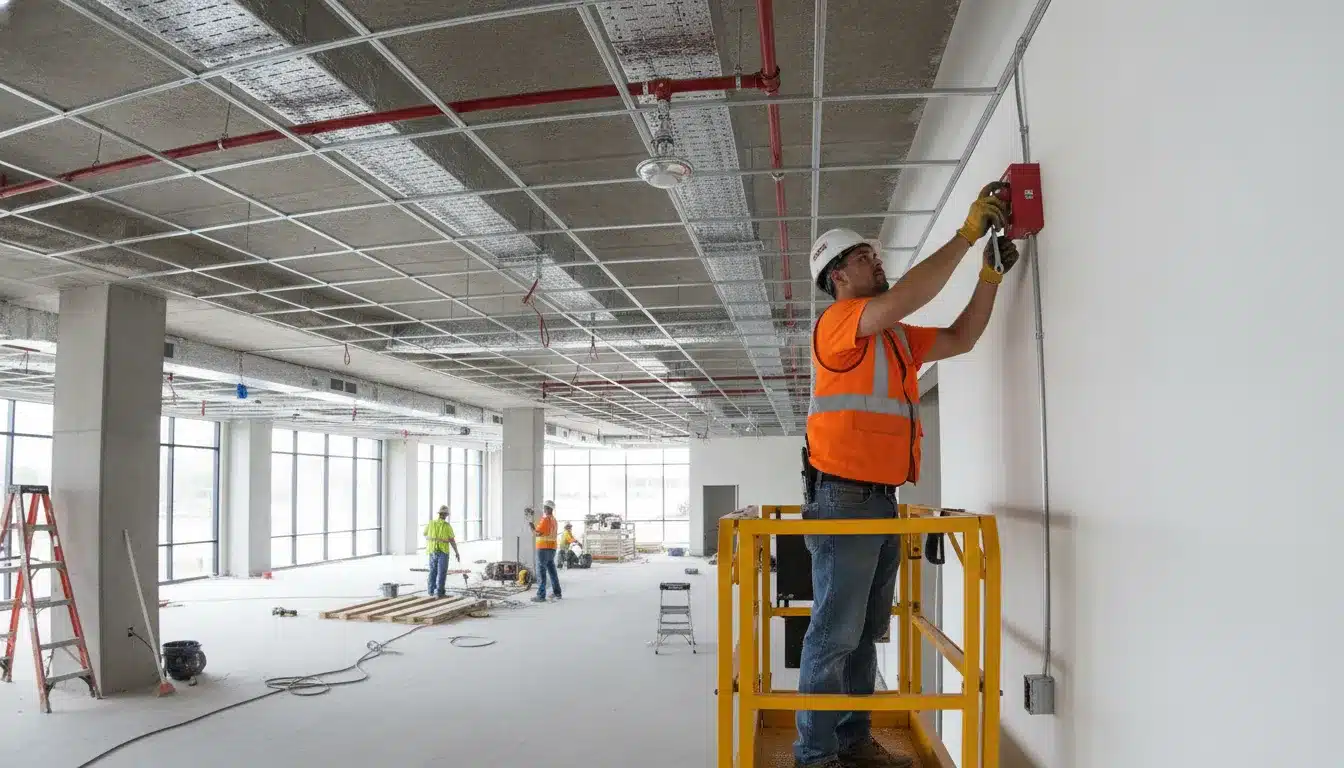
Commercial fire protection permits in Florida require more than a building permit application. Fire alarm, sprinkler, and special suppression systems must be coordinated with the applicable authority having jurisdiction (AHJ). They are reviewed under the Florida Fire Prevention Code and documented through installation, testing, and acceptance milestones.
Florida commercial fire alarm permit requirements generally center on NFPA 72-compliant design, AHJ or fire marshal plan review, properly prepared submittals, and documented testing before approval. Florida Statute 633.202 establishes the Florida Fire Prevention Code framework, while Section 553.791 excludes minimum fire prevention and firesafety codes from private-provider building inspection services. Review Section 633.202 and Section 553.791.
Because fire-safety review operates alongside, rather than inside, ordinary building-code permitting, missed coordination can delay inspections, tenant turnover, and the certificate of occupancy. The statutory and code framework explains why these permits are required and how the review authority fits into the project schedule.
Why Commercial Fire Alarm Permits Are Required in Florida
Commercial fire alarm permitting is mandatory because fire alarm systems are regulated as life-safety systems under Florida’s fire prevention framework. Not merely as components of a building’s electrical scope. The permit review establishes that the proposed system, devices, notification appliances, control equipment, and associated interfaces meet the applicable fire code before installation and occupancy.
NFPA 72 is the baseline standard
Florida Statute 633.202 provides the foundation for the Florida Fire Prevention Code. The statute says the code is based on NFPA 1, the Fire Code, and NFPA 101, the Life Safety Code. It includes NFPA 72, the National Fire Alarm and Signaling Code. That adoption makes NFPA 72 the technical baseline for commercial fire alarm design, installation, testing, and related documentation in Florida. The applicable edition and local amendments still need confirmation for the project and jurisdiction.
For a commercial project, coordinate the permit package with the occupancy classification, egress strategy, suppression systems, emergency power, fire pump or supervisory signals, and construction documents. A coordinated commercial permit submittal package helps prevent conflicts between the fire alarm drawings and the broader permit set.
Chapter 633 is separate from the building code permit track
Florida’s private-provider inspection law does not transfer every regulatory review to a private provider. Under Section 553.791, the definition of applicable codes for alternative building plans review and inspection excludes the minimum fire prevention and firesafety codes adopted under Chapter 633. That exclusion matters on commercial projects because a private provider may support eligible building-code inspections, while the fire prevention portion remains subject to the fire code authority’s process.
The fire marshal remains the fire alarm AHJ
Section 633.202 also requires each authority having jurisdiction to enforce the Florida Fire Prevention Code as adopted by the State Fire Marshal. In practice, the local fire marshal or designated fire department reviewer remains the AHJ for fire alarm plan review, fire-code compliance, and acceptance requirements. The building department and fire marshal may coordinate, but approval of one track does not replace approval of the other. Treating the fire alarm permit as a separate life-safety approval from the outset gives the project team a clearer schedule and reduces late-stage inspection or certificate-of-occupancy risk.
How Fire Marshal Plan Review and AHJ Coordination Shape a Permit
Fire marshal plan review can become a critical-path item because fire protection approval is governed through the local authority having jurisdiction (AHJ). It is not a uniform extension of building permit review. Florida Statute 633.202 requires each AHJ to enforce the Florida Fire Prevention Code adopted by the State Fire Marshal. That gives local fire officials a direct role in reviewing fire alarm and other fire protection designs. Read the statutory framework in Section 633.202.
Local requirements can change the submittal path
County and municipal procedures may differ in plan quantity, routing, application requirements, and the point at which fire alarm approval is required. Tampa, for example, states that fire alarm permits are required under Section 11-48(4) of its Fire Prevention Code and are not transferable. Its published procedure also directs applicants to submit two sets of plans to the Construction Services Center. Review Tampa’s fire alarm plan review and permitting requirements.
That local variation matters when a project team is budgeting review time or sequencing inspections. A package that is complete for one municipality may still require a different routing step, supporting document, or fire marshal coordination process in another. The governing baseline remains the Florida Fire Prevention Code, but the AHJ controls how that authority is administered for the project.
Pre-submittal coordination protects the schedule
Before the official review clock starts, the design team should confirm the AHJ’s submittal pathway, required plan sets, fire alarm scope, and system interfaces. It should also confirm coordination points with building, electrical, and life-safety reviews. This is especially important when the design affects occupancy, access control, elevators, smoke control, or the certificate of occupancy sequence. The goal is to identify incomplete coordination before an examiner issues comments and sends the package into re-review.
Private-provider building inspection services do not replace this fire-safety authority. Section 553.791 excludes minimum fire prevention and firesafety codes adopted under Chapter 633 from its definition of applicable codes. See Section 553.791. For developers and project managers, disciplined AHJ coordination creates clearer handoffs, reduces avoidable submittal corrections, and gives the construction schedule a more reliable path through fire marshal approval.
What the Florida Commercial Fire Alarm Permit Requirements Cover
A complete fire alarm permit submittal must give the AHJ enough technical information to verify system design, device placement, life-safety coverage, and coordination with the building scope. The package is more than a permit form. It typically includes engineered fire alarm plans, a device schedule, riser diagrams, battery calculations, notification appliance coverage, sequence-of-operations information, and the applicable equipment and installation details.
Plan documents and engineering responsibility
Fire alarm drawings should identify the control panel, initiating devices, notification appliances, power supplies, circuits, zones, and interfaces with other building systems. Riser diagrams show how those components connect across floors or fire areas, while battery calculations demonstrate that the standby and alarm power supplies support the proposed load. The plans should also make coverage review practical by showing device locations, candela settings where applicable, and the relationship between notification appliances and occupied spaces.
Florida code materials state that plans for fire protection systems, including automatic sprinkler and fire alarm systems, must be prepared by a licensed professional engineer. The Florida Building Code supplement identifies this engineering requirement. That requirement makes the engineer’s stamp, signature, and professional information a critical part of the submittal, not an administrative afterthought.
Device thresholds and commercial classification
Thresholds can change the documentation required by the reviewing jurisdiction. Miami’s standalone fire alarm and sprinkler permit guidance states that drawings for installations of 50 or more devices must be signed and sealed. The same guidance treats a residential property with three or more habitation units as commercial for these purposes. Review Miami’s fire alarm and sprinkler permit requirements before assuming that a multifamily project will follow a residential submittal path.
Project teams should also coordinate alarm interfaces with HVAC shutdowns, smoke control, access control, elevators, emergency power, and sprinkler monitoring. For related trade scopes, see the Florida commercial mechanical and trade permit requirements. Early coordination helps prevent conflicting drawings, missing sequences, and review comments that delay release of the fire alarm permit.
Fire Alarm, Sprinkler, and Special Suppression Permits Compared
Commercial fire-protection permits are system-specific. The fire alarm package is evaluated against NFPA 72, while sprinkler, cooking-exhaust, and clean-agent systems follow their applicable fire-protection standards and equipment requirements. These systems may move through separate fire marshal reviews even when they support the same building permit. Florida’s Fire Prevention Code includes NFPA 72, and each authority having jurisdiction enforces the code adopted by the State Fire Marshal. Florida Statute 633.202 establishes that framework.
| System | Governing code | Typical plan review | Testing/inspection frequency | Notes |
|---|---|---|---|---|
| Fire alarm systems | NFPA 72, adopted through the Florida Fire Prevention Code | Fire marshal or other AHJ reviews device layout, initiating devices, notification, monitoring, and sequence of operations. | Testing and maintenance follow NFPA 72, with documentation provided to the AHJ. Orlando commercial fire alarm permits are valid for one year and must be renewed at least 10 days before expiration. Orlando fire alarm registration guidance | Coordinate alarm interfaces with sprinkler supervision, elevators, smoke control, and emergency power where applicable. |
| Automatic fire sprinkler systems | NFPA 13 | Fire marshal or AHJ reviews hydraulic design, coverage, water supply, risers, zoning, and required coordination with the building. | Acceptance testing and ongoing inspection follow the applicable NFPA requirements and AHJ conditions. | Sprinkler plans and calculations may require professional design responsibility and coordination with architectural and mechanical plans. |
| Kitchen hood suppression | NFPA 96 and the listed suppression system manufacturer’s requirements | Fire marshal or AHJ reviews hood, duct, appliance, agent-discharge, fuel-shutoff, and alarm interfaces. | Inspection and servicing follow the applicable standard, system listing, and AHJ requirements. | Coordinate the suppression release with cooking equipment shutdown and the building fire alarm where required. |
| Clean-agent (special hazard) suppression | NFPA 2001 or the applicable NFPA standard and manufacturer requirements | Fire marshal or AHJ reviews hazard classification, enclosure integrity, agent concentration, detection, discharge, and occupant protection. | Inspection, testing, and cylinder or agent servicing follow the applicable standard and manufacturer’s requirements. | Use for specifically engineered hazards such as critical equipment spaces; coordinate detection, alarms, ventilation, and room conditions. |
The practical distinction is not only which code applies, but which drawings, calculations, testing records, and system interfaces the AHJ expects. Treating every fire-protection scope as one generic permit can create review comments, re-submittals, and inspection delays. Build the permit matrix early, assign design responsibility, and align each system’s acceptance testing with the project schedule. For complex commercial work, commercial inspection management can help keep fire marshal milestones coordinated with construction and certificate-of-occupancy requirements.
Inspection and Testing Milestones After the Permit Is Issued
Issuing the permit starts the field-compliance phase. The fire alarm scope moves from approved plans to installed devices, witnessed testing, documented closeout, and ongoing maintenance. The Florida Building Code supplement requires systems to be tested and maintained under NFPA 72. Testing documentation must be provided to the authority having jurisdiction (AHJ). See the Florida Building Code supplement.
Sequence the inspections around installation milestones
The first field checkpoint is typically the rough-in inspection. At this stage, the AHJ or designated inspector verifies pathways, boxes, wiring, sleeves, supports, and other concealed work before finishes close access. The project team can then complete device installation, programming, labeling, and interface work with confidence that concealed conditions will not require disruptive rework.
After installation, the fire alarm contractor performs functional checks and prepares the system for the final acceptance test. That test should account for initiating devices, notification appliances, supervisory and trouble signals, monitoring interfaces, and required connections to other life-safety systems. The AHJ reviews the witnessed results and supporting records, not simply whether the panel powers on. Record drawings, test reports, device schedules, and correction documentation should be assembled as a controlled closeout package.
Keep testing records and the permit current
Testing is not limited to the original acceptance event. NFPA 72 governs recurring testing and maintenance, with documentation retained for the AHJ. The owner, contractor, and facility team should assign responsibility for annual testing, deficiency correction, and record updates before turnover. This avoids an operational or certificate-of-occupancy risk.
Permit validity also requires calendar control. For example, the City of Orlando says fire alarm permits are valid for one year from issue unless otherwise noted. It also requires renewal at least 10 days before expiration. Review Orlando’s fire alarm registration and renewal guidance and confirm the local AHJ rule.
A permit expediter coordinates inspection requests with rough-in completion, ceiling close-in, commissioning, and turnover dates. Through commercial inspection management, the team can maintain a milestone tracker, organize testing records, and monitor renewal deadlines. That keeps the critical path visible.
Frequently Asked Questions
Are permits required for all new commercial fire alarm systems in Florida?
New commercial fire alarm installations generally require review and permitting through the applicable local authority having jurisdiction (AHJ). The system must comply with NFPA 72 as incorporated into the Florida Fire Prevention Code under Chapter 633. Confirm the local submittal and inspection sequence before procurement or installation begins. Florida Statute 633.202 establishes the code framework.
What information is typically needed to apply for a commercial fire alarm permit?
A complete package normally includes system plans, equipment and device information, project details, and the required professional credentials or seals. Florida code materials state that plans for fire protection systems, including fire alarm and automatic sprinkler systems, must be prepared by a licensed professional engineer. The AHJ may also require jurisdiction-specific forms or separate fire protection reviews. Florida Building Code fire protection provisions provide the cited plan-preparation requirement.
What role does the AHJ play in fire alarm permitting?
The AHJ reviews the fire protection design, applies the locally adopted fire code, coordinates required inspections, and determines whether the system is ready for approval. Florida law requires each AHJ to enforce the Florida Fire Prevention Code as adopted by the State Fire Marshal. Building permit approval does not replace the fire marshal or fire protection review. Florida Statute 633.202 identifies the AHJ enforcement responsibility.
Are standalone fire alarm systems treated differently from integrated sprinkler systems?
They can require different drawings, code references, inspections, and coordination points because alarm, sprinkler, and special suppression components perform different functions. The permitting authority should confirm whether the systems are submitted together or through separate fire protection applications. Regardless of the configuration, fire alarm testing and maintenance must follow NFPA 72, with testing documentation provided to the AHJ. Florida Building Code fire protection provisions support that testing and documentation requirement.
Ready to coordinate your fire-safety permits?
Fire alarm, sprinkler, and special suppression permitting requires alignment among design professionals, contractors, inspectors, and the AHJ. All Florida Permits can help organize the submittal, review milestones, and inspection management needed to keep your commercial project moving. Request a proposal for professional fire-safety permitting and inspection management through our consultation services.