

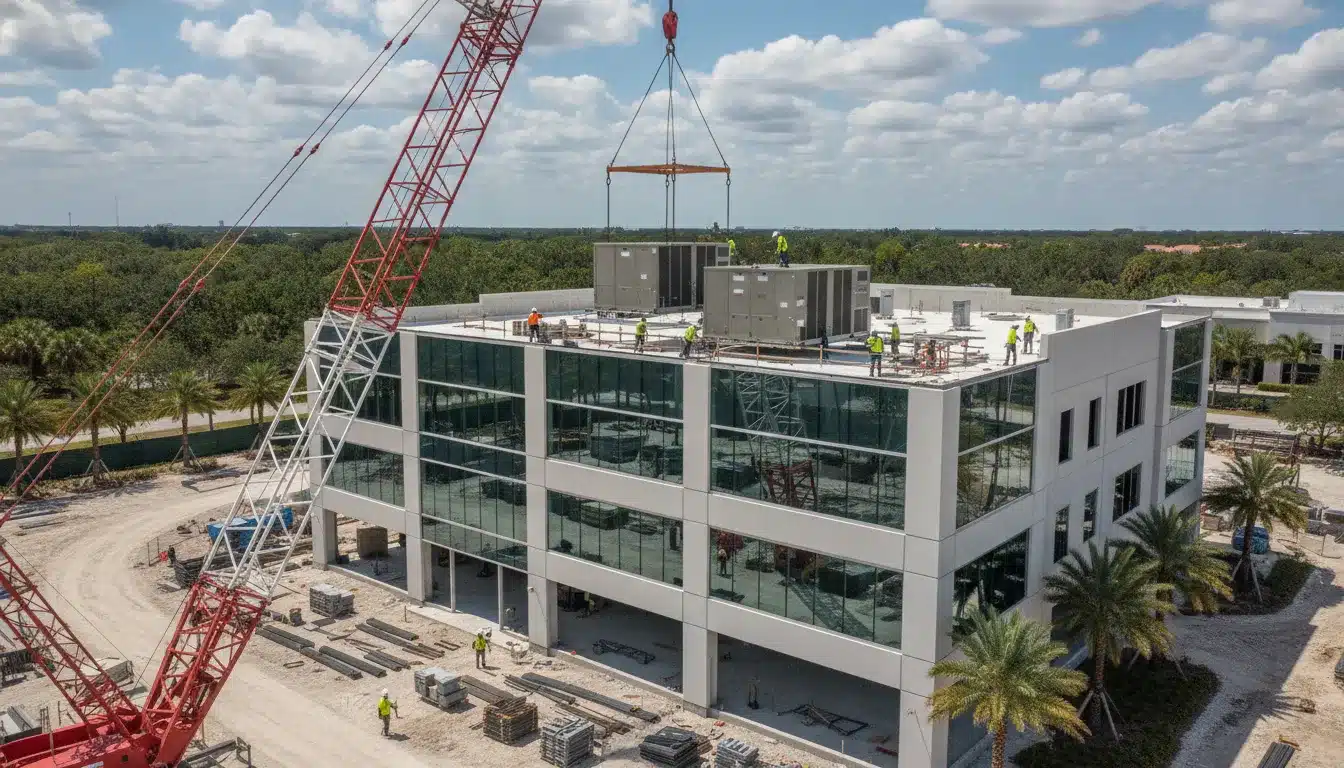
Commercial HVAC work in Florida is a permitting issue before it becomes an installation issue. A contractor, owner, or authorized agent generally must apply for and obtain the required mechanical permit before installing, altering, repairing, or replacing a regulated mechanical system. The Florida Building Code, Mechanical applies to heating, cooling, air-conditioning, ventilation, and refrigeration systems, along with related equipment and appurtenances.
Florida mechanical permit requirements generally apply before commercial HVAC systems are installed, altered, repaired, or replaced. Although the code provides narrow exemptions for portable equipment, certain minor part replacements, and limited self-contained refrigeration systems. Confirming the scope with the local AHJ helps protect the project schedule and prevents avoidable rework.
For commercial contractors and developers, the practical question is not simply whether the work involves HVAC. It is which work falls within the code, which documents the AHJ expects, and how inspections must be sequenced. The governing framework starts with the permit scope itself.
What Are Florida Mechanical Permit Requirements?
Florida mechanical permit requirements are the code-based controls that govern when mechanical work must be approved by the local building official before construction begins. Under the Florida Building Code, a contractor, owner, or authorized agent who intends to install, alter. Repair, or replace a required mechanical system must first submit an application and obtain the required permit. The rule applies to commercial construction as well as qualifying alterations to an existing facility. It is not limited to installing a new rooftop unit.
What systems fall under the mechanical code?
The Florida Building Code, Mechanical applies to the installation, alteration, repair, and replacement of mechanical systems, including associated equipment, appliances, fixtures, fittings, and appurtenances. The covered systems include heating, cooling, air-conditioning, ventilation, and refrigeration equipment. The code also addresses incinerators and other energy-related systems. This scope makes the mechanical permit a distinct part of the MEP permitting package, even when the work is coordinated with a building, electrical, or plumbing permit.
For a commercial project, the permit review may therefore involve more than the equipment schedule. The AHJ may need to evaluate the proposed system, its connections, ventilation approach, energy-related components, and the way the work integrates with the permitted building. The exact submittal requirements and review process are set by the applicable AHJ, but the statutory basis for the permit obligation comes from the Florida Building Code.
Who is responsible for obtaining the permit?
The applicant may be the contractor performing the work, the property owner, or an authorized agent acting for either party. Responsibility should be assigned before procurement and mobilization so the permit application, plans, equipment information, and contractor details are consistent. Waiting until equipment arrives or rough-in work is scheduled can create avoidable coordination issues, particularly where mechanical work is concealed behind walls or ceilings.
The controlling source is the Florida Building Code administrative provisions, which establish the application and permit requirement and define the mechanical systems covered by the code. Project teams should confirm the current code edition and local AHJ procedures before submitting. Because a compliant permit strategy must align the statewide code framework with the jurisdiction’s review requirements.
When Is a Mechanical Permit Required in Florida?
A mechanical permit is generally required before installing, replacing, altering, or repairing a mechanical system in a Florida commercial building. That includes most HVAC replacements, not only new installations. The Florida Building Code, Mechanical applies to ventilating, heating, cooling, air-conditioning, refrigeration, incineration, and related energy systems. The owner, contractor, or authorized agent must apply to the building official before the work begins. See the Florida Building Code administrative provisions for the governing permit language.
Do you need a permit to replace an AC unit in Florida?
In most cases, yes. Replacing an air-conditioning unit changes or replaces a regulated mechanical system, so it generally requires a permit and the applicable inspections. The requirement can apply even when the replacement is in an existing building and the new equipment appears similar to the old unit. The AHJ may need to verify equipment information, installation conditions, electrical coordination, condensate provisions, ductwork, structural support, and code compliance before approving the work.
New construction, replacements, and renovations
New commercial construction typically requires mechanical permit review as part of the building permit package or coordinated MEP permit process. The scope may include equipment schedules, load calculations, duct layouts, ventilation details, refrigerant information, and other documents required by the local building department. Organizing these materials early helps prevent mechanical comments from delaying the broader construction schedule. Review the mechanical permit submittal documents before filing.
For an equipment replacement, the permit scope depends on what changes. A like-for-like replacement still generally requires a permit, while a project that changes capacity, distribution, controls, structural support, or fuel source may require additional review. During a commercial renovation, new or relocated rooftop units, exhaust systems, kitchen ventilation. Split systems, and other equipment should be coordinated with architectural, electrical, plumbing, and fire protection scopes. For tenant build-outs, see the guide to mechanical trade permits for tenant improvements.
Work that may be exempt
Florida recognizes limited exemptions, but they should not be treated as a blanket exception for HVAC work. Portable heating appliances, portable ventilation equipment, and portable cooling units may be exempt. Replacing a minor part may also be exempt when the replacement does not alter the equipment’s approval or make it unsafe. A self-contained refrigeration system with no more than 10 pounds of refrigerant and a motor of 1 horsepower or less is another listed exemption. When the work falls near an exemption threshold, confirm the interpretation with the local AHJ before mobilizing.
Permit fees and review requirements vary by jurisdiction and project scope. Include the permit in the project budget rather than treating it as an incidental service cost. This guide to budgeting for commercial mechanical permit costs can help project teams plan the filing and review expense.
Mechanical Permit Application Process and Required Documents
For a commercial HVAC installation or alteration, the permit package must give the local AHJ enough information to evaluate equipment capacity. Energy performance, life-safety impacts, and coordination with the building design. Florida mechanical permit requirements are statewide in their code foundation, but each jurisdiction can vary in forms, digital-submittal standards, and supporting documents.
Assemble the mechanical permit package
Commercial applications typically use the jurisdiction’s building permit application, with the mechanical category or trade scope selected. The submission commonly includes signed and sealed mechanical plans, load calculations, equipment schedules, ductwork plans, and manufacturer cut sheets. Depending on the project, the AHJ may also request energy-code documentation, ventilation information. Equipment locations, roof or structural details, and details for penetrations, supports, or fire and smoke assemblies.
Coordinate these materials with the architectural, electrical, and plumbing sets before submission. MEP trades often require coordinated plan review, and inconsistencies between mechanical equipment, electrical service, structural supports, and reflected ceiling plans can generate comments or force a resubmittal. Use the building permit submittal requirements checklist to organize the base package, then confirm the specific checklist published by the project AHJ.
Plan review and local AHJ requirements
The plan reviewer evaluates the mechanical scope against the applicable Florida Building Code provisions and local administrative requirements. Review the Florida building plan review process before filing so the design team understands how comments, revisions, and resubmittals will be handled. Requirements can differ by municipality and project type. One AHJ may require additional ventilation calculations or product data, while another may impose separate upload categories, naming conventions, or trade-specific affidavits. Confirm those requirements before the contractor submits rather than treating a neighboring jurisdiction’s checklist as authoritative.
When an annual facility permit may apply
For an existing occupancy with recurring service, repair, refurbishing, minor renovation, or component-replacement work. The building official is authorized to issue an annual facility permit instead of requiring an individual permit for every alteration. This option is described in the Florida Building Code administrative provisions cited by the Florida Building Code. It is not a blanket substitute for a project permit. Confirm eligibility, documentation, and inspection procedures with the local AHJ before relying on it. For new construction or major system replacement, include permitting fees and review scope in the broader analysis of commercial building permit costs in Florida.
Mechanical Permit Inspection Stages for Commercial Projects
Commercial mechanical work should be sequenced around the inspections required by the Florida Building Code and the procedures of the local authority having jurisdiction (AHJ). The contractor or permit representative must schedule each inspection with that AHJ, confirm that the work is ready, and keep approved plans and required documentation available on site. A failed inspection can stop the next trade, trigger rework, and delay the project schedule, particularly when walls or ceilings have already been closed.
Rough-in inspection before concealment
The rough-in inspection occurs after concealed mechanical components are installed and after required framing, roof work, fire blocking, and bracing are in place. It must occur before wall or ceiling membranes are installed. This inspection gives the building official an opportunity to verify items such as ductwork, equipment clearances. Piping, supports, penetrations, and other components that will no longer be visible after the build-out is closed. The Florida Building Code administrative provisions identify this timing directly in the rough-in inspection requirement: review the applicable FBC inspection language.
Project teams should coordinate the rough-in with framing, firestopping, electrical, and plumbing milestones. Scheduling too early can produce an incomplete inspection. Scheduling too late can force removal of finished surfaces, create additional labor, and push downstream activities. For complex projects, inspection management services can help track readiness, AHJ appointments, corrections, and reinspection requirements.
Final inspection and equipment connection
The final mechanical inspection is performed after the building is complete, the mechanical equipment is in place and properly connected, and the structure is ready for occupancy. The final review is not simply a confirmation that equipment was delivered. The installation must be complete, accessible as required, connected to its systems, and consistent with the approved scope. The FBC source describes the final inspection timing and readiness standard in the same administrative exhibit cited above.
Before requesting final inspection, the superintendent should verify equipment connections, controls, access, labels, required testing, and any documentation requested by the AHJ. Open corrections or incomplete connections can delay the certificate of occupancy or require a reinspection. Confirm local scheduling cutoffs and inspection prerequisites in advance because each AHJ may apply its own administrative process.
Miami-Dade boiler and pressure-vessel certificates
Miami-Dade County applies additional certificate-validity requirements to certain pressure equipment. A high-pressure boiler certificate is valid for no more than six months, while a low-pressure boiler certificate is valid for no more than 12 months. An unfired pressure vessel operating above 60 PSI and having a volume greater than five cubic feet requires a certificate valid for no more than 12 months. These requirements are stated on Miami-Dade County’s mechanical permits page.
Those certificate periods should be incorporated into the commissioning and turnover schedule rather than treated as a post-completion administrative detail. Confirm the equipment classification, inspection status, and documentation requirements with the AHJ before final sign-off.
How Local AHJ Requirements Vary Across Florida
The Florida Building Code establishes the statewide baseline, but the Authority Having Jurisdiction (AHJ) controls how a commercial mechanical permit is submitted, reviewed, inspected, and closed out locally. That difference affects drawings, supporting calculations, fee estimates, inspection scheduling, and the documentation required for specialized equipment. Contractors should confirm the applicable city or county procedures before pricing the work or committing to a construction schedule.
| Jurisdiction | Mechanical permitting consideration | Project impact |
|---|---|---|
| Miami-Dade County | Boiler and pressure-vessel certification requirements are a significant part of the local mechanical process. High-pressure boiler inspection certificates are valid for no more than six months, while low-pressure boiler certificates are valid for no more than 12 months. Unfired pressure vessels operating above 60 PSI with a volume greater than five cubic feet also require certificates valid for no more than 12 months. Review Miami-Dade mechanical permit requirements. | Specialized equipment may require recurring certification and a carefully managed inspection calendar. |
| Hillsborough County | The county maintains a list of exempt work. Whether a repair or replacement qualifies depends on the scope and the applicable exemption, not simply on the fact that the work is minor. | Confirm the exempt-work list before omitting a permit. A change in equipment, capacity, connections, or safety conditions can move the work into a permit-required category. |
| Orange County | Mechanical permitting is required for permanently installed equipment. Portable equipment and other limited exemptions should not be treated as equivalent to permanently installed systems without local confirmation. | Equipment schedules and installation details should be reviewed early so the permit scope matches the actual project. |
| Broward County | Local submittal, fee, and inspection procedures apply in addition to the Florida Building Code baseline. Requirements can also differ between the county and municipalities operating within the county. | Identify the responsible AHJ and its current application workflow before preparing the mechanical permit package. |
These variations make jurisdiction-specific due diligence a schedule-control issue, not an administrative formality. The commercial building permit costs in Florida can change with local valuation methods, review charges, and inspection services. Likewise, the Florida building plan review process must be aligned with the AHJ’s submittal standards. An experienced permitting team can identify the correct jurisdiction, reconcile local requirements with the FBC, and prevent avoidable resubmittals or inspection delays.
Risks and Penalties for Unpermitted Mechanical Work
Proceeding with commercial HVAC or other mechanical work without a required permit creates exposure for both the contractor and the property owner. Florida Statutes Section 553.79 establishes the state permit requirement, while the local Authority Having Jurisdiction (AHJ) enforces compliance through its permitting and inspection process. If the work proceeds outside that process, the project can face enforcement before the mechanical system is approved for use.
The immediate financial risk can be substantial. The customer guidance for commercial permitting places non-compliance fines at approximately $500 to $1,000 or more per day, depending on the violation and local enforcement action. A stop-work order can add labor, remobilization, redesign, and carrying costs while the team documents existing work, corrects deficiencies, and obtains approval. Those costs are separate from the permit fees that should have been budgeted at the start.
Schedule and certificate-of-occupancy exposure
Unpermitted mechanical work can delay rough-in and final inspections, which in turn can delay a certificate of occupancy or a tenant handover. Concealed work may need to be opened for inspection, and equipment that does not match approved plans may require revised drawings or replacement. For a commercial project, that disruption can affect commissioning, tenant improvements, lender milestones, and the planned opening date.
Liability, sale, and insurance complications
Unresolved permit violations also create a documentation problem. Contractors may face corrective-work demands, disputes over responsibility, or allegations that the installation was not performed in accordance with the approved code path. Owners can encounter additional diligence questions when refinancing or selling the property, and insurers may scrutinize undocumented alterations when evaluating coverage or a claim. The exact consequence depends on the AHJ, the work performed, and the project record, but the risk is avoidable.
For commercial teams, the cost of confirming Florida mechanical permit requirements and securing approval upfront is typically far lower than absorbing enforcement penalties and schedule delays later. Schedule a consultation before work begins to identify the applicable permit path and local AHJ requirements.
Frequently Asked Questions
What requires a mechanical permit in Florida?
A permit is generally required before a contractor, owner, or authorized agent installs, alters, repairs, or replaces a regulated mechanical system. The Florida Building Code scope includes heating, cooling, air-conditioning, ventilation, and refrigeration equipment, along with related appliances and appurtenances. Review the applicable code requirements with the project AHJ before mobilizing work. Florida Building Code source
Do you need a permit to replace an AC unit in Florida?
Usually, yes, when the replacement involves a regulated air-conditioning system or changes that affect the equipment, installation, or approved configuration. Minor replacement parts that do not alter the equipment’s approval or make it unsafe may be exempt. Portable cooling units and certain self-contained refrigeration systems are also listed exemptions, but commercial contractors should confirm the specific scope with the AHJ before treating work as exempt. Florida Building Code source
What documentation is required for a commercial mechanical permit?
The exact submittal package depends on the AHJ and project scope, but commercial applications typically need enough information for plan review. Including equipment schedules, mechanical plans, and supporting design or load information when applicable. Confirm local forms, electronic-submittal rules, and coordination requirements before filing. For routine service, repair, or minor renovations in an existing occupancy, the building official may authorize an annual facility permit instead of separate permits for each alteration. Florida Building Code source
When are commercial HVAC inspections scheduled?
Plan the rough-in inspection after concealed mechanical components are installed but before wall or ceiling membranes cover them. The final inspection occurs after the building is complete, the mechanical equipment is properly connected, and the structure is ready for occupancy. Missing the rough-in window can create rework and schedule exposure, so coordinate inspection requests with framing, drywall, and commissioning milestones. Florida Building Code source
Ready to Get a Proposal for Your Mechanical Permit?
Commercial HVAC permitting requires coordinated submittals, plan review, and inspections that align with the project schedule. All Florida Permits can help your team organize the permit path and maintain momentum through the AHJ process. To discuss your scope and next steps, get a proposal for mechanical permit expediting services.