

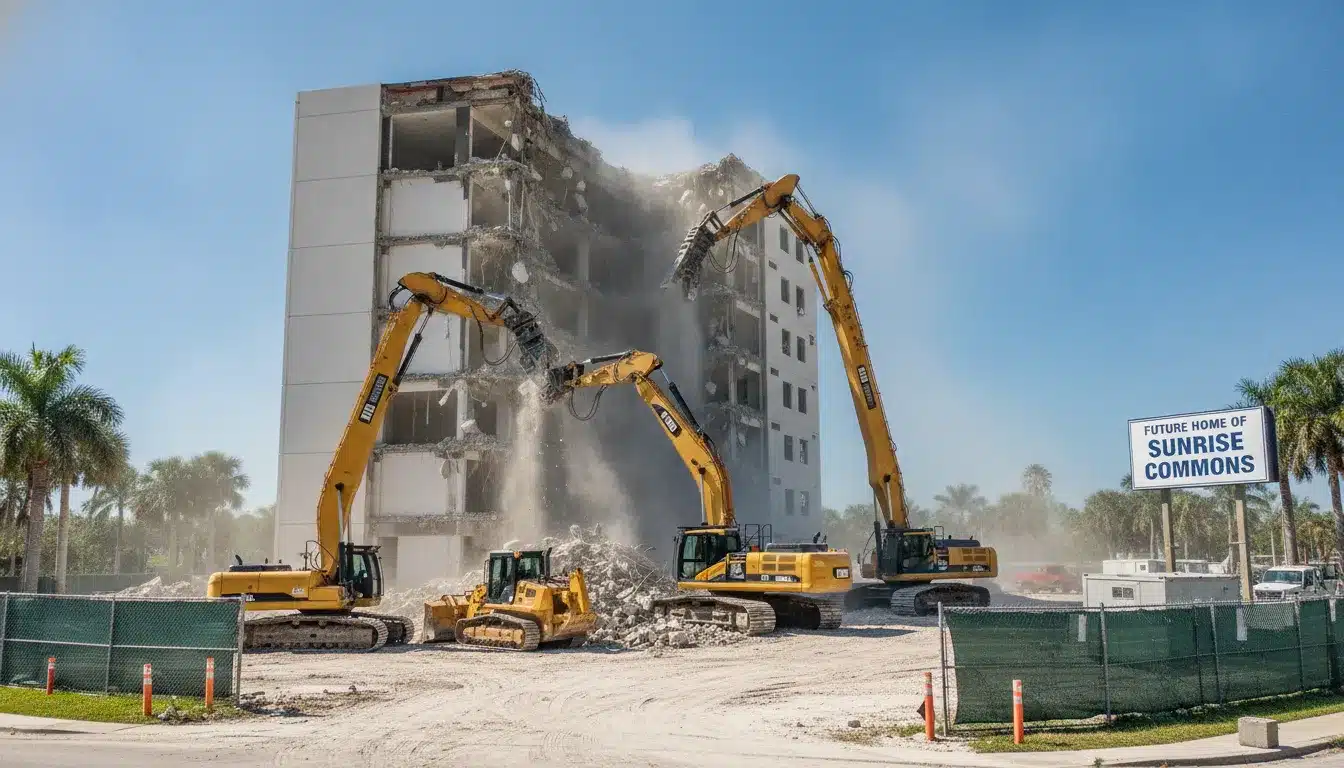
A late demolition permit can stall a major project before any site work even starts.
Florida demolition permit requirements demand that contractors and developers get official approval from the local agency before tearing down any structure. Under Florida Building Code Section 553.79, it is against the law to demolish or change any building in the state without first getting this permit. To get approval, you must send a complete package to the local building department. This package usually includes detailed site plans, utility disconnect letters, rodent control certificates, and a professional asbestos survey. For commercial projects, developers must also give tree protection plans and set up safety fencing. Following these statewide rules keeps your job on schedule, prevents costly fines, and ensures your team stays completely safe.
Every project manager and builder must know exactly when these strict rules apply to their work site. To help you plan your next job without delays, let us first look at When Do You Need a Demolition Permit in Florida? Here is how you can find out.
Florida Demolition Permit Requirements: When Do You Need a Demolition Permit in Florida?
Before starting any teardown project, you must understand Florida demolition permit requirements. Demolition work is not a simple task that you can begin without official approval. State law sets clear rules to keep people safe, protect the environment, and preserve utility lines. Under Florida Building Code Section 553.79, it is unlawful to demolish any building or structure in the state without first getting a permit from the local enforcing agency. This rule applies to both commercial and residential properties across every county and city.
Types of Demolition Work That Need a Permit
Most complete teardowns need a specific demolition permit from the local building department. If you plan to pull down a whole office building, store, or single-family home, a permit is always needed. This is because complete structural removal affects the ground, local trees, and public utility connections. Local authorities must check your plans to make sure the work will not harm the public or damage city pipes.
Some smaller projects or partial tear-downs do not use a standard demolition permit. For example, partial demolitions, swimming pool removals, or interior-only demolition work often require a standard building permit instead. If you only plan to strip out interior walls or take down a backyard pool, you must still navigate the Florida building permit application process. Always check with your local authority having jurisdiction (AHJ) to see which type of permit fits your exact scope of work.
Who Can Apply for a Florida Demolition Permit?
Florida has strict rules about who can pull a permit for demolition work. You cannot hire an unlicensed crew to pull down a building. Building departments typically issue these permits only to property owners or licensed contractors. Licensed operators include general, building, or specialized demolition contractors who hold active licenses from the Department of Business and Professional Regulation (DBPR).
While some cities allow property owners to apply under an owner-builder disclosure, this option is usually limited to residential projects where the owner lives in the home. For commercial jobs, multi-family properties, or large structures, a licensed contractor must apply. This ensures that the team doing the heavy work has the proper training, safety gear, and insurance to handle the job without risking lives or property.
Required Documents for Florida Demolition Permit Applications
Before any tearing down begins, you must gather a detailed package of paperwork. Each local Authority Having Jurisdiction (AHJ) enforces specific rules, but the core list of required files remains similar across the state. Meeting these demolition permit submittal requirements keeps your schedule on track and prevents costly project delays.
To comply with Florida demolition permit requirements, you must compile and submit the following essential documents to your local building department:
- Asbestos Survey and Notification: You must submit a full asbestos survey or a signed statement from a licensed consultant showing no asbestos is on site. Under Florida rules, this safety step is standard to prevent the spread of toxic dust. A copy of this survey must be filed with your building department package, as outlined by the Palm Beach County Building Division.
- Pest and Rodent Control Certificate: You must secure a rodent control certificate from a pest control expert licensed by the state. This document shows that the site has been treated and is free of pests. Local offices, such as the City of Orlando, require this step to stop pests from fleeing to nearby properties when work begins.
- Utility Disconnection Verification Letters: You must provide letters from each utility company showing all services are cut off. This includes power, water, sewer, and gas lines. These letters prove the site is safe for heavy equipment and will not cause dangerous utility line breaks.
- Detailed Site Plan and Survey: You must submit a scaled site plan showing the exact structure to be removed. For commercial builds, you must also show tree protection zones, utility caps, and fencing plans. Commercial demolition sites often need a separate permit to put up temporary eight-foot security fencing around the work area.
- Proof of Ownership or Owner Authorization: You must show that you have the right to clear the site. This requires a recorded deed or a tax record. If a contractor applies, they must provide a signed and notarized owner agent letter that grants them power to pull the permit.
- Contractor Credentials and Demolition Affidavit: You must submit proof of active state licenses and liability insurance. You must also sign a demolition affidavit. This document states that you will follow all local safety, noise, and environmental rules during the job.
Florida Building Code Requirements for Demolition Projects
Every commercial development or site preparation project in the Sunshine State begins with a clear understanding of the regulatory baseline. To remain compliant, contractors and developers must align their plans with the strict Florida Building Code. These rules govern how structures are safely brought down across all jurisdictions. Under Florida Statute Section 553.79, it is unlawful to demolish any building in the state without first getting a permit from the local enforcing agency. This statutory rule acts as the foundation for all local municipal codes.
The Statutory Rule for Demolition Permits
The requirement for a demolition permit is not a local option or a minor municipal rule. Under state law, any person, firm, or corporation must obtain a permit from the Authority Having Jurisdiction (AHJ) before commencing any work. Attempting to bypass this step can lead to immediate stop-work orders, civil penalties, and double permit fees. For project managers, this means scheduling and securing the permit is the critical path item for the site preparation phase. Navigating the complex steps of the Florida building permit application process is essential to keep project timelines on track.
Enforcement and Permit Revocation Rights
Once a permit is in hand, the AHJ retains strong oversight during the entire project life cycle. Under state law, local enforcing agencies have the explicit authority to revoke a demolition permit. This action occurs if the agency finds that the demolition work is in violation of the Florida Building Code or does not match the approved plans. A revoked permit can halt a project indefinitely, which drives up holding costs and disrupts subcontractor schedules. To avoid this risk, general contractors must ensure that field operations match the submitted safety plans and environmental control measures exactly.
Legal Protections Against Arbitrary Permit Denial
While local building departments hold broad enforcement power, the law also provides important protections for applicants. When a building department denies a demolition permit application, it cannot simply issue a generic rejection. The local enforcing agency is legally required to identify the specific code chapters and project features that do not comply. This legal protection prevents arbitrary delays. It gives developers a clear roadmap to address any plan review objections. Knowing these statutory boundaries helps construction professionals resolve plan disputes quickly, which keeps the pre-construction phase moving forward.
Asbestos and Environmental Considerations for Demolition
Managing a structural teardown requires strict adherence to environmental rules. In Florida, hazardous materials can trigger major legal and financial issues if you do not handle them correctly. Meeting environmental permitting for demolition standards is a key step in securing local approvals and avoiding costly project shut downs.
Federal NESHAP and Asbestos Survey Rules
Federal law dictates how contractors handle toxic substances on a job site. Under the National Emission Standards for Hazardous Air Pollutants (NESHAP), you must perform a thorough asbestos inspection before starting any work. The Environmental Protection Agency (EPA) oversees this standard at the federal level to control airborne dust. You can learn more about these safety guidelines directly from the Environmental Protection Agency.
Florida building departments enforce this standard locally. A professional asbestos survey is a mandatory part of your application package. A licensed inspector must test the property and write a full report. If they find asbestos, you must hire a licensed specialist to remove it before heavy equipment arrives.
Florida DEP Notification Requirements
The Florida Department of Environmental Protection (DEP) must receive notice before you tear down any regulated structure. You must submit a formal notification form to the DEP at least 10 working days before demolition starts. This rule applies even if the asbestos survey shows no hazardous materials are present. The state uses this window to coordinate inspections and verify that dust control plans are in place.
Failing to notify the DEP can stall your project. It can also lead to hefty administrative fines that threaten your project budget. Timely filing keeps your schedule on track and keeps you in compliance with Florida demolition permit requirements.
Lead Paint and Rodent Control Concerns
Older structures present additional safety challenges for builders. For any structure built before 1981, you must evaluate the risk of lead-based paint. Distributing lead dust during a knockdown violates safety codes. Workers must use specific containment barriers and wet-demolition methods to keep lead dust from drifting into neighboring areas.
You must also secure a rodent control certificate before the local building office will approve your files. A state-certified pest control operator must inspect the building. They must bait the structure and certify that all pests are gone. This step prevents rodents from migrating to nearby properties when the building comes down.
Municipality-Specific Demolition Permits Across Florida
Local rules for securing a permit vary widely among Florida towns and counties. While the Florida Building Code provides a general framework, each local building department or authority having jurisdiction (AHJ) sets its own submission guidelines, review timelines, and fee structures. Builders and developers must adapt to these regional rules to prevent expensive delays on their job sites.
South Florida and Central Florida Requirements
In the City of Miami, demolition permits come with strict site planning rules. Any boundary survey submitted with your application must be less than six months old, according to the City of Miami Unsafe Structures guidelines. Miami also enforces strict tree protection offsets, which usually require an eight-inch to twelve-inch radius per inch of trunk diameter. If a builder starts work before getting a permit to resolve a code violation, Miami will double the permit fee and add a one hundred ten dollar fine.
Further north, the Orange County residential demolition rules require a two-page Building and Land Use permit application. Property owners or licensed contractors must fill out and sign both pages completely to start the review process. Unlike other jurisdictions, Orange County separates residential structures into distinct categories to check for utility and environmental safety before demolition starts.
Gulf Coast and Panhandle Procedures
Along the Gulf Coast, Hillsborough County residential demolition rules require property owners acting as their own contractor to submit a notarized Owner-Builder Disclosure Statement. This document confirms that the owner accepts full liability for code compliance and safety on the job site.
In Southwest Florida, the Lee County Demolition Application and Permitting Guide states that a permit is required to raze, dismantle, or remove any portion of a residential or commercial structure, including interior walls. In the Florida Panhandle, the City of Panama City Beach demolition guidelines require a detailed site plan showing silt fence placement for erosion control. Developers there must also submit a formal letter of authorization from the property owner before the city will review the file.
Comparison of Local Demolition Requirements
To help you plan your next project, the table below highlights the key differences in demolition permit submittal requirements across these major Florida jurisdictions:
| Municipality | Key Requirements | Special Rules | Department Contact |
|---|---|---|---|
| City of Miami. | Recent boundary survey, tree protection plan. | Survey must be less than 6 months old; violation doubles fee plus $110. | Building Department (305-416-1416). |
| Orange County. | Two-page land use application, contractor license. | Requires complete signatures and property owner disclosures. | Division of Building Safety (407-836-5550). |
| Hillsborough County. | Owner-Builder Disclosure, utility sign-offs. | Property owners must assume full liability for the site work. | Permitting Section (813-272-5600). |
| Lee County. | Detailed demolition guide, full site layout. | Required for partial interior wall removals and complete teardowns. | Development Services (239-533-8585). |
| Panama City Beach. | Silt fence layout, owner authorization letter. | Strict erosion control and active sediment barriers required. | Building Department (850-233-5100). |
Plan Review and Inspection Process for Demolition Permits
Getting a demolition permit involves two main steps: plan review and field inspections. The path your project takes depends on whether you are working on a residential or commercial structure. Understanding these demolition permit submittal requirements helps you avoid costly delays on your site.
When Is a Plan Review Required?
Most residential demolition permits in the state are inspection-only. This means the local building department does not require a formal plan review for straightforward single-family teardowns. When reviews are needed, the timeline is fast. Single-family plan reviews are typically completed within 24 hours. Commercial demolition reviews are more complex but still move quickly, averaging about two days to finish.
The type of work also shapes the review process. Full structural teardowns of commercial buildings need a detailed review of site safety plans, tree protection, and utility disconnects. For accessory structures like sheds or detached garages, the process is much simpler. Interior-only demolition often avoids deep reviews but still requires basic checks to protect shared walls and utility systems.
The Field Inspection Process
Once your permit is issued, you must complete the required field inspections. For a standard teardown, you will need a pre-demolition inspection and a final inspection. Inspectors visit the site to check that all utilities are capped, rodent baiting is complete, and tree barriers are in place. The final inspection verifies that the structure was safely removed, all debris was cleared, and the soil is stabilized.
Virtual Private Provider Inspections
Florida law offers a faster way to handle these field checks. Under Florida Statute 553.791, contractors can hire a private provider to perform virtual final inspections. This option is available for interior demo, full structural demo, and accessory-structure teardowns. Using a private provider lets you schedule reviews at your convenience. You can submit video or photo proof of your completed site work, which helps you close out your permit without waiting for a local government inspector.
How a Permit Expediter Accelerates Demolition Approvals
Securing a demolition permit in Florida can quickly stall a major construction project. Local departments have their own rules, and the state has strict safety codes. For building contractors and real estate developers, any delay in the pre-construction phase can stop progress before it even begins. Working with a professional expediter helps you meet permit expediting services guidelines and keeps your project on track.
Navigating Hundreds of Local Jurisdictions
Florida has 67 counties and more than 400 separate municipalities. Every single local authority having jurisdiction (AHJ) enforces its own local amendments and submittal rules. Some cities require hard-copy plans, while others use different online portals. A permit expediter knows the precise requirements for each office. This local knowledge saves you from spending days searching through code books. It also ensures your package goes to the right desk with the correct local forms on the very first try.
Avoiding Costly Project Delays
When heavy machinery sits idle at a job site, the costs pile up fast. Project delays on major commercial developments can easily drain between $1,000 and $5,000 per day in carrying costs, equipment rentals, and labor. A permit expediter eliminates these risks by managing the entire process. They track your application daily and handle questions from plan reviewers immediately. This active management keeps the review moving and prevents your files from getting lost in the municipal system.
Managing Environmental and State Agency Approvals
Demolition permits often require more than just local building department sign-offs. If a building is old, you must deal with federal and state environmental rules. The National Emission Standards for Hazardous Air Pollutants (NESHAP) requires an asbestos survey before any commercial demolition can begin. You must also submit a notice to the Florida Department of Environmental Protection (DEP) at least 10 working days before starting work. An expediter coordinates these submissions so you do not violate state law.
Coordinating Private Providers Under Florida Law
Florida law offers a faster path for plan review and inspections. Under Florida Statute Section 553.791, developers can hire private providers to handle these critical tasks. This private path can cut weeks off your schedule by bypassing busy municipal offices. A skilled expediter knows how to coordinate with these private engineers and inspectors. They ensure all notices are filed properly with the local government so your permit remains fully compliant.
Pre-Submission Reviews Prevent Denials
Most permit denials happen because of simple, preventable mistakes in the application package. Missing utility disconnect letters, incomplete site plans, or outdated surveys can trigger an immediate rejection. When an AHJ denies an application, the project goes back to the end of the line. A permit expediter performs a complete audit of all your documents before submission. They verify every signature, seal, and certificate to make sure your package is perfect before the city ever sees it.
Frequently Asked Questions
How long does a demolition permit take in Florida?
Approval timelines depend entirely on the local building department and your overall project scope. Simple single-family home demolition reviews can take as little as 24 hours in some cities. However, commercial demolition permits typically require two to four weeks for full department reviews. If your local building department is backed up, or if the project needs complex utility disconnects, the approval process can take up to three months to finish.
How much does a demolition permit cost in Florida?
The cost of a demolition permit depends on your local municipality and the physical size of the building. Most cities charge a flat administrative fee between 100 and 500 dollars for standard residential projects. Commercial projects often scale based on total square footage or total job value. If you begin demolition work before obtaining an approved permit, local building departments will double the fees.
Do I need an asbestos survey for a single-family home?
According to Palm Beach County rules and federal NESHAP standards, a standard residential house with four or fewer units is exempt from asbestos surveys. However, this rule only applies if you demolish the home for private residential use. If you tear the house down for future commercial development or public use, you must hire a professional inspector to complete a survey.
Can a homeowner pull a demolition permit in Florida?
Yes, property owners can pull a demolition permit under the owner-builder exemption in Florida. To qualify for this exemption, you must own the home and occupy the property for at least one year after all work is done. If you do not meet these rules, you must hire a licensed general, building, or demolition contractor to apply for the permit.
What happens if I demolish without a permit in Florida?
According to Florida Statute 553.79, it is unlawful to demolish any structure without an approved permit. If you proceed with demolition without approval, the local building department will issue a stop-work order. They will fine the property owner, double the permit fees, and can report unlicensed activity to state licensing boards for severe legal penalties.
Ready to start your Florida demolition project?
Delaying your demolition plans can stall your entire commercial construction schedule, holding up excavation, foundation work, and framing. Every day of waiting on local municipal building departments or county environmental reviews can cost developers thousands of dollars in carrying costs and idle crew fees. Managing local plan reviews, asbestos notifications, and utility sign-offs across hundreds of different Florida municipalities requires deep regulatory expertise and constant follow-up.
All Florida Permits manages this complex process for contractors and developers statewide. Our team of expert permit expediters coordinates directly with authority-having jurisdictions to resolve code issues and push your paperwork through without delay.
Ready to start your Florida demolition project? Request a demolition permit proposal today to secure your approvals, protect your construction timeline, and keep your site moving forward.