

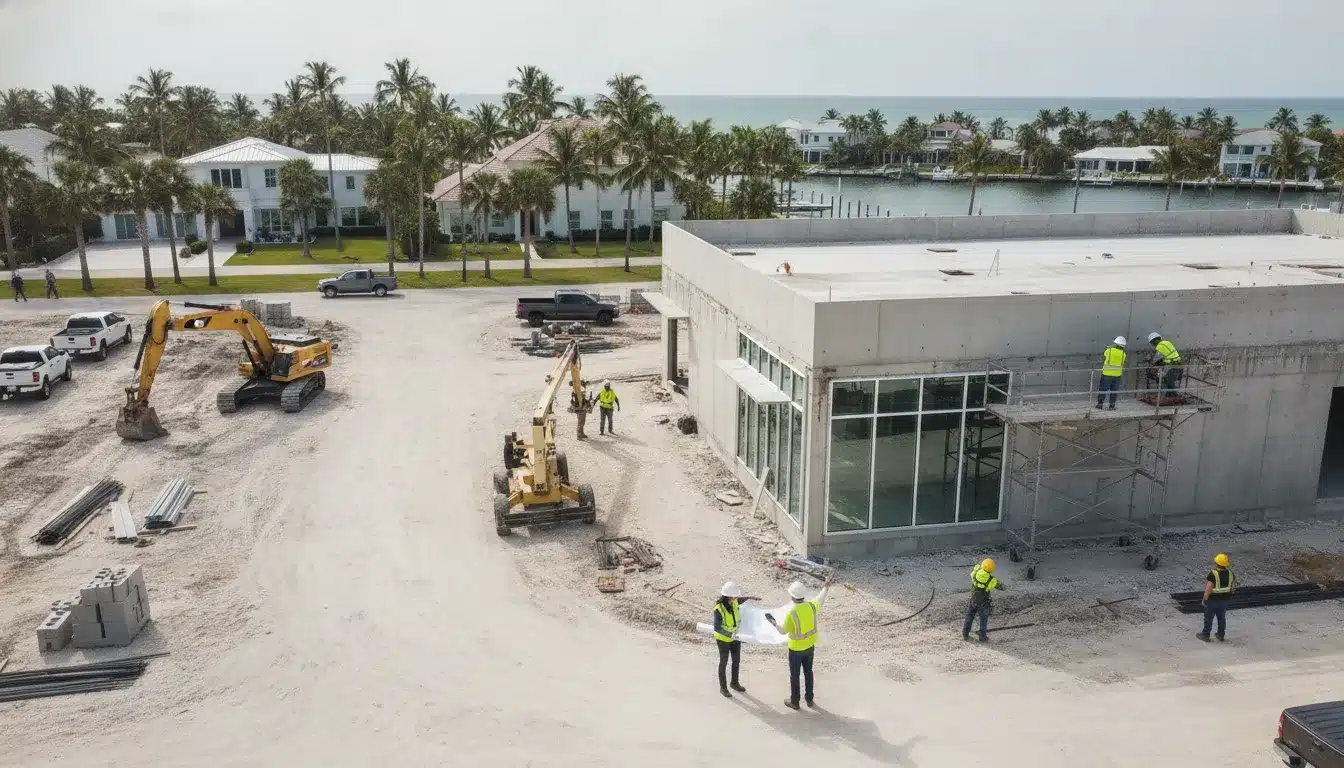
Commercial teams should treat the Golden Beach building permit process as a jurisdiction-specific coordination workflow, not a generic online filing. The Town Building Department handles permit processing, inspections, and contractor registration, while its current intake rules require appointment-based service and limit online submissions to certain permits and documentation. Confirming the correct channel before sending plans helps prevent a rejected submission and an avoidable reset.
Request a Golden Beach commercial permit proposal
The Golden Beach building permit process starts with the right application path, a complete commercial package, and coordination with the Town’s Building Department. Missing checklist information can delay review and approval, so the project team should align plans, supporting documents, appointments, and scope-specific forms before submission. The Town’s Building Department guidance is the controlling local reference.
That preparation becomes especially important when multiple permits, consultants, and trade packages must move through the same project schedule. The first step is to identify what the Town requires from the commercial team before intake begins.
What does the Golden Beach building permit process require from commercial teams?
The Town of Golden Beach Building Department is the controlling local authority for building permit processing, inspections, and contractor registration. Commercial teams should treat the department’s published intake instructions as an operating requirement, not a general customer-service note. Confirm the jurisdiction, identify the permit scope, and establish the correct submission route before sending a package or scheduling site activity. Review the Town’s Building Department instructions before mobilizing the project team.
The first contact depends on the transaction. The Town directs permit-processing documents to onlinepermits@goldenbeach.us. Inspection requests and updated registration documents go to inspections@goldenbeach.us. Keep those functions separate in the project communication plan so inspection coordination, contractor registration, and plan-processing records do not become mixed in one thread. Both addresses are identified on the Town’s official Building Department page.
Golden Beach’s current access rule: walk-in service is suspended, and customers are served by appointment only until further notice. The Town also states that multiple permit submissions require multiple appointments. Confirm the current Building Department instructions before routing a commercial package.
- For separate building, electrical, mechanical, or plumbing scopes, map each submission and appointment separately.
- Confirm the appointment requirement before sending field staff or a permit runner to Town offices.
- The posted Building Department hours are Monday through Thursday from 8:30 a.m. to noon and 1:30 p.m. to 3:30 p.m., and Friday from 8:30 a.m. to noon. These are access hours, not a promised review or approval timeline.
Do not assume every permit can be transmitted online. Golden Beach states that online permitting is limited to certain permits and documentation. It specifically instructs applicants not to send permits requiring in-person submission through the online channel because those submissions will be rejected. That routing check belongs in the team’s pre-submittal review, alongside document completeness and consultant-signature verification. When internal staff are balancing several jurisdictions, permit expediting and management services can help organize the package, route communications, and track the Town’s required next step without representing Town requirements as guaranteed outcomes.
How does the Golden Beach building permit process move from intake to issuance?
For a commercial project, the Golden Beach building permit process is best managed as a controlled sequence. Confirm the scope, select the Town’s forms, submit a complete package, respond to comments, and protect the permit after approval. The Town does not publish a universal plan-review or approval turnaround, so project teams should not build a schedule around an assumed number of days.
- Confirm the scope and submission route. Identify the work covered by the permit and determine whether the project needs additional materials for demolition, drainage, NPDES, roofing, or another scope-specific activity. The Town’s forms page lists these packages alongside the main permit resources. It also states that online submission is limited to certain permits and documentation, so do not send a permit requiring in-person submission through the online channel. Review the Town’s official permit forms before assembling the intake package.
- Select the current forms and checklist. Start with the permit application, application addendum, submittal checklist, documentation log, contractor information package, and plans-order instructions that match the project. Treat the checklist as the controlling intake document, rather than relying on a package from a prior job or another jurisdiction.
- Assemble and submit a complete package. Coordinate the signed application, required plans, supporting documentation, and any contractor registration materials. The Town directs permit-processing documents to onlinepermits@goldenbeach.us. If the project requires separate submissions, plan the appointments accordingly because Golden Beach states that multiple permit submissions require multiple appointments. A permit-management partner can help coordinate package control and tracking through permit management services.
- Track review and correct the package. Monitor Town comments, route each correction to the responsible design or trade professional, and resubmit a coordinated response. Golden Beach expressly warns that missing checklist information delays permit review and approval. There is no published universal approval turnaround, so the practical schedule depends on completeness, correction cycles, and the Town’s review.
- Complete approval, pickup, and payment. Once approved, confirm the pickup instructions and required payment with the Town. Golden Beach states that an approved permit must be picked up and paid for within 60 days or the application will be destroyed. After issuance, protect the construction schedule by starting work within 180 days, as required by the Town’s general permitting procedure.
This workflow separates what the Town requires from what the project team must coordinate internally. That distinction helps prevent an accepted intake package from being mistaken for an issued permit.
Which plans and documents belong in the commercial submittal package?
A commercial package should be assembled around the project scope, the Town checklist, and the disciplines involved, rather than treated as a generic drawing upload. Golden Beach’s official 2024 master permit checklist identifies several core documents. The checklist also uses conditional language such as “when required.” Confirm the applicable checklist and scope-specific forms before submitting through the Town’s permit forms page.
Core application and cost documentation
Start with the signed contracts that show construction costs. Include the permit application, any applicable addendum, the submittal checklist, and the documentation log for new construction, additions, or remodels. The contractor information package and plans-order instructions should be reviewed with the responsible contractor and design team before the package is finalized. These resources are listed by the Town on its forms page and help the team align the application with the proposed work.
Plans, surveys, and technical support
For projects where they are required, the 2024 checklist calls for two sets of scaled plans. It also identifies two plot plans or surveys using both NGVD and NAVD 88. The design team should confirm that the survey reference systems, site information, and drawing scale are consistent across the package. Product approvals may be needed for roofs, windows, exterior doors, shutters, and skylights. Energy calculations and heating and cooling load calculations should be included when the project scope triggers them.
Plans should bear the architect or engineer drawing-review stamp where applicable. Organize the drawing set in the Town’s stated order: general, architectural, civil, structural, mechanical, electrical, plumbing, irrigation, landscaping, and DERM-approved plans. Consistent sheet order gives reviewers a predictable package and makes correction tracking easier when multiple disciplines are involved.
Civil, landscape, and scope-specific submissions
Golden Beach’s checklist directs civil and landscape plans to be submitted in both hard-copy and electronic formats. The electronic submission should reference the permit number and be sent to the Town’s permit-processing channel identified in the checklist. Coordinate the hard-copy set and electronic files so revisions do not create competing versions.
- Confirm whether demolition, drainage, NPDES, roofing, signs, tree removal, windows and doors, or other specialized work requires a separate package.
- Include special-inspector materials when the project requires that involvement.
- Check outside-agency requirements, including DERM-related plans, against the project scope before filing.
Not every commercial project needs every item. A disciplined package review should map each document to the work proposed, identify conditional requirements, and remove irrelevant materials. Missing checklist information can delay permit review and approval. Teams that need help coordinating document versions, submissions, and correction responses can use permit management services as part of their filing workflow.
How should teams manage Golden Beach permit fees and correction cycles?
Fee planning should begin with the current Town schedule, not a generic South Florida estimate. Golden Beach publishes both a fee schedule and an impact fee schedule on its official forms page. Florida Statutes Section 166.222 also authorizes municipalities to levy and collect fees for development permits and related activities. The practical rule for a project team is simple: identify every applicable trade and scope, then confirm the current schedule with the Town before filing.
| Planning category | Published schedule figure | How to use it |
|---|---|---|
| Base administrative fee | Listed in the current Town schedule; two reviews are identified in the dated reference | Use as a time-sensitive budgeting reference and confirm before submission. |
| Building review | Listed in the current Town schedule for two reviews | Confirm applicability to the project’s permit scope and current fee year. |
| Electrical review | Listed in the current Town schedule for two reviews | Confirm whether the electrical scope is filed as its own trade package. |
| Mechanical review | Listed in the current Town schedule for two reviews | Use only as the published 2026-2027 agenda reference, not a permanent price. |
| Impact fees | Separate Town impact fee schedule | Check the current schedule and project-specific applicability before filing. |
The figures above come from the Town’s official 2026 budget agenda, which identifies the fiscal year 2026-2027 schedule as carried forward without changes. Because schedules can change, teams should treat these as dated planning figures rather than guaranteed prices. The forms page remains the working source for the Town’s downloadable fee and impact fee schedules.
Correction management should be just as deliberate as fee planning. Before submission, reconcile the application, addendum, checklist, documentation log, contractor package, plans order, and any scope-specific forms. The Town expressly warns that missing checklist information delays permit review and approval. If comments are issued, log each correction by discipline, assign it to the responsible design or construction professional, then resubmit a complete response package rather than sending isolated replacements. The published materials identify review allowances in the fee schedule, but they do not establish a universal approval timeline. Plan staffing and mobilization around the correction process, not an assumed turnaround.
What inspection rules matter after a Golden Beach permit is issued?
Once work is authorized, inspection coordination becomes a project-control function, not an administrative afterthought. Golden Beach directs inspection requests and updated registration documents to inspections@goldenbeach.us. Keep the permit number, inspection type, requested date, approved plans, and responsible trade contacts aligned before submitting the request.
The Town posts defined windows for some disciplines. Building inspections are listed for Tuesdays and Thursdays from 11:00 a.m. to 3:00 p.m., while electrical inspections are listed for Tuesdays and Thursdays from 9:00 a.m. to 1:00 p.m. Mechanical, plumbing, and landscape inspections are coordinated directly with the inspector. The same Town page states that requests must be received by noon on the day before the inspection, establishing a 24-hour cutoff for scheduling. These are posted inspection windows, not a promise of approval or field availability.
Plan the sequence around actual site readiness. The superintendent should confirm that the relevant work is exposed, accessible, and consistent with the approved plan set before requesting the inspection. Mechanical, plumbing, electrical, and landscape scopes may involve different trade contacts, so a single project calendar should show who is responsible for each request and disposition. Teams that need a centralized workflow can use inspection management support to coordinate requests, monitor outcomes, and follow up on deficiencies.
Some projects also require special-inspection documentation. Golden Beach lists a Special Inspector Package among its official permit resources. Treat that package as part of the project record when the approved scope calls for special inspections, and confirm the required reports and signoffs before covering work or moving to the next phase. For third-party coordination, third-party inspection scheduling in Florida can help keep the inspector, contractor, and permit record synchronized.
Finally, Golden Beach’s general permitting procedure states that, after construction starts, inspections cannot be scheduled more than 180 days apart. Build recurring inspection activity into the baseline schedule rather than waiting until a milestone creates urgency. The rule and current inspection instructions should be checked against the Town’s published procedures before execution.
How does Golden Beach close out a commercial project?
Closeout in Golden Beach starts with controlling the permit’s administrative lifecycle, then confirming that the completed work is ready for the Town’s certificate review. An approved permit must be picked up and paid for within 60 days under the Town’s general permitting procedure. The same procedure states that work must begin within 180 days after issuance and that inspections cannot be scheduled more than 180 days apart after construction starts. These are lifecycle requirements to track in the project schedule, not a substitute for confirming the current permit status with the Building Department. Review the Town’s general permitting procedures before mobilization and closeout planning.
During construction, maintain continuity between the approved scope, inspection records, correction responses, and final field conditions. The 180-day inspection-spacing rule makes an active inspection log important for project teams managing phased commercial work. Keep inspection results, approvals, revised documents, and consultant sign-offs organized so the closeout package can be assembled from the project record rather than recreated at the end.
For final occupancy or completion, use the Town’s published CO/CC checklist as the starting point. Golden Beach lists that checklist with its other official permit forms, along with the special inspector package and scope-specific resources. The checklist establishes the Town’s published closeout framework, but the exact evidence required for a particular project can depend on its permitted scope, design professionals, inspections, and outside-agency coordination. Access the Town’s official forms and CO/CC checklist.
Before requesting final action, reconcile open corrections and confirm required inspections are complete. Separate Town checklist items from project-specific records such as as-built documents, warranties, testing reports, or owner turnover materials. This distinction keeps the submission precise without assuming that every commercial project needs the same closeout documents.
When should a permit expediter join the Golden Beach process?
A permit expediter is most useful before a commercial package reaches the Town. The project team may need a disciplined process for assembling, checking, submitting, and monitoring the application. The expediter does not replace the Town’s building department, design professionals, contractor of record, or required inspectors. Instead, the role is to keep the administrative work aligned with the jurisdiction’s requirements while the project team remains responsible for its technical decisions and contractual obligations.
Bring in All Florida Permits when the scope involves multiple disciplines, a tight procurement or mobilization sequence, several consultants, or a high risk of corrections caused by missing or inconsistent documents. The first step is document QA: reviewing the application package, plans, supporting calculations, contractor information, and other required materials for completeness and internal consistency. For electrical scopes, the team’s commercial electrical permit requirements guide can help frame the documentation questions that should be resolved before submittal.
After the package is ready, the coordination work continues through jurisdictional submission, status tracking, and correction management. All Florida Permits can organize review comments, route questions to the appropriate project participant, monitor revisions, and help maintain a clear record of what was submitted and when. This is particularly valuable when an architect, engineer, contractor, owner, and specialty subcontractor each control part of the response.
The same support can extend into inspection coordination. The team can help align inspection requests with construction readiness, coordinate with contractors and subcontractors, monitor dispositions, and follow up on deficiencies. That administrative layer complements, rather than substitutes for, the Town’s inspection requirements and the inspector’s determinations.
For teams that need a single coordination partner from package preparation through approval delivery, review the company’s permit expediting and management services. Engage early enough to identify missing information before submission, not after a correction cycle has already affected the project schedule.
Request a proposal for Golden Beach commercial permit support
Frequently Asked Questions
How long does the Golden Beach building permit process take?
Golden Beach does not publish a universal plan-review or approval timeline on its permitting pages. Plan a realistic schedule around package completeness, correction cycles, and the Town’s required intake method. The Town specifically warns that missing checklist information delays permit review and approval, so confirm the required forms and supporting documents before submission. Review the Town’s general permitting procedures before setting a project milestone.
Can every commercial permit be submitted online?
No. Golden Beach states that online permitting is limited to certain permits and documentation, and that permits requiring in-person submission should not be sent through the online channel because they will be rejected. The Building Department also states that walk-in service is suspended and customers are served by appointment only. Confirm the correct intake route with the Town before transmitting a commercial package. Check the Town’s Building Department instructions.
What happens if required information is missing from a permit package?
Missing checklist information delays permit review and approval. Treat the submittal checklist as a package-control document, not a formality. Confirm the application, contractor information, plans, calculations, approvals, and any scope-specific materials before filing. Golden Beach lists separate resources for items such as demolition, drainage, NPDES, special inspections, and certificates of occupancy or completion. Use the Town’s permit forms repository to identify applicable materials.
How long can an approved permit remain uncollected?
Golden Beach states that an approved permit must be picked up and paid for within 60 days, or the application will be destroyed. After issuance, the Town’s procedure also states that work must begin within 180 days. Once construction starts, inspections cannot be scheduled more than 180 days apart under the stated procedure. Track these deadlines in the project schedule and confirm the current requirements with the Building Department. Read the full lifecycle rules.
Request a Golden Beach permit proposal
Commercial permit coordination is easier when the submittal package, correction tracking, inspections, and closeout steps have a clear owner. Request a proposal for Golden Beach commercial permit coordination and document review.