

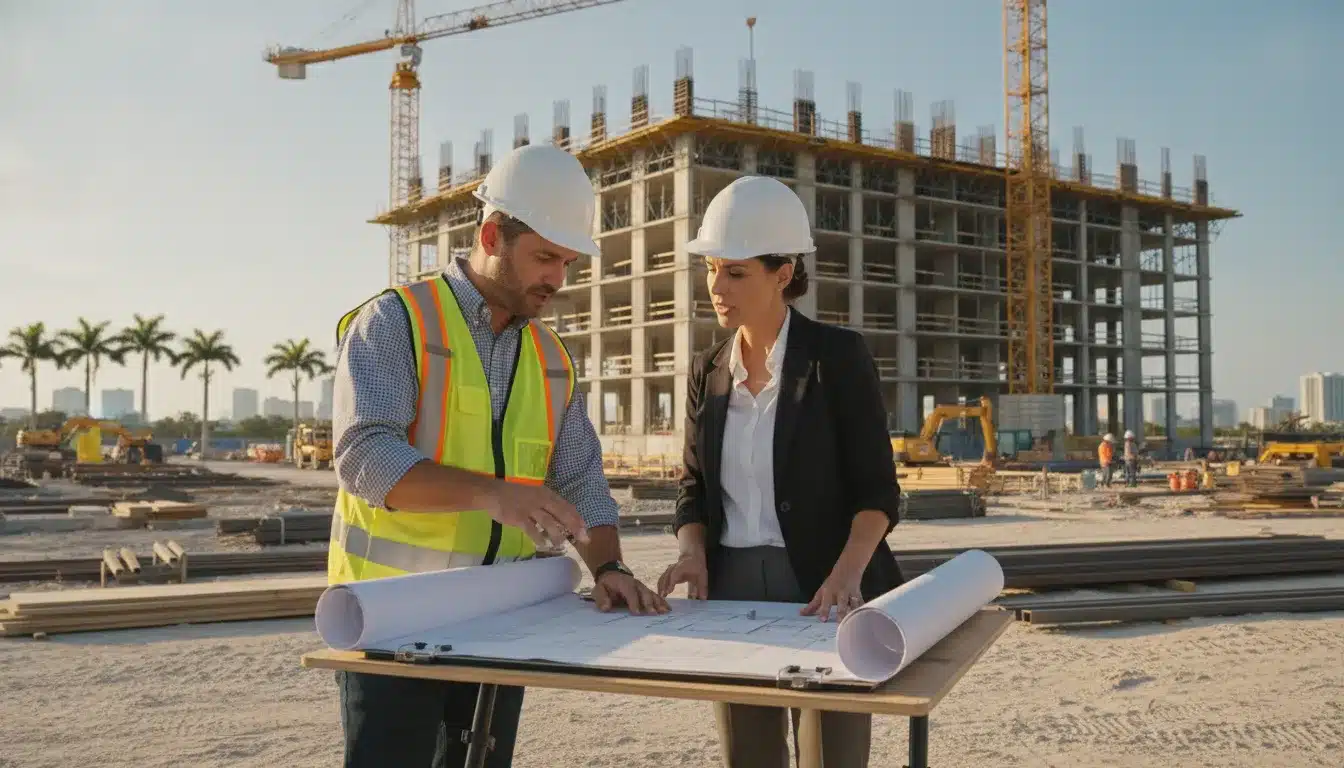
Commercial permit work in Volusia County is a coordinated review process, not simply a building-plan upload. The project team must confirm jurisdiction, assemble the required submittal, and move through the county’s defined review steps. It must respond to corrections and carry the permit through inspections and closeout without losing schedule control.
The volusia county building permit process begins with the applicable authority and pre-application requirements, then advances through building, fire, and other reviews before inspections and final approval. Volusia County’s Permit Center receives and processes commercial applications, issues permits, and directs applicants to its Permit Guide for zoning, submittal, and fee information (Volusia County Permit Center).
Request a proposal for Volusia County commercial permit support
Before preparing drawings or assigning review responsibilities, confirm which agency has authority over the property and which parts of the scope fall within its workflow. That jurisdictional decision determines the right application path, review sequence, and project controls from the outset.
Who administers the Volusia County building permit process?
The applicable building department administers the permit process, so the first control point is jurisdiction confirmation. A project in unincorporated Volusia County may proceed through the county’s Permit Center, while a project inside an incorporated municipality may be subject to that municipality’s permitting workflow. Do not assume the county portal, review sequence, or submittal requirements apply until the property location and governing authority are confirmed.
For county-administered work, Volusia County’s Permit Center receives and processes residential and commercial applications, verifies submitted documents, and issues permits for construction activities that require them. The county’s Building and Code Administration Division includes Code Compliance, the Permit Center. Building Code Administration, and Contractor Licensing, creating a defined administrative structure around permitting and code oversight. See the county’s Building and Zoning resources for the division’s responsibilities.
Before filing, the county directs applicants to use its Permit Guide for zoning and permitting information. That step helps the project team determine whether the proposed work is allowed, identify the permits the scope may require, review submittal requirements, and estimate applicable fees. Treat the guide as a pre-application control, not a substitute for confirming the authority that will review the project.
Once county jurisdiction is established, the Permit Center’s official process and portal become the reference points for application handling. If the site is within a city, the team should instead verify that city’s building department, portal, forms, and local review requirements. Resolving that distinction before assembling plans prevents an otherwise complete package from being routed to the wrong authority, which can create avoidable corrections and schedule disruption.
What should a commercial applicant confirm before filing?
Before assembling a commercial application, confirm that the project is being routed to the correct authority and that the proposed scope can be supported by the site records. Volusia County’s Permit Guide is designed for this pre-filing review: it helps applicants check where a project is allowed. Determine which permits are required, review submittal requirements, and estimate permit fees. Use those checks to establish a documented filing strategy rather than treating the building permit as a standalone form.
Confirm jurisdiction, zoning, and property data
First determine whether the property is in unincorporated Volusia County or within an incorporated municipality. The applicable building department, zoning rules, intake portal, and review sequence may differ. The county’s Permit Guide can help with the initial zoning and permitting questions, but it does not replace confirmation with the authority that will review the work.
Validate the parcel before design and filing decisions are finalized. Volusia County’s property-record search supports searches by owner name, location address, and parcel number, and the county states that its data is updated weekly. Compare the legal and site information against the owner’s project records, survey, and design documents. Resolve discrepancies in ownership, address, parcel identification, or existing use before they create an avoidable correction cycle. For broader application planning, review the process to apply for a Florida building permit.
Define the complete permit scope and site constraints
List every component that may require review, including the primary building work, change of use, site or improvement work, and applicable trade permits. The Permit Guide helps applicants determine which permits are required and identify application submittal requirements. For commercial work, do not assume that the building permit alone captures the full approval path.
Check site conditions that can affect design and documentation. Volusia County provides interactive GIS resources that include flood-information mapping and wind-speed maps for building construction. Review those maps alongside the project location and applicable design criteria, then confirm any resulting requirements with the responsible authority and design professionals.
Finally, use the Permit Guide to develop an initial fee estimate, then verify the amount against the county’s current fee schedules before authorizing the filing. Fees can depend on the final scope and applicable reviews, so a preliminary estimate should support budgeting, not be treated as a fixed project price.
How does Volusia County’s two-step commercial application work?
For covered commercial permit types, Volusia County separates the application into a pre-application review and a building application review. That sequence lets the county address land-use and development conditions before the plans move through building, fire, and applicable impact-fee review. The county identifies this as a two-step process for commercial permit types, among other categories, so confirm the applicable path for the project and jurisdiction before filing.
- Step 1: Complete the pre-application reviews. The first step routes the project through zoning, planning, land development, development engineering, and environmental reviews. These disciplines evaluate the site and proposed development from their respective regulatory perspectives before the building application is submitted. For a commercial team, this is the point to align the scope, site information, and supporting materials across the owner, architect, engineer, and contractor. Volusia County’s Permit Guide is intended to help applicants review zoning information, determine required permits, and identify application submittal requirements before applying. A coordinated package is also consistent with the county’s stated two-step structure and reduces the risk of carrying unresolved site issues into the building review. See the county’s official Permit Center guidance and review the project’s building permit submittal requirements before uploading documents.
- Step 2: Submit the building application and complete technical reviews. The second step includes fire, building, and impact-fee review when applicable. Volusia County states that impact-fee review is required for commercial construction or expansion and for a change in use anywhere in the county. The Permit Center’s online service supports applying, managing the application, uploading documents, checking status, scheduling inspections, and paying fees. Through Connect Live, registered users can submit certain applications, make payments, check application status, and schedule inspections. Use the portal as the project record for current status and next actions, while keeping the approved drawing set and submitted supporting documents synchronized with the application.
The two-step structure does not replace the need to confirm whether the property falls under county jurisdiction or an incorporated municipality. It defines the county workflow when Volusia County is the applicable authority. Treat each review comment as a controlled correction item, update the affected documents. And upload the required response through the designated channel rather than allowing separate project participants to submit conflicting revisions.
What belongs in a commercial permit plan package?
A commercial permit package should be assembled as one coordinated, correction-ready document set, not as a collection of files uploaded because each consultant finished a separate task. The objective is to let the applicable building department understand the proposed scope. Verify that required forms and supporting materials are present, and route the submission through the appropriate reviews.
Start with the administrative core: the permit application, owner and contractor information, project address and parcel details. Valuation or scope information where requested, and any jurisdiction-specific affidavits or authorization forms. Volusia County’s Permit Guide directs applicants to review application submittal requirements before applying. But that guidance should be treated as a project-screening tool rather than an assumption that every commercial project has the same checklist. Confirm the current requirements for the actual scope and jurisdiction.
The drawing set should match the work being proposed and should be signed and sealed by the responsible design professionals where applicable. Depending on the project, that may include architectural, structural, civil, mechanical, electrical, plumbing, fire protection, or specialty drawings. Supporting documents can include site information, engineering calculations, product or system data, energy-code documentation, surveys, specifications, and approvals tied to the specific scope. Do not add documents simply to make the package look substantial. Include the materials needed to explain compliance and resolve the reviews the project will enter.
Coordinate the consultants before submission
Architects, engineers, contractors, and owners should compare the plans before upload for consistent project names, addresses, sheets, dimensions, equipment schedules, and scope descriptions. A mismatch between the architectural plans and a trade drawing can create a correction even when each individual document appears complete. All Florida Permits describes its document-preparation workflow as including required forms, supporting materials, completeness and code-compliance review, plus coordination with architects, engineers, and contractors. That coordination is most valuable before the application enters review, when revisions are less disruptive.
Build the final package with clear file names, current revision dates, complete sheets, and a simple internal index. Keep a correction log and preserve the exact submitted set so responses can be matched to the reviewer comment. For a practical checklist, review these building permit submittal requirements, then confirm the final package against the applicable Volusia County instructions rather than relying on a generic list.
How do plan review, corrections, and fees affect schedule?
Schedule control in the Volusia County building permit process depends on treating review as a coordinated workflow, not a single approval event. The county’s commercial sequence separates pre-application review from the building application. Step 1 can involve zoning, planning, land development, development engineering, and environmental review. Step 2 can involve fire, building, and applicable impact-fee review, so a correction in one lane can affect the documents or assumptions used in another. Volusia County’s Permit Center guidance identifies those review lanes.
| Review issue | Project risk | Response |
|---|---|---|
| Incomplete or inconsistent plans | Corrections return to the design team and may require coordinated revisions across disciplines. | Maintain a correction log, assign an owner to every comment, and resubmit a complete response package. |
| Separate zoning, planning, engineering, or environmental comments | A building-ready package may still be unable to advance through the full approval path. | Track each review lane independently, then verify that revised site, civil, architectural, and supporting documents agree. |
| Impact-fee review | New commercial construction, commercial expansion, or a change of use can require an additional review before the project is cleared. | Confirm applicability during scope and pre-application planning, and reserve time for the county’s impact-fee determination. |
| Fee estimate or fee schedule mismatch | Underbudgeting or an unexpected payment requirement can interrupt submission or release of the permit. | Use the Permit Guide to estimate fees, then confirm the current county fee schedule before filing and before payment. |
Impact-fee review is specifically required for commercial construction or expansion and for changes in use anywhere in Volusia County, according to the county’s published process. That makes it a scope-control item, not an administrative detail to discover after plans are submitted. The county also publishes current fee schedules, while its Permit Guide provides a fee-estimating function. Because schedules and project-specific charges can change, avoid relying on an old fee table or a third-party estimate as a commitment.
The project team should designate one person to manage the correction log, verify document versions, monitor portal status, and confirm payments. Connect Live supports document uploads, status checks, and fee payments, which gives the team a central place to maintain the submission record. For a broader correction-prevention checklist, see how to avoid Florida permit delays. Third-party timing figures are not definitive; the defensible planning approach is to build the schedule around the actual review lanes. Response quality, and current county instructions rather than an advertised number of days.
How are inspections and commercial permit closeout managed?
Inspection management begins after the permit is issued and continues until the applicable building department records final approvals. Volusia County’s Permit Center assists with building permit applications and inspections. While the county or applicable municipal building department remains the authority that schedules, performs, and approves inspections for its jurisdiction. Confirm the governing authority before assigning inspection responsibilities, particularly when a project is inside an incorporated city.
Schedule inspections through the approved channel
Registered users can use Connect Live to schedule inspections, check application status, make payments, and submit certain applications. The county’s online permitting service also supports document uploads and permit management, giving the project team a central place to monitor the permit record. Those functions support coordination, but they do not replace the inspector’s field determination or the AHJ’s approval process. See the county’s Connect Live services for current portal capabilities.
Before requesting an inspection, the contractor should confirm that the relevant work is ready, required documents are available, and the correct inspection type has been selected. For structural scopes, the project team should also review the applicable structural inspection requirements and coordinate the general contractor, subcontractors, design professionals, and inspector. A request made before the work is ready can create a failed disposition and additional coordination work.
Track dispositions, deficiencies, and final approval
Each inspection disposition should be logged against the permit, with deficiencies translated into clear corrective actions for the responsible trade or design professional. All Florida Permits describes its inspection-management workflow as coordinating with contractors, monitoring inspection dispositions, confirming that deficiencies are addressed, and scheduling follow-up inspections. That support helps keep the correction cycle visible, but the AHJ decides whether the corrected work satisfies the applicable requirements.
Closeout is more than passing one final inspection. The team should verify that every required inspection and trade approval is complete, outstanding corrections are resolved, and the permit record is ready for final review. Where the project requires a certificate of occupancy or related authorization before use, coordinate that submission with the building department and the owner, tenant, and design team. This Florida certificate of occupancy guide provides additional closeout context. The final certificate or approval comes from the responsible authority, not the expeditor.
What does commercial permit expediting change for the project team?
Commercial permit expediting changes who owns the administrative workload between the design team, contractor, applicant, and building department. It does not replace Volusia County or an applicable municipal building department as the authority, and it cannot guarantee approval. Its value is tighter control over the permit workflow, so project leaders can see what has been submitted, what remains outstanding, and which issues require action.
A controlled submittal and review workflow
The process begins with a completeness and code-compliance review of required forms, drawings, and supporting documents. That review also coordinates inputs from architects, engineers, contractors, and other consultants before the package reaches the authority. For a commercial project, this can reduce avoidable administrative gaps and make correction management more organized when reviewers return comments. All Florida Permits describes its workflow as consultation, document preparation, submission and tracking, followed by approval and delivery; the county or municipality still performs the official review.
After submission, the team receives a single workflow for tracking status, documenting reviewer comments, assigning correction items, and confirming that revised materials are returned through the appropriate channel. That visibility matters in the commercial permit expediting support model because the project manager is not forced to reconstruct the permit history from scattered emails and portal updates. It also supports coordination across related permit types instead of treating each application as an isolated task.
Inspection coordination and schedule visibility
Expediting extends beyond plan approval. Inspection management can coordinate with general and subcontractors, monitor inspection dispositions, confirm that deficiencies are addressed, and schedule follow-up inspections. Volusia County’s Connect Live system supports inspection scheduling and application-status checks, but the project team still needs an accountable process for interpreting dispositions and closing open items. A consolidated status view helps identify whether the next schedule risk is a correction, an outstanding document, an inspection deficiency, or a required follow-up.
Pricing is proposal-based rather than a published flat fee. The proposal reflects project complexity, jurisdiction, urgency, permit types, and service level. The appropriate objective is improved coordination and schedule visibility, not a promised approval date or guaranteed result.
Frequently Asked Questions
What are the main steps in the Volusia County building permit process?
For commercial projects, the county describes a two-step application workflow. Step 1 is the pre-application review, which can involve zoning, planning, land development, development engineering, and environmental review. Step 2 is the building application, with fire, building, and applicable impact-fee reviews. The exact path depends on the project scope and jurisdiction, so confirm whether the county or an incorporated municipality is the authority before filing. Volusia County’s Permit Center guide is the controlling starting point.
How long does it take to obtain a commercial permit?
There is no responsible single timeline for every commercial permit. Duration depends on jurisdiction, application completeness, review scope, correction cycles, and whether zoning, environmental, fire, or impact-fee issues require additional action. The project team should track status and respond to corrections through the county’s designated workflow rather than rely on an assumed approval date. If the project is in a municipality, confirm that department’s published process and timing separately.
Where do I submit documents and check permit status?
Volusia County uses Connect Live for application submittal and permit, property, and contractor information. Registered users can upload documents, check application status, schedule inspections, and make payments. The county also states that some applications can be submitted online, but not every commercial permit follows the same online path. Verify the applicable permit type and jurisdiction before assembling the final submission. Connect Live e-services information explains the available account functions.
When is an impact-fee review required?
Volusia County states that an impact-fee review is required for commercial construction or expansion and for a change of use anywhere in Volusia County. Include that review in early project planning because it is part of the building application workflow when applicable. The Permit Guide and current county fee resources can help identify the required review path. But they should not be treated as a substitute for project-specific jurisdiction and scope confirmation.
Keep your Volusia County permit workflow moving
Commercial permitting requires more than submitting drawings. It requires a controlled process for jurisdiction checks, document coordination, review comments, inspections, and closeout. All Florida Permits can support the administrative workflow while the county or applicable municipal building department retains authority over the permit decision.
Request a project-specific proposal for Volusia County permit support