

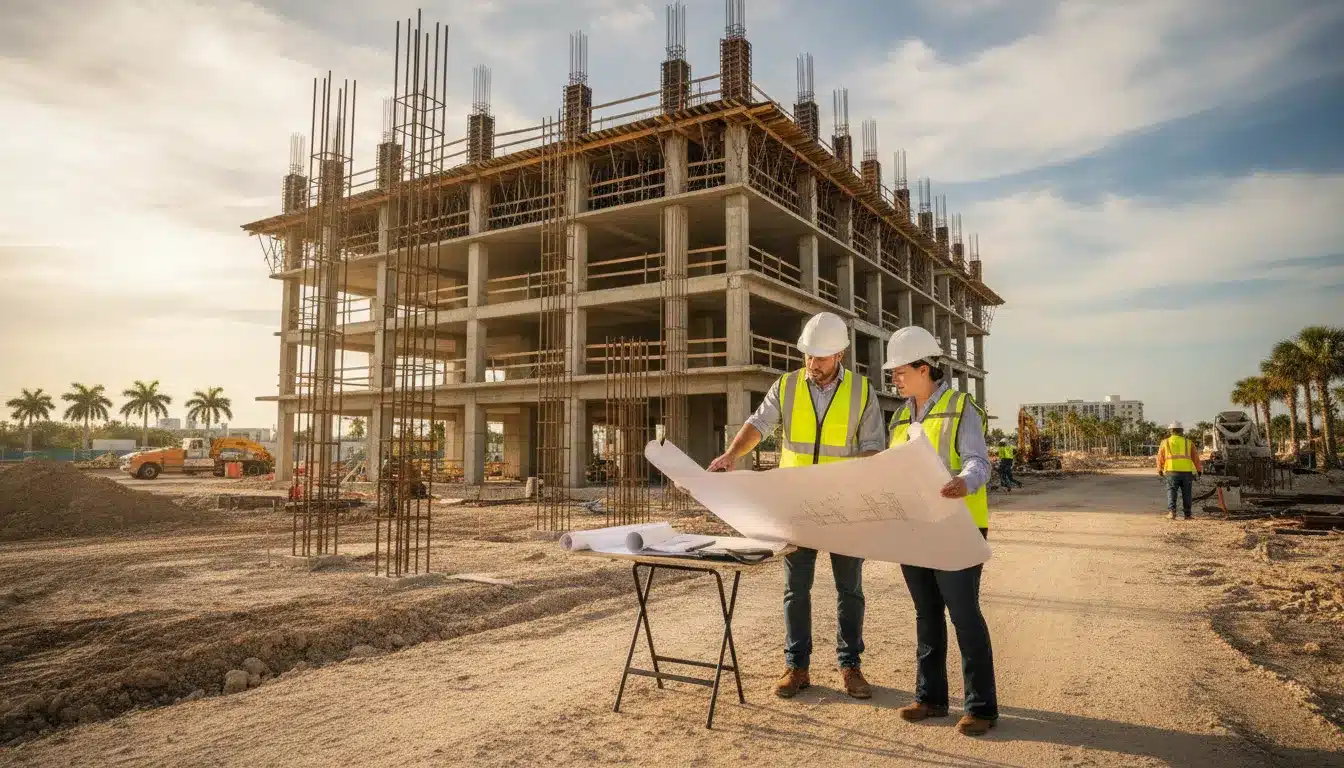
The Florida building permit revision process begins when approved construction documents no longer describe the work a project team intends to build. Before the affected scope proceeds, the permit holder, design professionals, contractor, and authority having jurisdiction (AHJ) should classify the change, document it, submit the required package, and confirm the accepted record.
Request a proposal for permit revision support
What Is the Florida Building Permit Revision Process?
The Florida building permit revision process is the controlled review of a material change to an issued permit or its approved construction documents. It commonly requires a scope description, marked or replacement sheets, supporting calculations or product information, responsible design-professional review, and submission through the local AHJ. Keep changed work on hold until the AHJ confirms the permitted path.
A permit revision is not simply an internal redline. A contractor markup, consultant email, or project-management change log does not amend the permit record by itself. The local building department determines whether a correction, clarification, revision, deferred submittal, separate permit, or other procedure applies.
Use a conservative threshold for commercial, multifamily, and industrial work. If a change affects the approved scope, structural design, life-safety analysis, site conditions, building systems, materials, accessibility, energy compliance, or inspection sequence, route it for formal classification before the affected work continues.
Which Changes Usually Trigger a Revision?
Material changes usually trigger a revision when they alter an assumption that the AHJ reviewed during permit issuance. The trigger may be technical, administrative, or jurisdictional. The project team should compare the proposed condition with the latest approved set, not with an older working drawing.
Structural and life-safety changes
A new beam, footing, opening, load path, connection, foundation condition, or structural material can change the design basis. A relocated exit, changed occupancy arrangement, fire-resistance assembly, fire protection system, or accessible route can change life-safety review. Monroe County publishes permitting and forms guidance that identifies amended plans and major revisions as a local review issue. Check Monroe County amended-plan guidance, then confirm the actual requirement with the project AHJ.
Florida Building Commission materials explain that a code-change analysis is a comparison aid, not a replacement for the adopted code. Review the Florida Building Code analysis only as reference material. The design team must apply the requirements governing the project and the submitted change.
Site, zoning, and trade-scope changes
A revised footprint, setback, site layout, equipment location, drainage condition, or utility route may require planning, zoning, civil, or development review in addition to building review. Santa Rosa County identifies Development Services as a separate local function, which illustrates why a building reviewer may not be the only reviewer for site-related changes. Confirm the local development-review path before resubmitting a site or footprint change.
Electrical, mechanical, plumbing, fire protection, and utility revisions can affect trade permits or sub-permits. Compare the change against each affected discipline. Use the existing commercial electrical permit requirements guide, commercial plumbing permit guide, and commercial mechanical permit guide for topic context, but follow the actual jurisdiction’s instructions for the revision.
Who Owns Coordination of the Revised Permit Package?
The permit holder or designated project manager should appoint one coordination owner. That person controls the change log, identifies affected disciplines, confirms document responsibilities, tracks AHJ communications, and distributes only the accepted revision. Clear ownership prevents the field team from receiving conflicting instructions.
Permit holder and project manager
The permit holder remains responsible for maintaining an accurate project record and authorizing the submission path. The project manager should record the permit number, project area, reason for change, current construction status, affected sheets, affected trades, and schedule risk. The manager should also identify whether the changed condition has already been installed or inspected.
A permit-management workflow gives the team one place to track submissions, correction comments, responses, receipts, and approvals. Review permit management services when several reviewers, permits, or subcontractors must remain aligned.
Design professionals and contractors
The architect, engineer, or trade design professional evaluates technical changes within the applicable professional scope. That review may require revised drawings, calculations, specifications, product data, or professional signatures and seals. The contractor supplies accurate field conditions, dimensions, equipment information, installation status, and constructability details.
The contractor should not ask a design professional to revise from an assumption that has not been verified in the field. The design team should not certify a condition it cannot evaluate. The coordination owner reconciles these inputs before submission and identifies unresolved questions instead of hiding them in a general note.
AHJ responsibilities
The AHJ determines whether the proposed change is acceptable under the local process. It may approve the revision, request corrections, route it to another discipline, require a separate permit, impose conditions, or direct the applicant to resubmit. A complete package is not the same as an approved package.
How Should Revised Sheets and a Delta Narrative Be Prepared?
A reviewer should be able to see what changed, why it changed, where the change appears, and what approved conditions remain unchanged. A delta narrative reduces review friction because it directs attention to the affected sheets and interfaces. It should be specific enough for another project professional to understand the decision without a verbal explanation.
- Freeze the proposed scope. Record the affected area, reason for change, construction status, involved disciplines, and known schedule or procurement effects. Do not let several informal versions circulate.
- Compare approved documents with field conditions. Use the latest approved drawings, specifications, prior revisions, shop information, and site observations. Note work that has already been installed, covered, or inspected.
- Create a sheet register. List each current approved sheet, proposed replacement or revision, affected detail, revision date, and responsible discipline. Include every interface that could change, not just the sheet where the edit first appears.
- Write the delta narrative. State the original condition, proposed condition, reason for the change, and relevant code or performance issue. Explain effects on dimensions, loads, egress, fire protection, accessibility, energy compliance, equipment, utilities, and inspection sequencing.
- Coordinate and seal the package. Route affected documents to the responsible design professional and trade consultants. Resolve conflicts among plans, schedules, details, backgrounds, and specifications before submission.
- Submit through the current AHJ channel. Include the revised sheets, narrative, supporting calculations or product information when required, and local application information. Save the receipt and any assigned revision number.
- Distribute only the accepted set. Label proposed and superseded sheets clearly. Release the accepted revision to the superintendent, affected subcontractors, inspectors, owner representatives, and records staff.
Avoid vague language such as “updated per field conditions.” A useful narrative identifies the exact changed condition. For example, it can state that a mechanical unit moved to a new location. Identify the affected equipment schedule and coordination sheets, and explain whether clearances, structural support, electrical service, condensate routing, or inspection sequencing changed.
Do not use a delta narrative to conceal a larger redesign. If the change affects a broad area, changes the code analysis, or creates a new scope of work, ask the AHJ whether the package should be treated as a major revision or separate permit.
How Does AHJ Review Affect the Revision Schedule?
AHJ review controls whether the proposed change can be added to the permit record, must be conditioned, or must be revised and resubmitted. Local procedures control the intake channel, file requirements, review sequence, routing, fee treatment, and correction response process.
Jurisdictional examples show why a statewide guide cannot promise one universal revision timeline. Miami-Dade publishes plan-review information for its own process and reviewer coordination. Review Miami-Dade plan-review guidance as a local example, not as a substitute for the AHJ serving another project.
| Revision condition | Likely coordination | Project control |
|---|---|---|
| Structural or major change | Building review and design professional | Prepare amended documents and confirm signature or seal requirements. |
| Footprint, site, zoning, or setback change | Building plus planning or zoning | Confirm whether separate development approval is required. |
| Fire, egress, or life-safety change | Building plus fire review | Route affected plans and supporting information to each required reviewer. |
| Trade or utility change | Trade reviewer or sub-permit process | Coordinate discipline documents and confirm inspection impacts. |
Manage comments and resubmittals
Assign each correction comment to an owner, record the response, and confirm that the response is reflected in the revised sheets. Do not close a comment because an email was sent. Close it when the AHJ accepts the response or provides direction that controls the next step.
Keep revision planning separate from initial approval assumptions. The Florida permit approval timeline guide provides general initial-review context, while the actual revision schedule depends on scope, completeness, routing, comments, and resubmittal requirements.
Can Work Continue While a Permit Revision Is Pending?
Do not allow the affected scope to proceed under documents that no longer describe the work. A pending revision is not an approved revision. Isolate the changed area, preserve safe unaffected work when it is physically and technically independent, and ask the AHJ for written clarification when the boundary is uncertain.
Miami-Dade plan-review guidance warns that unapproved field modifications can create stop-work and delay exposure. That local warning supports a broader control principle: field execution should remain tied to the approved permit record. A verbal interpretation, internal redline, or email without AHJ authority is not a substitute for approval.
Define unaffected work carefully
Unchanged work may continue only when it remains covered by the approved documents, does not rely on the changed condition, and does not affect a shared structure, egress route, utility, fire protection system, or sequence dependency. The superintendent should document the boundary in daily reports and communicate the hold to affected subcontractors.
Resume against the accepted record
Before resuming changed work, verify that the accepted revision set is available at the job site and in the project record. Confirm that the permit board, inspection requests, subcontractor distribution list, and schedule reference the current revision. If the AHJ response is unclear, hold the changed scope and request clarification rather than translating uncertainty into field direction.
What Records Must Be Updated Before Inspection and Closeout?
Revision control continues after approval. The project record should show the active permit, accepted revisions, inspection history, correction responses, testing documents, and final as-built information. Accurate records help inspectors and closeout personnel compare completed work with the accepted scope.
- Update the permit board with the active status and approved revision identifiers.
- Keep the latest accepted sheets and delta narrative together in the job-site permit file.
- Mark superseded sheets as inactive so crews do not use an earlier detail.
- Match inspection requests to results, correction notices, reinspections, and final disposition.
- File photographs, testing reports, special-inspection records, and written field responses that support the revised work.
- Document which trades received the accepted revision and when the change was communicated.
- Reconcile as-built drawings and closeout submissions with the final approved permit record.
City of Sweetwater’s permit procedures emphasize current permit records for inspections. Review Sweetwater permit procedures and confirm the equivalent requirements with the actual project AHJ.
Inspection management must account for work installed before the revision was accepted. The AHJ may require an additional inspection, documentation, testing, or correction path. Do not assume that a final inspection resolves a mismatch between installed conditions and approved plans. See inspection management services for coordination support. For broader preparation, use the Florida building inspection checklist alongside the revision record.
Where the change affects threshold or special-inspection work, coordinate the revised scope with the inspection professional and preserve the related reports. The Florida special inspections guide provides related context, but the responsible design professional and AHJ control the requirements for the project.
Florida Permit Revision Decision Checklist
Use this checklist when a commercial, multifamily, industrial, or other permitted project changes after issuance:
- Identify the permit, project area, proposed change, and construction status.
- Classify the change with the responsible AHJ rather than relying on an internal label.
- List every affected discipline, sub-permit, reviewer, and inspection sequence.
- Confirm whether revised plans, calculations, product data, or professional signatures are required.
- Freeze affected work and define any documented unaffected work that may continue.
- Prepare marked sheets, a sheet register, and a precise delta narrative.
- Submit through the current local channel and preserve the receipt and comments.
- Distribute the accepted revision set and retire superseded documents.
- Update the permit board, inspection requests, daily reports, and closeout file.
- Confirm that installed conditions, inspections, and as-builts match the final accepted record.
If any step is unclear, ask the AHJ or responsible design professional before directing the field team. A controlled revision is easier to manage than an inspection failure or closeout dispute caused by undocumented scope change.
Request a proposal for Florida permit revision coordination
Frequently Asked Questions
When is a permit revision required after a Florida building permit is issued?
A revision may be required when proposed work changes approved scope, structural design, life-safety conditions, site or zoning information, building systems, materials, or other construction documents. The AHJ determines the applicable path. Ask the building department before affected work proceeds from an unapproved markup.
Can work continue while a permit revision is under review?
Unchanged work may continue only when it is independent from the revised scope and remains covered by the approved permit record. Hold affected work until the AHJ confirms the permitted path. Document the boundary and distribute written direction to the field team.
Who prepares revised permit drawings?
The architect, engineer, or other qualified design professional prepares or directs revisions within the applicable professional scope. The contractor supplies accurate field conditions and construction information. The permit holder or project manager coordinates the package, and the AHJ reviews it.
Does a permit revision require another inspection?
Not automatically. The need for an additional inspection, reinspection, testing, or correction depends on what changed, what has been installed, and the AHJ’s direction. Update the inspection record and ask the responsible reviewer how revised work should be documented before closeout.
How can a project team reduce revision delays?
Assign one coordination owner, identify every affected discipline, provide accurate field information, mark revised sheets clearly, write a specific delta narrative, and submit through the current AHJ channel. Track comments and distribute only the accepted revision set.
Get Started With Permit Revision Support
All Florida Permits helps project teams coordinate permit documentation, AHJ submissions, review tracking, and inspection-related records across Florida jurisdictions. The service does not replace the AHJ’s authority or the design professional’s technical responsibility. It gives the permit holder a clearer administrative path from field question to documented approval and closeout.