

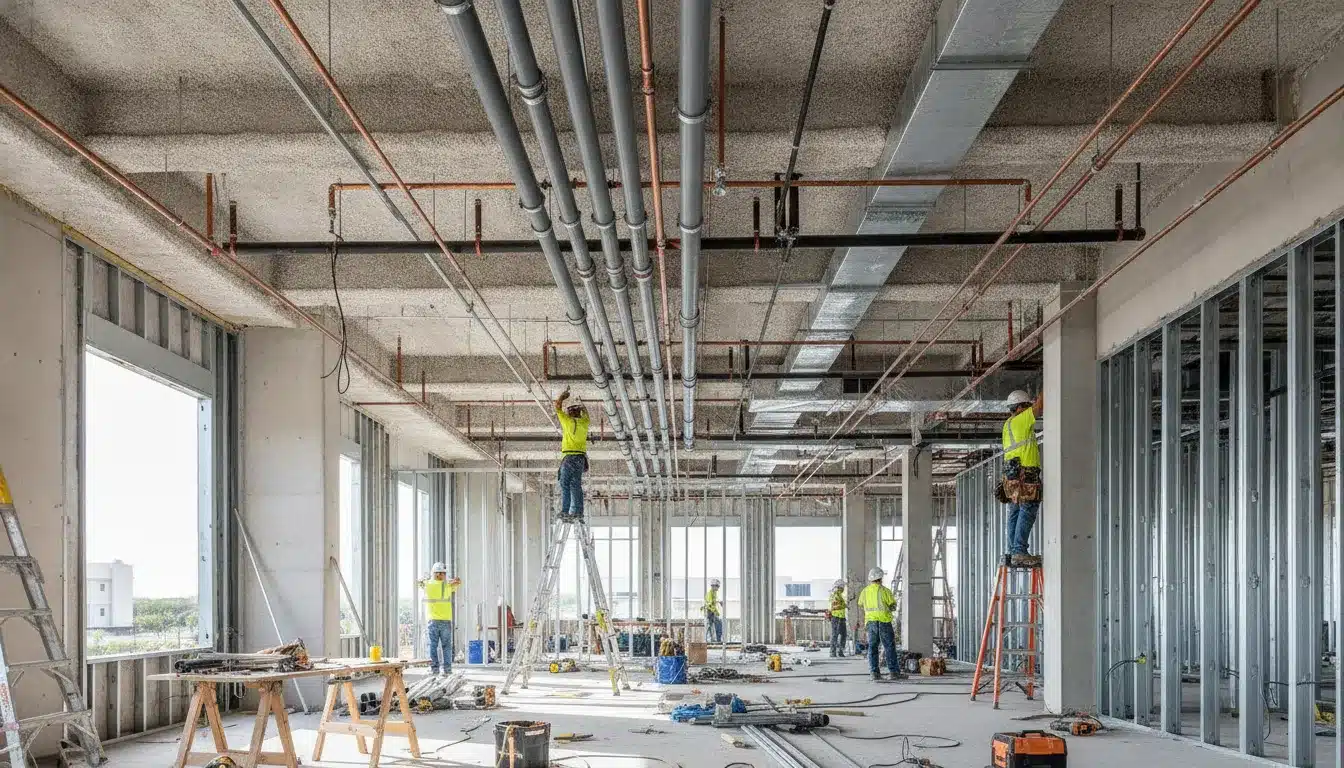
Commercial plumbing work in Florida is a permitting and compliance issue from the first scope review, not an administrative step to address after mobilization. New installations, alterations, repairs, and tenant improvements can affect plans review, inspections, and the project schedule, while the applicable authority having jurisdiction (AHJ) may impose local technical requirements.
Florida commercial plumbing permit requirements generally require contractors to secure approval before covered construction begins and demonstrate compliance with the Florida Building Code and applicable local amendments. Florida Statute 553.79 makes it unlawful to construct, alter, modify, repair, or demolish a building without first obtaining a permit from the appropriate enforcing agency. See the statute text.
Correctly identifying the work that triggers a permit is the first schedule-control decision. The scope, project type, and jurisdiction determine what must be submitted and when inspections can proceed.
When Do You Need a Commercial Plumbing Permit in Florida?
A commercial plumbing permit is generally required before installing, altering, repairing, or extending plumbing systems as part of a regulated construction project in Florida. That includes work on domestic water supply, sanitary drainage, storm drainage serving the building, gas piping, fixtures, and related site connections. Florida Statute 553.79 makes it unlawful to construct, alter, modify, repair, or demolish a building without first obtaining a permit from the appropriate enforcing agency. Review the statutory permit requirement before mobilizing a plumbing subcontractor.
New commercial construction
New construction almost always triggers plumbing permitting because the project introduces new building systems and connections. Permit scope may include underground utilities, building water and sewer services, interior distribution, sanitary and vent piping, gas systems, and the fixtures connected to them. The permit drawings should match the approved architectural and engineering scope, including occupancy-related plumbing requirements.
Alterations, renovations, and tenant improvements
A permit is also typically required when an existing commercial space is renovated or reconfigured. Moving restrooms, adding sinks, replacing a water heater, extending drainage, changing fixture counts. Or modifying gas service can affect code compliance and therefore should not be treated as maintenance by default. Tenant build-outs deserve particular attention because a seemingly limited interior scope may change water, sewer, drainage, grease waste, or fixture layouts. See the guide to commercial tenant improvement plumbing requirements when defining a build-out package.
Site work and service connections
Florida’s statutory definition of a building-related project includes construction, additions, improvements, and certain site work for which permitting is required. Consequently, plumbing scope can extend beyond the walls of the structure. New or relocated service lines, utility connections, private sewer or water infrastructure. And site drainage interfaces may require review through the building department, utility authority, or another local agency.
Confirm the AHJ’s specific scope
The appropriate authority having jurisdiction, or AHJ, determines the local application path, trade-permit structure, inspections, and technical amendments that apply to the project. One jurisdiction may coordinate plumbing under a building permit, while another may require separate trade permits or utility approvals. Contractors must obtain permits before work begins. Florida law prohibits unpermitted construction, and noncompliant work can create stoppages, correction costs, and complications at final inspection. Confirm the AHJ’s requirements during preconstruction rather than relying on a prior permit from another Florida county.
Florida Building Code Requirements for Commercial Plumbing Permits
Commercial plumbing design and installation in Florida must align with the Florida Building Code (FBC). Which uses the International Plumbing Code as its base model and applies Florida-specific amendments. The result is not a single national checklist that can be used unchanged on every project. The governing standard includes the state code and any applicable local technical amendments, as recognized in Florida law.
How the FBC and IPC work together
The IPC provides the underlying framework for plumbing system design, including requirements affecting water distribution, sanitary drainage, venting, fixtures, and related components. Florida amendments modify or supplement that framework for conditions and regulatory priorities in this state. Plans must therefore be reviewed against the applicable Florida edition and the project’s adopted local requirements, rather than against an unamended IPC reference alone.
Florida Statute 553.791 defines “applicable codes” to include both the Florida Building Code and local technical amendments. That definition is directly relevant to commercial plumbing permit requirements because compliance is measured against the code set enforced for the project. Not merely the standards selected by the design team. Review the statutory definition of applicable codes before finalizing a commercial plumbing submittal.
Local amendments can change the permitting path
Counties and municipalities may adopt technical amendments that affect how plumbing details are documented. Which materials or assemblies are accepted, or what the authority having jurisdiction (AHJ) expects during review. Those amendments can change the information needed for plan approval even when the underlying FBC provisions are familiar to the contractor.
Compliance verification continues after plan approval. The enforcing agency can evaluate whether construction conforms to the FBC. And Florida law permits a building permit to be revoked when the permitted work is not in conformity with the code. For that reason, the plumbing plans, approved revisions, field installation, and inspection records must remain consistent throughout the project.
Before submitting, confirm the current FBC requirements and the AHJ’s local technical amendments. Treat that verification as a project-control step, not a clerical formality. Resolving code conflicts before rough-in or inspection is materially easier than correcting concealed work after installation.
Commercial Plumbing Permit Application and Plan Submittal Requirements
A complete commercial plumbing permit package should allow the AHJ to verify the proposed work before permit issuance. At minimum, assemble the jurisdiction’s completed application, engineered plumbing drawings, plumbing isometrics, and material specifications. Then confirm whether the project requires additional schedules, calculations, product data, or trade-specific attachments. Florida Statutes require local enforcement agencies to publish each permit application type and its required attachments, drawings, and other requirements online. See the statutory application requirements before submitting.
The plans reviewer evaluates the package against the Florida Building Code and applicable local requirements. A missing isometric or incomplete fixture schedule can create a correction cycle even when the underlying design is sound. Use this commercial plumbing submittal requirements checklist to coordinate the package, and review the expected commercial plumbing plan review workflow before filing.
| Project type | Core submittal package | Scope items to verify before filing | Common review focus |
|---|---|---|---|
| New construction | Completed application, engineered plumbing plans, isometrics, material specifications, and required payment. | Coordinate domestic water, sanitary, storm, gas, fixtures, equipment connections, and any site utility work with the building plans. | System sizing, routing, code compliance, fixture counts, equipment connections, and coordination with structural and mechanical sheets. |
| Renovation or alteration | Completed application, existing-condition information, revised engineered drawings, isometrics for affected systems, and product specifications. | Identify what remains, what is removed, and how new piping connects to existing water, sanitary, drainage, or gas systems. | Whether the stated scope fully captures altered systems, access conditions, phasing, and connections to existing infrastructure. |
| Commercial tenant improvement | Trade application, tenant-improvement plumbing plans, affected-system isometrics, fixture and equipment data, and required attachments. | Document new fixture locations, service capacity, changes to drainage or water distribution, and coordination with the base-building design. | Scope boundaries, fixture counts, existing-system capacity, accessibility coordination, and whether separate trade permits are required. |
Fee structures vary by local enforcing agency and may be based on valuation, scope, trade, fixtures, review services, or other locally adopted schedules. Confirm the amount and payment method with the AHJ rather than relying on a fee estimate from another jurisdiction. This guide to commercial plumbing permit fees can help with early budgeting. After submission, the local agency must post and update the application status on its website until the building permit is issued. Which gives the project team a documented status point during review.
Required Inspection Stages for Commercial Plumbing Permits
Commercial plumbing work cannot move from installation to concealment or occupancy on assumptions. The AHJ must verify the work at the required stages, and the minimum mandatory inspections under the building code must be performed and properly recorded. Florida Statute 553.791 identifies that inspection record as part of code-compliance oversight. The exact inspection names and scheduling procedures vary by jurisdiction, but most commercial projects should plan around three core milestones.
Underground rough-in inspection
Schedule the underground inspection after buried sanitary, storm, and water piping has been installed, tested as required, and positioned according to the approved plans. The piping must remain visible before the trench is backfilled or the slab is placed. This is the AHJ’s opportunity to verify routing, slopes, connections, penetrations, and other concealed conditions that cannot be evaluated after coverage.
A failed underground inspection can affect the concrete schedule immediately. Common causes include incomplete installation, standing water or inadequate testing, incorrect pipe elevations, unapproved field changes, and work covered before the inspector arrived. Coordinate the request with the superintendent, plumbing contractor, and concrete team so the inspection window is protected.
Top-out or above-ceiling rough-in inspection
After walls and vertical runs are framed, but before piping is concealed by drywall, insulation, ceilings, or access-restricting finishes, request the top-out or rough-in inspection. The reviewer examines exposed distribution piping, drainage and vent connections, supports, clearances, penetrations, and fixture locations against the permitted plumbing drawings.
This stage commonly generates delays when other trades conceal the work prematurely, the approved plans are not available onsite. Or the installed routing differs from the permit set without documented revision approval. A disciplined pre-inspection walk with the plumbing foreman can identify missing supports, inaccessible cleanouts, incomplete firestopping, and unresolved conflicts before the AHJ visit.
Final plumbing inspection
Request the final after fixtures and equipment are installed, the system has been tested, and all related corrections are complete. The AHJ typically verifies overall system operation, fixture performance, drainage and water-supply functionality, and required backflow prevention devices. Backflow documentation, access panels, equipment labels, and test results should be ready when the local jurisdiction requires them.
Final approval can be delayed by uninstalled fixtures, active leaks, failed tests, missing backflow verification, inaccessible valves, incomplete correction notices, or outstanding inspections from related permits. Maintain a milestone log showing the request date, inspection result, correction list, and sign-off. Properly performing and recording the mandatory inspections is a core compliance requirement, not an administrative afterthought. For projects with compressed schedules, inspection management services can coordinate AHJ requests, readiness checks, and correction follow-up across the plumbing scope.
Confirm the inspection sequence, cutoff times, required tests, and documentation with the enforcing agency before rough-in begins. Early coordination prevents a trade from covering work before the AHJ has an opportunity to inspect it and keeps the permit record aligned with actual field conditions.
Backflow Prevention and Grease Trap Requirements for Commercial Plumbing
Backflow protection and grease-control equipment can determine whether a commercial plumbing package passes review, inspection, and final approval. The correct design depends on the hazard, the fixture or process served, and the requirements of the local authority having jurisdiction (AHJ). These components should be identified on the plumbing plans, not treated as field-added accessories after rough-in.
Select the backflow device by cross-connection risk
Commercial projects may use reduced-pressure-zone (RPZ) assemblies, double-check valve assemblies, or atmospheric vacuum breakers. The appropriate device is based on the degree of hazard and the connection being protected. An RPZ assembly is commonly evaluated where a higher health risk exists, while a double-check assembly may be appropriate for lower-risk conditions. Atmospheric vacuum breakers serve specific point-of-use applications and installation conditions. The plumbing engineer and AHJ should confirm device selection, location, clearances, and discharge provisions before submittal.
Backflow prevention also belongs within the jurisdiction’s cross-connection control program. Required testing, tester qualifications, certification records, and test-report submission schedules can vary by utility or county. A device that is installed correctly but not tested, documented, and maintained on the required cycle can still create a compliance issue. Coordinate the testing process with the water utility and building department, and preserve records for inspection and certificate-of-occupancy closeout.
Grease interceptors require design, permitting, and maintenance
Food service establishments typically require grease-control equipment sized for the expected wastewater flow, fixture load, and operating conditions. Depending on the facility and jurisdiction, the solution may be an interior grease trap, an exterior grease interceptor, or another approved configuration. Sizing should be supported by the plumbing design and reviewed against the applicable Florida Building Code plumbing provisions. Including the code chapters governing sanitary drainage and indirect waste, together with local amendments and utility standards.
Grease interceptor requirements are not uniform statewide. Florida counties and municipalities may impose specific ordinances addressing sizing calculations, access, sampling points, placement, pumping intervals, inspection access, and maintenance documentation. Confirm the local ordinance before finalizing the equipment schedule. Ongoing pumping and inspection records may be required even after the plumbing permit is closed.
How Private Provider Inspections Streamline Commercial Plumbing Permitting
Commercial plumbing inspections do not have to rely exclusively on the local building department’s scheduling queue. Florida Statute 553.791 permits an alternative path in which a qualified private provider performs applicable plans review and building code inspection services. Subject to the statutory documentation and oversight requirements. For contractors managing a compressed closeout schedule, that option can create more control over inspection timing while preserving code-compliance accountability.
Schedule inspections around the project, not the queue
Traditional AHJ inspections are coordinated through the enforcing agency’s availability. A private provider can coordinate inspection visits directly with the contractor and superintendent. Making it easier to align underground, rough-in, top-out, and final plumbing inspections with actual site readiness. When an inspection can be arranged promptly after a milestone is complete. The plumbing scope is less likely to become a predecessor holding up finishes, testing, or the certificate of occupancy process.
This is a scheduling advantage, not an exemption from inspection. Florida law still requires the minimum mandatory inspections under the building code to be performed and properly recorded. The private-provider route is most effective when the inspection schedule, approved plans, trade sequencing, and closeout documentation are managed as one coordinated workflow. Contractors can use inspection management services to keep those records aligned across the project team.
Maintain statutory recognition and local oversight
The permit file must identify the private-provider arrangement correctly. Florida Statute 553.791 requires the plan-review affidavit to be properly completed and submitted with the permit documents before the local building official recognizes the private provider’s work. That administrative step is critical. An incomplete or improperly submitted affidavit can undermine the timing benefit the contractor expected.
Once the required documentation is in place. The local building official generally may not replicate the plan review or inspection work being performed by the private provider, unless the statute authorizes it. The official does, however, retain the authority to audit the private provider’s work. The audit right preserves public oversight and reinforces the need for accurate inspection reports, code references, photographs where required, and complete sign-off records.
For commercial plumbing contractors, the value is practical: fewer scheduling handoffs, better control of inspection milestones, and a clearer path from completed plumbing work to project closeout. The permit still has to satisfy the Florida Building Code and applicable local technical amendments, but the inspection workflow can be managed with the project’s schedule in mind.
Frequently Asked Questions
Can commercial plumbing work begin before the permit is issued?
No. Florida law generally prohibits construction, alteration, repair, or modification without first obtaining a permit from the appropriate enforcing agency. The contractor should confirm that the permit is issued, required fees are paid, and approved plans are available before mobilizing regulated plumbing work. See Florida Statute 553.79.
What qualifications does a contractor need for commercial plumbing work in Florida?
Commercial plumbing should be performed by a properly licensed contractor or qualified plumbing professional authorized for the scope and jurisdiction. The Florida Department of Business and Professional Regulation oversees contractor licensing, including qualification, experience, and examination requirements. Confirm the current license category and project requirements with DBPR before submitting or starting work.
What is considered commercial plumbing work?
Commercial plumbing includes plumbing systems installed, altered, repaired, or extended in commercial, industrial, and multi-family buildings. Typical scopes include domestic water, sanitary and storm drainage, fixtures, equipment connections, and related piping. The Florida Building Code governs the work, together with applicable local technical amendments.
Do renovations and tenant improvements require a plumbing permit?
Often, yes. A renovation or tenant improvement generally requires permitting when the scope changes existing water, sewer, drainage, fixtures, or other regulated plumbing systems. The local AHJ determines the applicable permit path and submittal requirements. Review the jurisdiction’s application checklist before construction, because local requirements and technical amendments can affect the submission.
Schedule a Consultation for Commercial Plumbing Permit Support
Clear permit coordination helps contractors align plan submittals, inspections, and project schedules before work reaches a critical path. Request a proposal for commercial plumbing permit expediting and inspection services through All Florida Permits consultation services. Share your project scope and jurisdiction so the team can outline the appropriate next steps for your commercial plumbing work.